
Evolution of Lamborghini V12 Supercars
 Brendan McAleer

Evolution of Lamborghini V12 Supercars Gallery


Lamborghini has built V12 supercars since the 1964 350 GT, using two engine families: Giotto Bizzarrini's original 3.5-litre design, which grew to 6.5 litres and ran until the Aventador, and an all-new in-house 6.5-litre V12 from 2011 onward. The engine was never turbocharged. It was hybridized instead, from the 2019 Sián FKP 37 to the 1,065 CV Revuelto SV of 2026.
Lamborghini has evolved from making coarse, raucous V12 supercars to making coarser, more raucous and wildly styled supercars.
When Ferruccio Lamborghini first saw the engine that was to power his cars, he was furious. Engineering genius Giotto Bizzarrini, the man who shaped the Ferrari 250 GTO, had been handed the job of building a twelve-cylinder to rival Ferrari, but one built for the road. What he delivered was a 3.5-litre 60-degree racing engine with a redline far beyond anything a road car needed. Ferruccio, it is said, was furious. But so too were the cars that bore his name, and 62 years later Lamborghini's V12 is still naturally aspirated, still difficult to tame and now has electric motors bolted to it.
Key Takeaways
- One engine family carried the brand for its first 47 years: Bizzarrini's 3.5-litre V12, reworked for the 350 GT and stretched to 6.5 litres. The second arrived with the Aventador in 2011, developed entirely in-house.
- The naturally aspirated V12 was never turbocharged and never downsized. Lamborghini electrified it instead, starting with the Sián FKP 37 in 2019.
- The Aventador LP 780-4 Ultimae, built until 2022, was the last Lamborghini V12 without hybrid assistance, and Lamborghini describes it in exactly those terms.
- Peak system output has climbed from 270 CV in the 350 GT to 1,065 CV in the Revuelto SV. The engine record belongs to the 29-coupé Fenomeno, whose V12 alone makes 835 CV inside a 1,080 CV hybrid system.
- All-wheel drive arrived with the Diablo VT and became standard on the Murciélago, but it was never universal. The Diablo SV and the track-only Essenza SCV12 both drive the rear wheels alone.
Every V12 Lamborghini Flagship Compared
Every figure below comes from Lamborghini's own media material, accessed Sept. 7, 2026. Production figures are the factory's own. The Countach figure is the sum of the five version totals Lamborghini publishes, and where the factory publishes only a variant run rather than a nameplate total, the cell says so.
| Model | Production Years | Engine | Peak output | Drive | Units built | Why it matters |
|---|---|---|---|---|---|---|
| 350 GT | 1964-1966 | 3.5-litre, front, longitudinal | 270 CV | Rear | 150, plus two Spiders | First V12 to reach customers |
| Miura | 1966-1971 | 4.0-litre, transverse, mid-mounted | 385 CV (SV) | Rear | 150 (SV only) | First supercar |
| Countach | 1974-1990 | 4.0 to 4.8 to 5.2-litre | 455 CV (Quattrovalvole) | Rear | 1,999 across five versions | Introduced the longitudinal V12 |
| Diablo | 1990-2001 | 5.7 to 6.0-litre | 510 hp (SV) | Rear / all-wheel drive (VT) | More than 2,900 | First past 320 km/h |
| Murciélago | 2001-2010 | 6.2 to 6.5-litre | 670 CV (LP 670-4 SV) | All-wheel drive | 350 + 50 (LP 670-4 SV only, per Lamborghini) | All-wheel drive standard |
| Reventón | 2007 | 6.5-litre | 650 CV | All-wheel drive | 20 coupés | First modern few-off |
| Aventador | 2011-2022 | 6.5-litre, all-new | 780 CV (Ultimae) | All-wheel drive | 11,465 | Biggest V12 success |
| Sián FKP 37 | 2019 | 6.5-litre + supercapacitor | 819 CV | All-wheel drive | 63 | First electrified V12 |
| Essenza SCV12 | 2020 | 6.5-litre | 830 CV | Rear | 40 | Track-only |
| Countach LPI 800-4 | 2021 | 6.5-litre + supercapacitor | 814 CV | All-wheel drive | 112 | Supercapacitor homage |
| Revuelto | 2023 | 6.5-litre + three electric motors | 1,015 CV | All-wheel drive | Series production | First plug-in hybrid twelve |
| Fenomeno | 2025 | 6.5-litre hybrid | 1,080 CV system (V12 835 CV) | All-wheel drive | 29 coupés, plus 15 roadsters | Most powerful V12 ever |
| Revuelto SV | 2026 | 6.5-litre + three electric motors | 1,065 CV | All-wheel drive | 1,963 | Quickest-accelerating production Lamborghini |
How to Read the Power Figures
Lamborghini quotes power output in CV, or metric horsepower, which sits slightly above the imperial figure. Where the factory's own English releases print hp, as they do for the Diablo SV, that is the number reproduced here rather than a conversion. Comparing CV against hp from another source always produces a small discrepancy.
Prologue: 1964-1966 Lamborghini 350GT
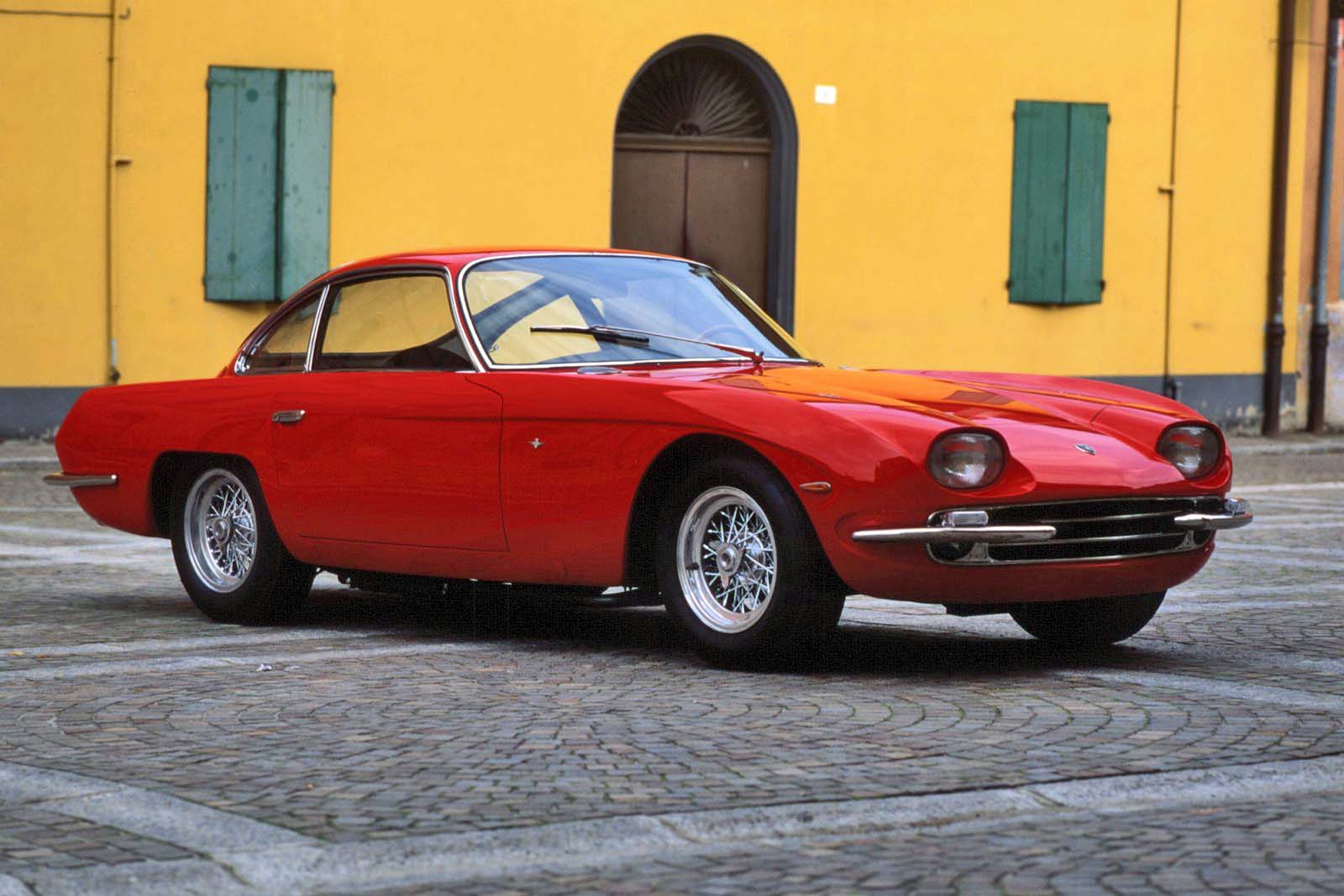
After Bizzarrini left, Lamborghini drafted in another genius engineer: Gian Paolo Dallara, with Paolo Stanzani finishing the job the factory now credits him for. Between them they tamed Bizzarrini's prototype, engine and chassis both. The V12 came down to 270 CV, and with the reduced power came much greater reliability.
The 350GT was most emphatically a Grand Tourer, with a five-speed ZF manual transmission and all-round disc brakes. Every engine was bench-tested and signed off before it left the factory, with test driver Bob Wallace doing the road work. Compared to the more frenetic and perhaps fragile Ferraris, Lamborghini's first car had an identity all its own.
Carrozzeria Touring built the bodies, 150 of them plus two Spiders. That makes the 350 GT rarer than any Lamborghini built in volume since, though the modern few-offs are rarer still. The same Lamborghini V12 engine, bored out, went on to carry the 400 GT, the Espada, the Islero and the Jarama. Those cars are the unglamorous reason the twelve survived at all: they sold.
Genesis: 1966-1971 Lamborghini P400 Miura
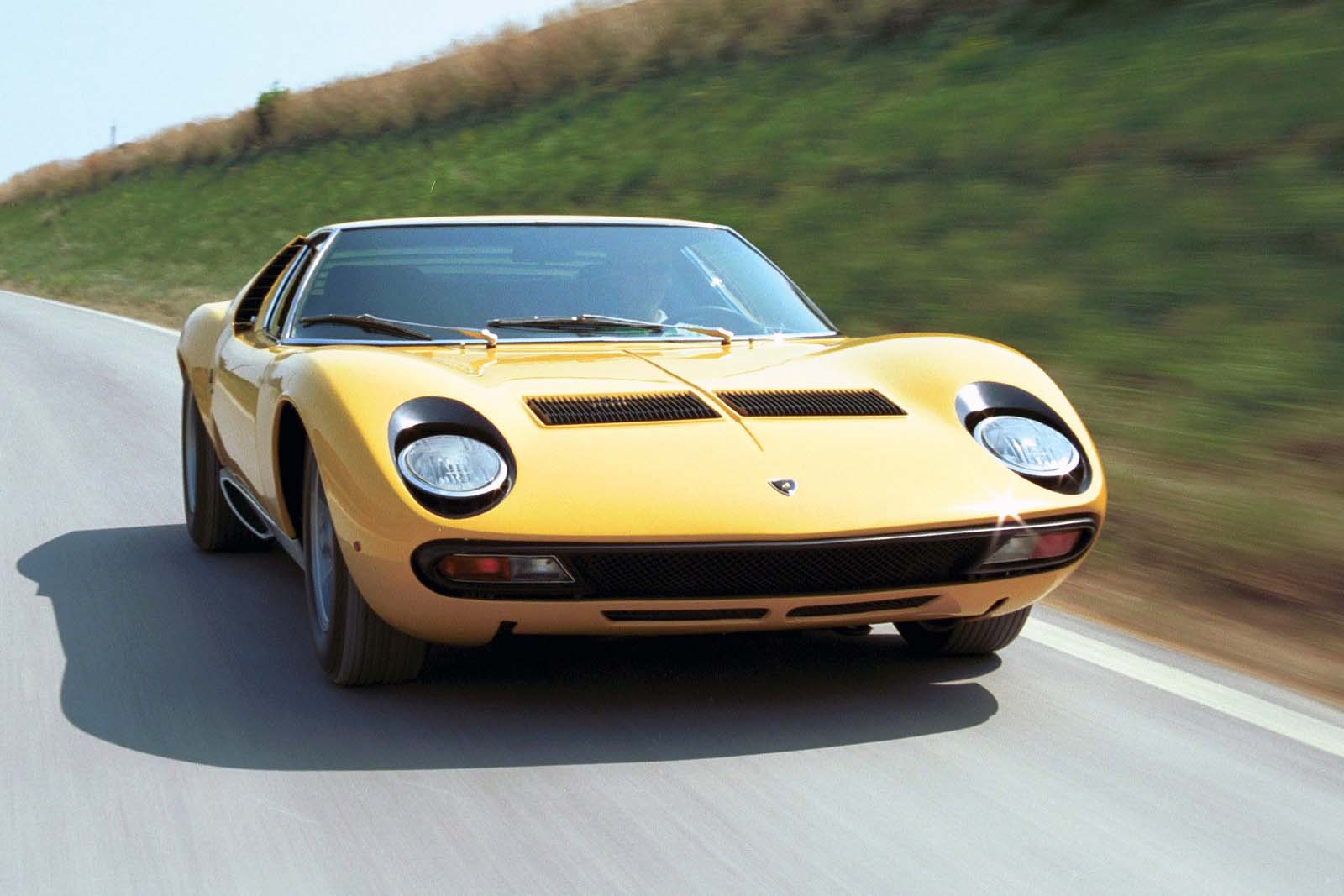
The bare rolling chassis stopped the Turin show in November 1965, and the finished car landed at Geneva on March 10, 1966. Two months after that, Bob Wallace threw his duffel bag into the prototype and ran it flat out toward Monaco, at speeds best described as extra-legal even for Italy, parking it in Casino square on the eve of the Grand Prix. The car was the Miura, at once the most beautiful car in the world and perhaps the most thrilling. The 12-cylinder had been upsized to four litres and now sat transversely, oh-so-close to the driver's head.
Again, this wasn't the sort of car Ferruccio said he wanted to build. The Miura was low-slung, vicious, tricky to drive: a racing machine let loose on the street, and a slightly ill-tamed one at that. Lamborghini's own account credits three young employees, Dallara, Wallace and Paolo Stanzani, who wanted to take the company racing and, refused, built a road car that behaved like a race car instead. Lamborghini itself now calls it the first modern-era supercar, and there is more on the supercar era it started if you want the wider view.
It went out on a high. The 1971 Miura SV brought 385 CV, a reinforced structure and better cooling, and the factory delivered 150 of them. It also invented something Lamborghini still trades on: Super Veloce, not a trim level but a harder, lighter, angrier reading of an existing flagship, built in small numbers.
Profanity on wheels: 1974-1990 Lamborghini LP400/500 Countach
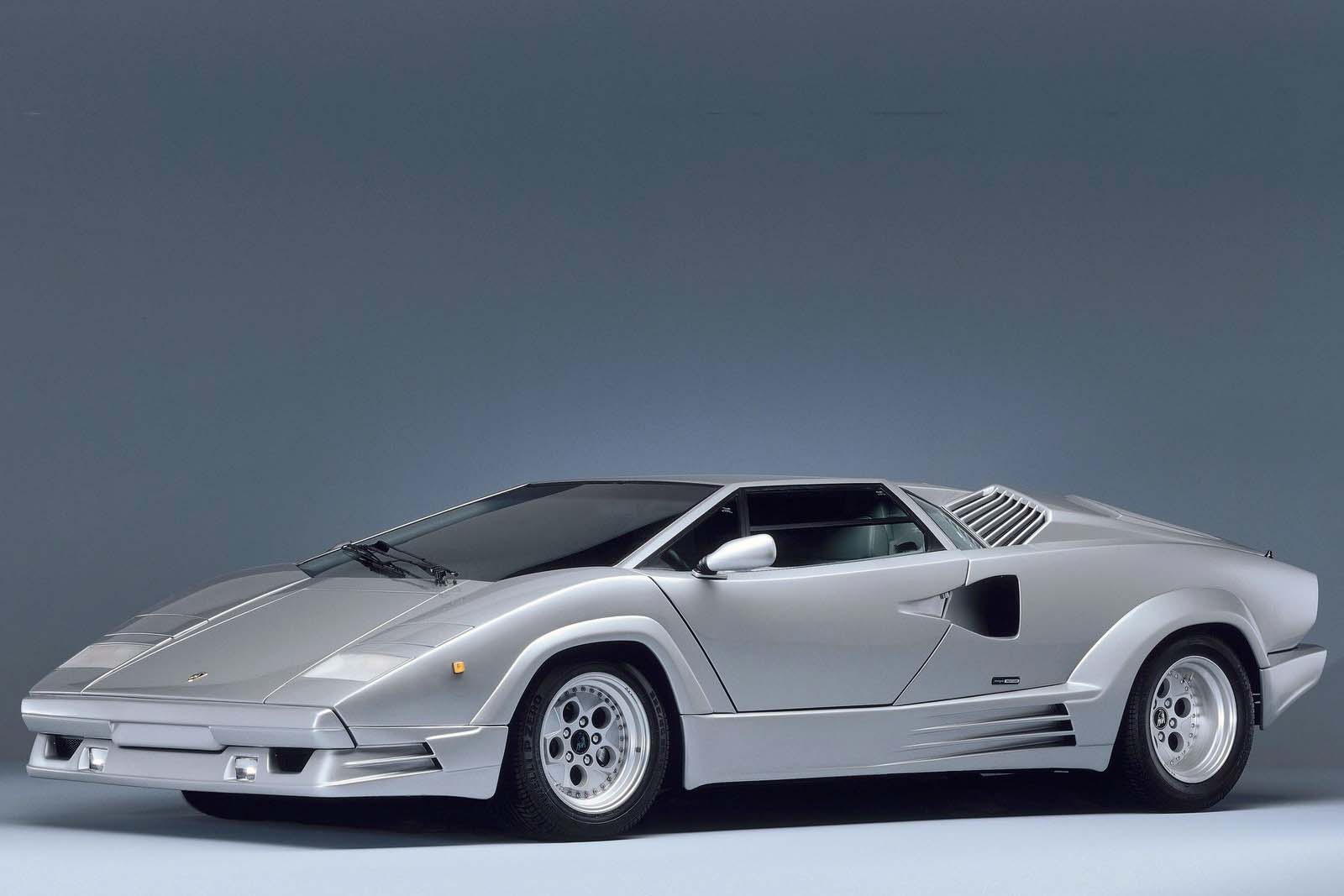
It's one of the oldest legends in the business. Nuccio Bertone walks into the workshop to see what young designer Marcello Gandini has crafted as a replacement for the Miura, the sheets come off and his response is "Countach!", a Piedmontese expression whose meaning is best left out of polite company. The first car named after a swear word. How true is the story? It hardly matters, it's just that good.
Much less comfortable than the Miura thanks to the space eaten by the now longitudinally mounted V12 engine, the LP400 is a bit of a bear to drive, difficult to see out of and very, very fast. There's a Canadian footnote, too. Formula One team owner and oil magnate Walter Wolf commissioned a series of specials through the 1970s, and Lamborghini's own account of the car's 50th anniversary states the production LP 400 S came directly out of Wolf's car. Whether his money also kept a debt-laden Lamborghini afloat is enthusiast lore rather than factory record; the engineering influence is documented.
The engine grew as the car aged. The 5000 S of 1982 went to 4.8 litres, holding the same power as the 4.0 but with more torque; the 1985 Quattrovalvole reached 5.2 litres with four valves per cylinder and 455 CV, the high-water mark of the first-generation V12 and the reason for the hump in the bonnet. The same engine found an unlikely second home in the LM002, which prefigured the Urus by three decades. Lamborghini built 1,999 Countaches over 16 years, and the last two versions sold best of all. There is a closer look at the Countach 5000S if you want the driving impression.
Sympathy for the Devil: 1990-2001 Lamborghini Diablo
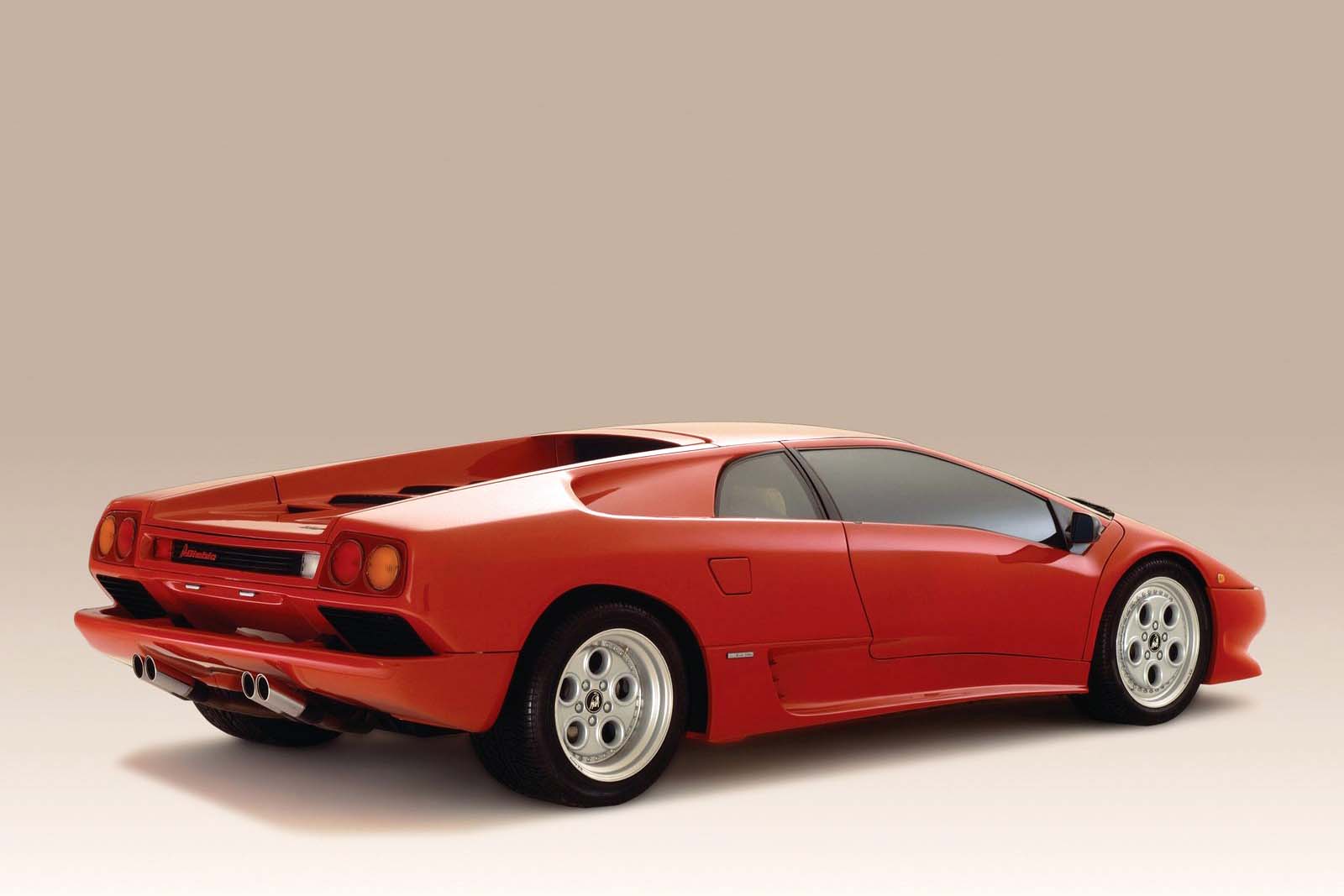
The Diablo had a protracted birth. The project started in the mid-1980s with Gandini again on design, then Chrysler bought Lamborghini in 1987 and its executives took fright at the sharp edges he had drawn. Essentially, if the Countach was a swearword, Chrysler wanted to bleep it out. The reworked car was considerably smoothed, yet the potency was still there beneath the skin: a 5.7-litre V12, power a hair below 500, and a top speed above 320 km/h. The Diablo was the first Lamborghini through that barrier and the publicity was enormous.
Rear-drive at first, it was soon joined by the VT, for viscous traction, whose new centre differential could send up to 28 per cent of the torque forward. That changed the character of the car, taming it, and it set the blueprint for nearly every road-going V12 Lamborghini since. The most sporting Diablo remained the SV, 40 kg lighter, up to 510 hp, and rear-wheel drive on purpose. More than 2,900 Diablos were built including the Roadsters, with a third series from 1998 taking the engine out to 6.0 litres.
Stealth Fighter: 2001-2010 Lamborghini Murcielago
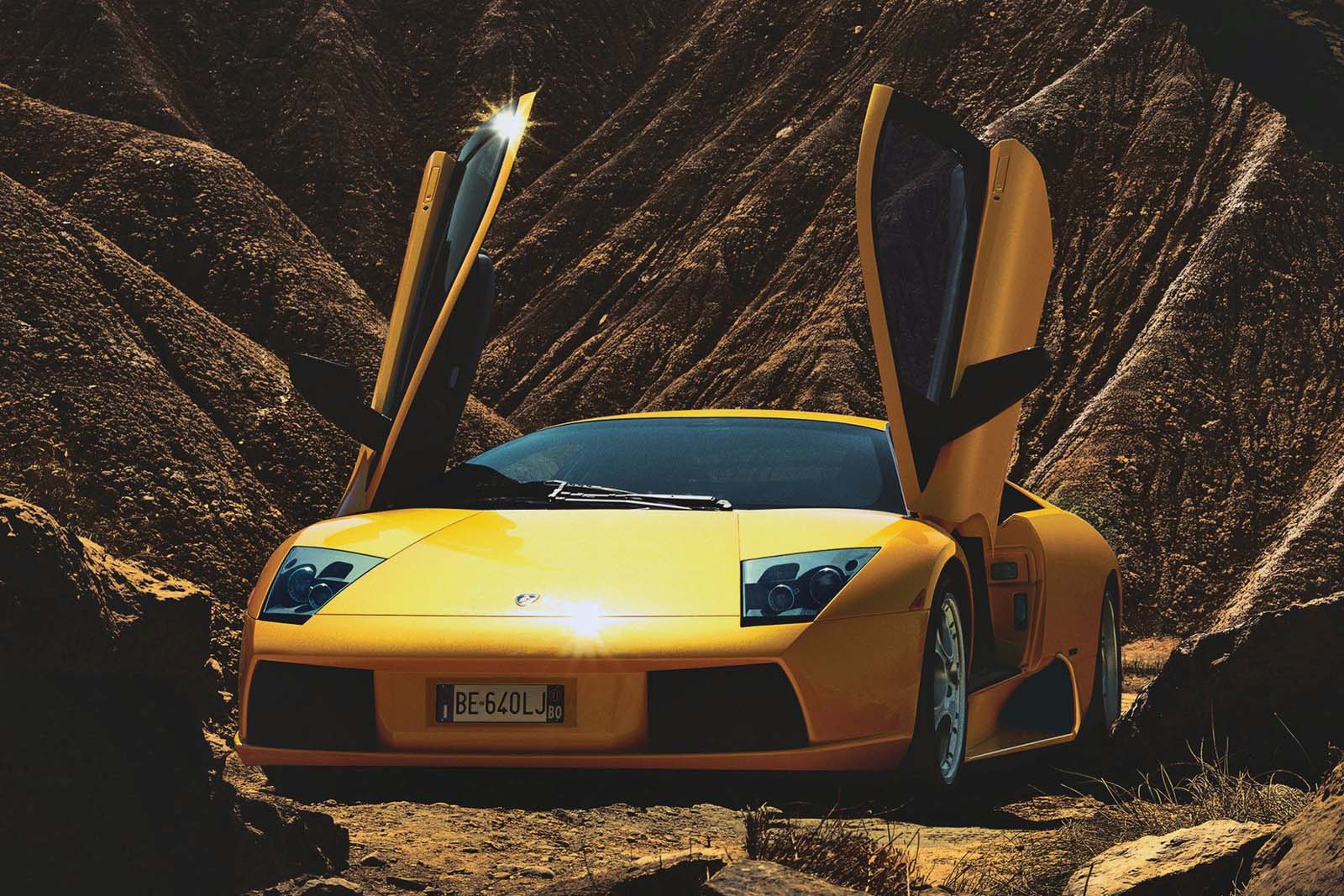
The Chrysler era ended and Audi stepped in. Lamborghini fans weren't thrilled at first, and you might as well try pairing a delicate Chianti with a giant lump of bratwurst, but a little German engineering turned out to be a very good thing.
Luc Donckerwolke's Murciélago replaced the Diablo's smoothed-out shape with the multi-angle trapezoids of an F-117, and like most Lamborghinis it took its name from a Spanish fighting bull, one whose bloodline ran through Don Miura's ranch in Seville. All-wheel drive, optional on the Diablo, was now standard. The naturally aspirated V12 started at 6.2 litres and grew to 6.5, ending with the 2009 LP 670-4 SV at 670 CV: roughly 100 kg lighter than standard, and the first Super Veloce driving all four wheels. Lamborghini quotes 350 coupés and 50 roadsters for it.
Ferruccio would have disapproved of the race-spec variants. He'd probably have loved the Reventón, though: 20 carbon-fibre cars at a million euros apiece before taxes, 650 CV, built on Murci underpinnings. If the Murciélago was an F-117A, this was an F-22, the highest-tech machine Lamborghini could field. It also started something: every few-off since, up to the Fenomeno, traces back to it.
Power in Numbers: 2011-2022 Lamborghini LP 700-4 Aventador
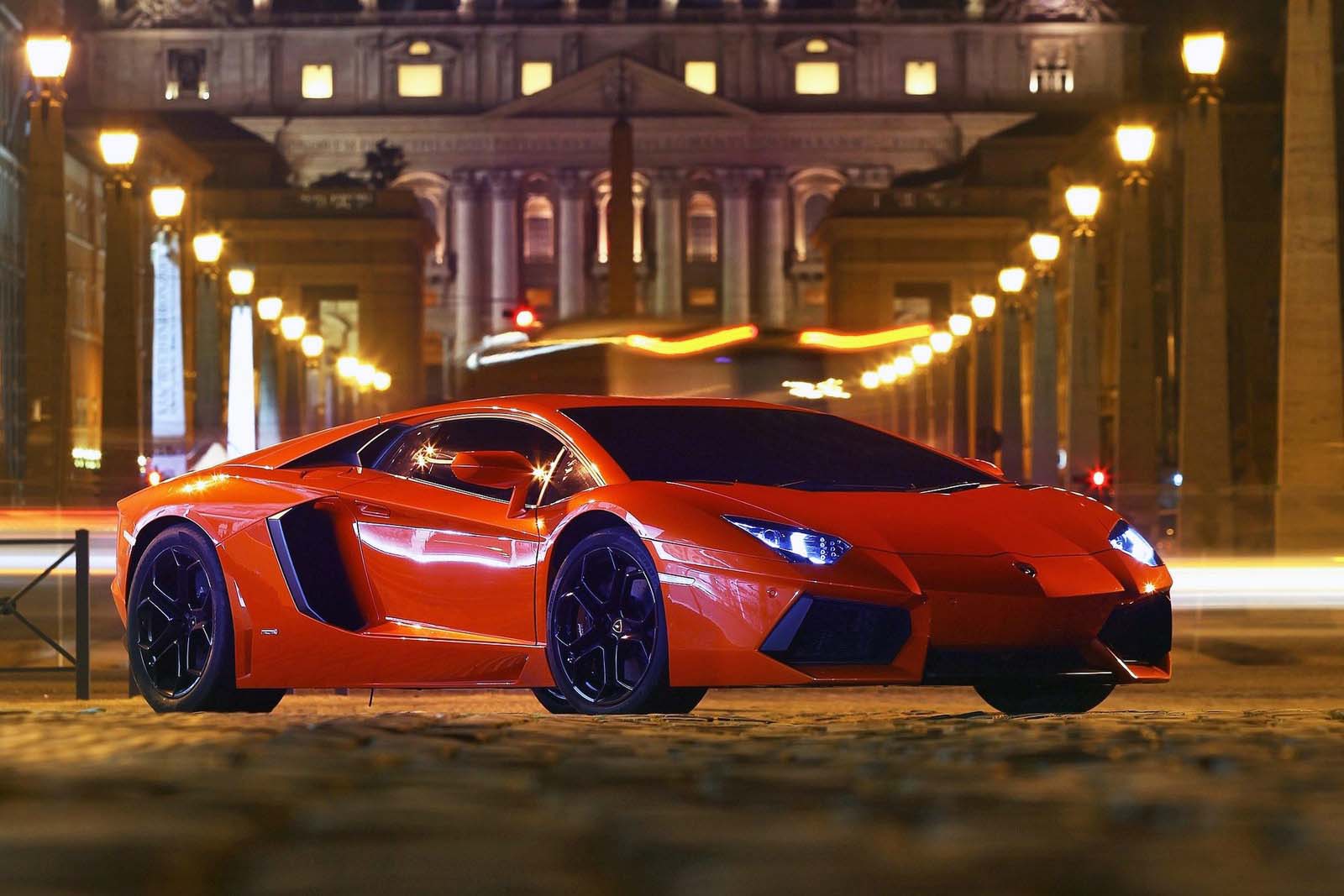
Building on the styling lessons of the Reventón, Lamborghini took extreme dimensions into the mass market with the Aventador. It seems odd to speak of mass production with a car this theoretically rare, but the numbers tell the tale: it took 16 years to build 1,999 Countaches and 11 to build just over 2,900 Diablos, while the Aventador sold more than every earlier V12 Lamborghini combined.
Powering it was an all-new V12, a break with tradition for the first time: a second-generation V12 owing nothing to Bizzarrini's design, 700 CV from 6.5 litres, hung behind a carbon fibre monocoque, with no hybrid or turbocharging in sight. Top speed 350 km/h, 0-100 km/h in about three seconds. There is a 2014 Aventador LP 700-4 Roadster in our archives if you want to see one up close.
Like the Diablo before it the Aventador got an SV, though this one kept all-wheel drive: 750 CV, wild aerodynamics, 600 cars. Then the SVJ. Then the one that matters most: the LP 780-4 Ultimae, the most powerful Aventador ever made, with 780 CV at 8,500 rpm, good for 355 km/h and 0-100 km/h in 2.8 seconds (2.9 for the roadster), in 350 coupés and 250 roadsters. Lamborghini calls it the last pure naturally aspirated V12 produced at Sant'Agata Bolognese. When the final Ultimae Roadster left the line in 2022, the unassisted twelve was finished.
Electrified: 2019-2021 The Hybrid V12 Arrives
Everyone expected turbocharging. Everyone expected downsizing. Lamborghini did neither, which remains the most surprising thing about the last decade of this engine: same displacement, same natural aspiration, same appetite for revs, with electric motors added to fill in the torque a high-revving engine leaves behind.
The hinge was the Sián FKP 37 of 2019. Its V12 made 785 CV and a small electric motor added 34 more for 819 CV, but the clever part was the storage. It used a supercapacitor rather than a battery, 34 kg with the motor, recharging every time the car braked. Lamborghini built 63, a nod to the 1963 founding, and called it the first step on its route to electrification.
Two more cars used that hardware in opposite directions. The Countach LPI 800-4 of 2021 dropped the Sián's system into a homage to the original: 814 CV and 112 cars. The Essenza SCV12 went the other way entirely: track-only, rear-wheel drive, 830 CV with help from dynamic supercharging at speed, 40 built, engineered to FIA prototype safety rules rather than road ones.
Hybrid Era: 2023-Present Revuelto, Fenomeno and Revuelto SV
The Revuelto of 2023 made the twelve a plug-in hybrid: an all-new 6.5-litre V12, three electric motors, 1,015 CV and, after decades of single-clutch stubbornness, the first dual-clutch gearbox ever fitted to a Lamborghini twelve.
Then it got faster. The Revuelto SV arrived on Aug. 14, 2026 with 1,065 CV and 1,425 Nm, 0-100 km/h in 2.4 seconds, over 345 km/h and a 1:41.6 lap of the Hockenheimring, the fastest production car recorded there. Lamborghini limits it to 1,963 cars and it is the first Super Veloce with a hybrid powertrain. Above it sits the Fenomeno, a 29-car few-off whose 1,080 CV system output includes a record 835 CV from the twelve alone, the most powerful engine the company has built.
Its heartbeat is a good deal different from that of its ancestors now. But that same twelve-cylinder fury still pulses in its veins.
What This Means If You Want One
Ownership divides by era, and production volume draws the line. The earliest cars exist in the numbers in the table above, 150 for the 350 GT and 150 Miura SVs, so they are collector cars by arithmetic before anything else. The Diablo at more than 2,900 and the Aventador at 11,465 were built in volume by comparison, which is why those generations are the ones that turn up in listings at all.
What to Check on Any V12 Lamborghini
Whichever era you look at, the mechanical questions are the same: documented service history on a complex naturally aspirated engine, drivetrain originality and the condition of the clutch and gearbox. Running costs are their own subject, and what an exotic car actually costs to own covers that ground. Filter by trim, model year and mileage to see how comparable cars are listed before committing to a generation.
See V12 Lamborghini Listings on AutoTrader.ca
Browse V12 Lamborghini listings on AutoTrader.ca to compare what is available by model year, trim and mileage.
Lamborghini V12 FAQ

All Articles
See all
The Power of Storytelling: How Car Brands Successfully Go Beyond the TV
A marketing professor explains why great storytelling is more important than the medium.
 Steven Bochenek

Planes, Trains and (Electric) Automobiles: A Race to Determine the Pros and Cons of Each
Discovering the best way from Toronto to Quebec City with the Subaru Uncharted.
 Jeff Wilson

5 Crazy Things Less Powerful than the Porsche Cayenne Electric
Putting the Porsche Cayenne Electric Turbo’s absurd numbers in perspective.
Jeff Wilson