
The Power of Storytelling: How Car Brands Successfully Go Beyond the TV
 Steven Bochenek

Many professional advertising creatives will tell you video is the best medium for storytelling because it uses the big tools: pictures, sound, text, and, since advertisers began putting video online (YouTube is only 21 years old), links within the text. Compare that impressive list with print, which lacks sound and links, or radio, which lacks pictures, links, and, arguably, text.
But unlike video, print needs only a second of your time, and radio won’t risk a life-threatening car crash. I maintain that the tools aren’t what make any medium best. It’s the skill of the storytellers and how they adapt to the context of where and when they find their target.
Example? Last month, I was on a long road trip in British Columbia and nearly hit a pair of elk crossing the highway on a misty night just outside the town of 100 Mile House. Early the next morning, I nearly hit a fox before the mist had burned off, just 30 miles down the road in, yes, 70 Mile House. In both cases, it was last-minute and disturbing. No wonder the following print ads for Chinese automaker Geely and its satellite tech hit home. The story goes straight to the climax, and only your brain can resolve it.
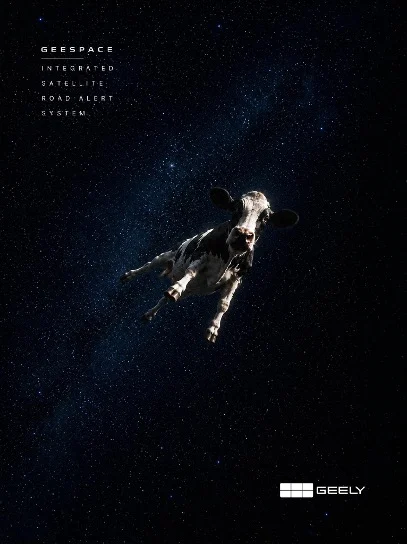
When the elk were crossing the highway, they were just suddenly, witlessly there, as this cow is. It’s a simple campaign idea, but you can’t call it simpleminded or a one-trick bovine. Just look at these other executions of the technique. Satellite road alerts aren’t just for cows anymore. There’s plenty of other stuff you can hit.
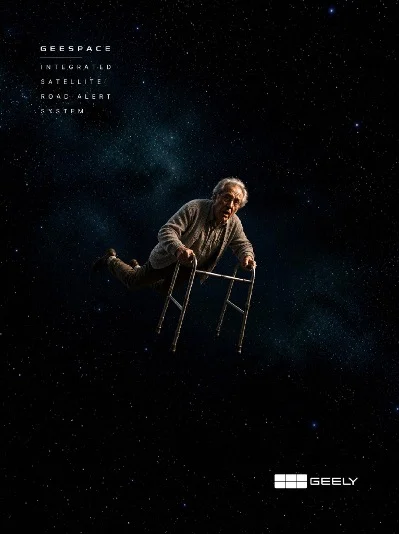
Many car buyers exist in sandwich generations, raising kids and looking after elders. You can look it up; during the pandemic, the British government actually warned voters before the holiday season, “Don’t kill your gran.” They didn’t need such an impactful headline here, because the visual says it all.
And clearly targeting Millennials who are in their prime and likely spending lots of time maintaining their physical fitness, here’s a reminder that, as the old song goes, sometimes you’re the windshield and sometimes you’re the bug.
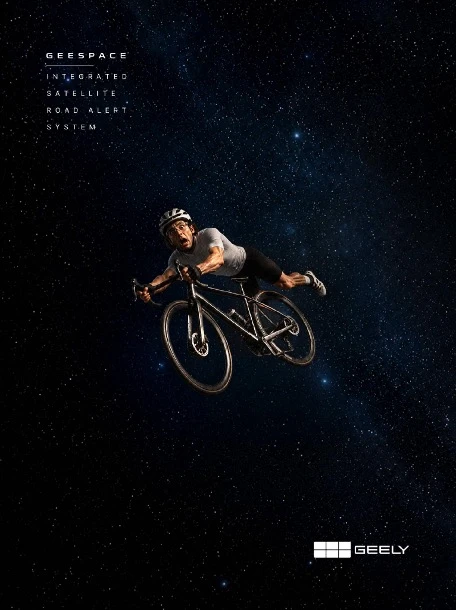
One last point regarding the above campaign. Note how all the about-to-be-impacted are looking square into the viewer/driver’s eyes. It’s alarming.
So, with that point about print proven, let’s look at some TV/video. We’ll address radio, kind of, at the end.
Volkswagen has always told its story better than nearly any other automaker, regardless of medium. A classic TV spot from the 1970s was what changed the mind of erstwhile advertising legend, David Ogilvy. A recovering Presbyterian, Ogilvy swore humour had no place in advertising. Why? “Nobody buys from a clown.”
Oops! Around the same time, he changed his mind; McDonald's was fast becoming the destination of choice for middle-class families. But here’s the classic that opened his eyes to the power of humour.
We talked above about Millennials and their prime. In this 2026 ad, VW is targeting men of a certain age who are doing their best to maintain their prime physique and finding it challenging. Is there a lesson?
More video storytelling: Isn’t it amazing how easily music can set the tone and telegraph how you’re supposed to feel? The movie Jaws 2 marketed itself with the line, “Just when you thought it was safe to go back in the water.” All it needed was that music.
Is this other Chinese manufacturer BYD putting its tongue in cheek? This spot could easily be an allegory for what could happen when their products get a foothold in America.
Renault has always made great creative, but we don’t see it because Renault doesn’t sell cars here; never mind its Romanian sub-brand, Dacia. Maybe we should, though. This spot is making an argument for hybrids and pokes fun at the visual clichés most auto ads use. Few drivers navigate an empty desert, conquer a mountain or ford a rushing river on their daily commute. In truth, most driving is boring, if we’re lucky. Note the lovely copy couplet setting up the payoff: You don’t drive far every day. You drive every day. The logical conclusion? Why are you paying for gas so often?
Your monthly marketing strategy lesson: There are ultimately just two messages in traditional advertising: buy this or buy more of this. That is, one tells you that you’re not doing things right; the other tells you that you are, and to keep doing them. The latter can allow for more creative leeway. And here’s why. There’s an old saw in advertising writing: When you haven’t got anything new to say, say it with style! Consider the massive wars that beer and cola ads engage in. Most of us can’t tell the difference or care to. That is, until you ask Waassaaaap!?
Example? Rivian owners already know they have a great piece of technology that’s fun to drive. (The message: They’re doing it right.) But maybe they didn’t know how more fun Rivian wants them to have. At the time of writing this article, we were five days away from Halloween. It’s a time when even conservatively quiet luxury brands can have some fun. Rivian wanted its drivers to engage with their product more.
Following up, this tongue-deeply-in-cheek product walk-through takes the stuffing out of technobabble, demonstrating Rivian’s utterly useless and hilarious toy for bored onboard commuters.
So, is TV the most creative medium for storytelling? I don’t think so. Watch one of my favourite storytelling campaigns of the past decade. It’s literally telling stories we all learned in primary school but with a twist. BUT: Please watch just the first in this British campaign’s trio. Then stop and come back to this article. (It’s worth it.)
Now, here’s a fascinating fact. That Vauxhall campaign began its life as radio only. And here’s a fascinating exercise. “Watch” the second and third spots with your eyes closed. Your brain makes all the pictures you need from the wonderfully designed and executed sounds. I will go to my grave believing that any medium can tell stories well. It’s about the creative’s skill as a storyteller, not the baubles a given medium presents its users.

All Articles
See all
5 Crazy Things Less Powerful than the Porsche Cayenne Electric
Putting the Porsche Cayenne Electric Turbo’s absurd numbers in perspective.
 Jeff Wilson

Shortest-Lived Car Brands of the Past 50 Years
The automotive brands that barely survived.
 Michael Karant

AutoTrader Find of the Week: 2015 Mitsubishi Lancer Evo GSR Was the End of an Era
The Evo X Final Edition marked the end of a JDM legacy and an entire era of sports car philosophy.
 Chris D’Alessandro