
Planes, Trains and (Electric) Automobiles: A Race to Determine the Pros and Cons of Each
 Jeff Wilson
Living with an electric vehicle (EV) is great if your automotive use case includes a reasonable daily commute and you have a suitable place to plug in at home or work. The savings in fuel, maintenance, and yes, even time, can make EV ownership worthwhile, but their smoothness, silence, and swiftness offer an unrivalled driving experience. Cruising solo in the carpool lane is a nice perk, too.
Still, concerns remain about taking road trips with an EV, and a recent adventure across Labrador illustrated some of the limitations of big adventures with electric vehicles. That didn’t stop my friend (and AutoTrader contributor) Kyle Patrick and me from wondering whether having the freedom of your own machine is always nicer than public transit, even if your transportation is electrified.
With that question in mind, we decided to venture from Toronto to Quebec City in search of some proper French-Canadian cuisine. After a few rounds of Rock-Paper-Scissors, it was determined I would book a train ticket while Kyle would drive an EV to determine once and for all which was the better way.
A big fan of poutine, my buddy Shaun proclaimed that the freedom (and speed) of flying one’s own aircraft is the best way to get around, and boasted that he’d see us in Quebec City with time to spare as he hurried off to prep his Cessna for the competition.
The Rules


Let’s be clear, this whole fiasco was meant as a fun way to experience the pros and cons of three different means of transportation between two major Canadian cities, each regularly served by multiple means of passage. Heck, if we’d had someone else with a boat, we could’ve included that, too, since the journey down Lake Ontario to the St. Lawrence River doesn’t sound like a bad way to travel, either.
Far from scientific, we still had some rules. First, we all needed to set off from the same spot in downtown Toronto, at the same time. From this point, the clock started ticking to see who could get to a favourite café in Quebec City first. We decided the aircraft’s speed would clearly give it the advantage of being the quickest, but we also wanted to factor comfort, convenience, and cost into the evaluation process.
The EV
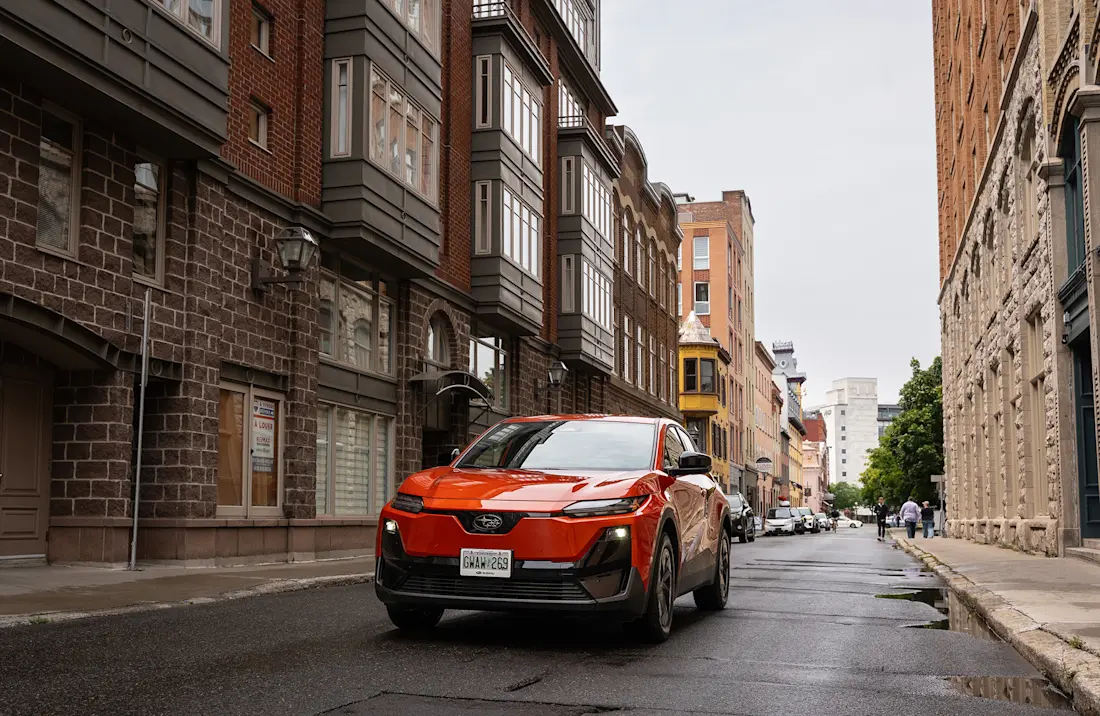
The distance between our starting point near the CN Tower and our figurative finish line in Old Quebec is just over 800 km. The only EV that could possibly make the trip on a single charge is the Lucid Air, with a range of 824 km, which means that no matter what else we chose, we were likely facing at least one stop to juice up the car. Realistically, most humans will need a bio break or two, especially for what’s roughly a nine-hour drive, so a quick recharge or two should be convenient and welcomed.
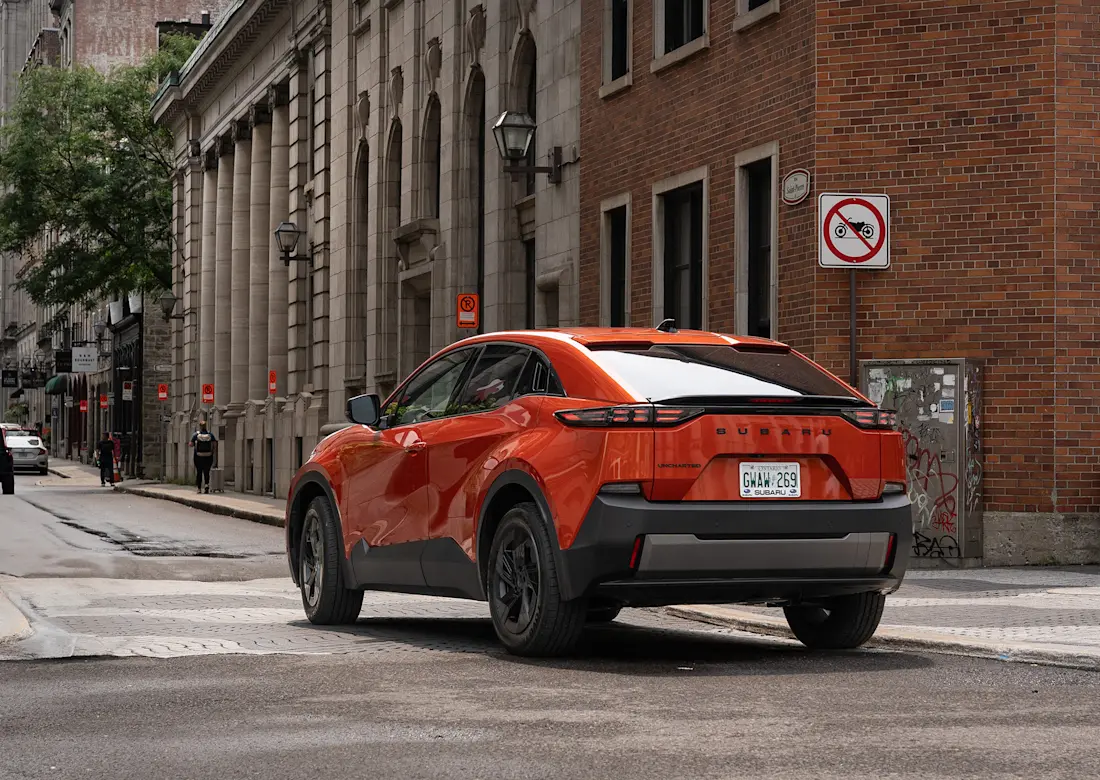
Kyle and I have each spent some time with Subaru’s Uncharted, a compact electrified crossover that’s handsomely styled, offers efficient space, and in its all-wheel-drive format, is properly fun to drive (see my thoughts on it being a great basis for a future enthusiast hot-hatchback). We even stacked the deck for this trip by choosing the single-motor (front-drive) format with its range of 496 km. Travelling through the most densely populated part of our country with plentiful charging infrastructure, especially in Quebec, should make the trip a breeze for Kyle.
The Plane and Train
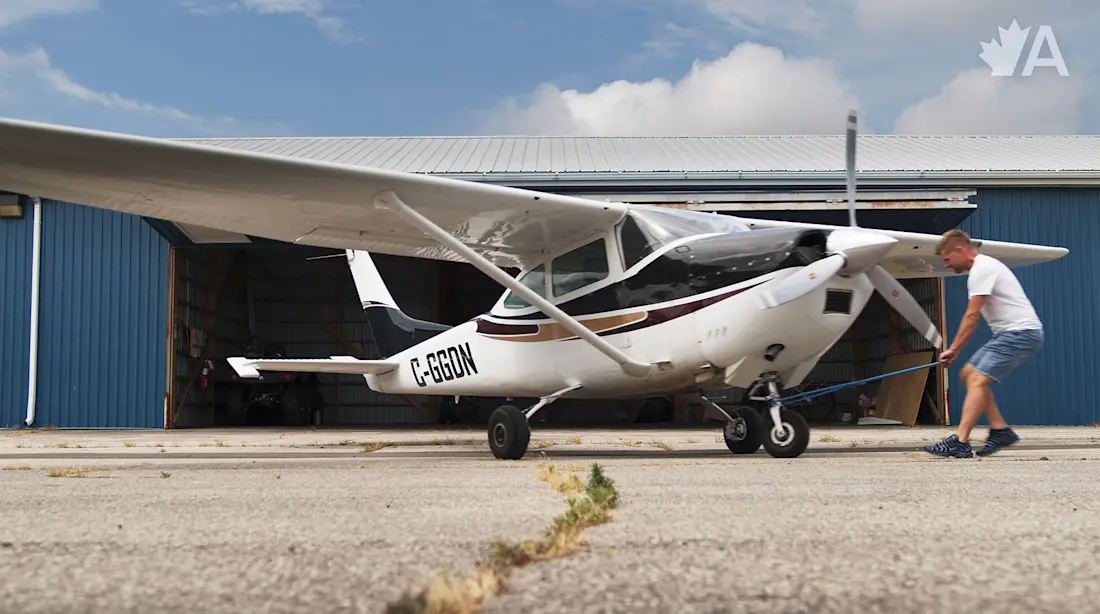
Shaun has invested a considerable sum in restoring his 1966 Cessna 182J Skylane, modernizing and gussying up the 60-year-old aircraft. He’s also taken a hot-rodder’s approach, replacing the standard 230-hp engine with a 285-hp boxer-six from a larger aircraft. This gives his plane an easy cruising speed north of 240 km/h, and with a relatively straight shot to Quebec City, should mean shaving more than 100 km from the actual travelled distance compared to the terrestrial travellers.
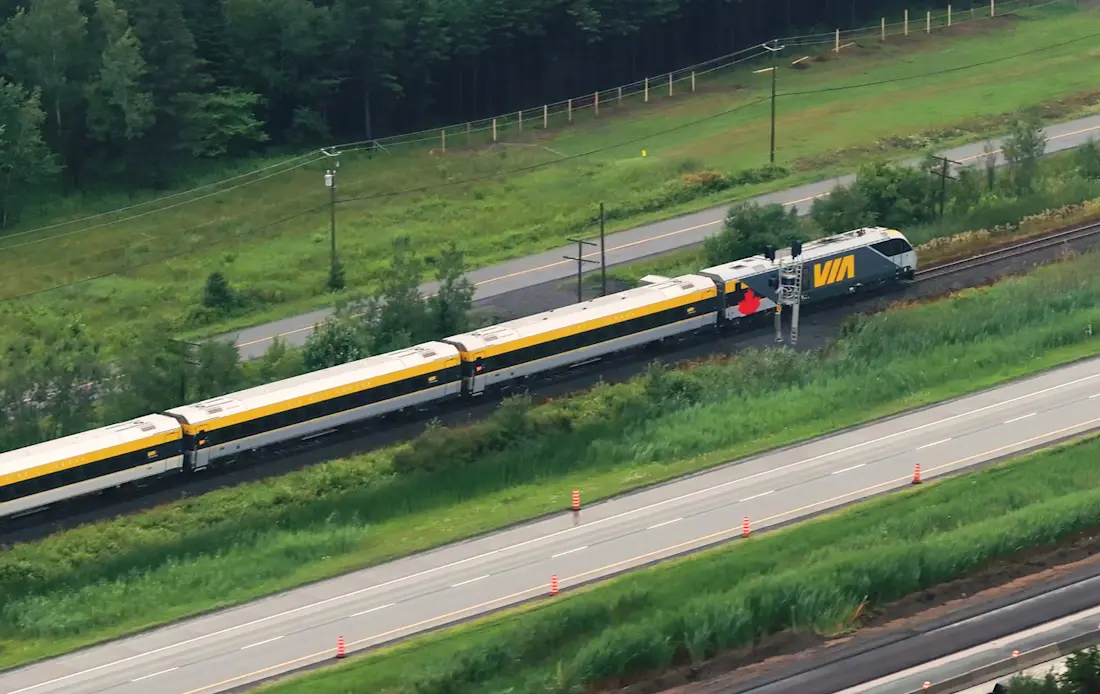
My steed is VIA Rail’s train number 64 out of Toronto that happened to be one of the newer Siemens SCV-42 Charger units. It’s powered by a 16-cylinder diesel Cummins engine that puts out 4,200 hp at 1,800 rpms and is rated for a top speed of 201 km/h. Unfortunately, our track system limits the trains to 160 km/h here.
The Race
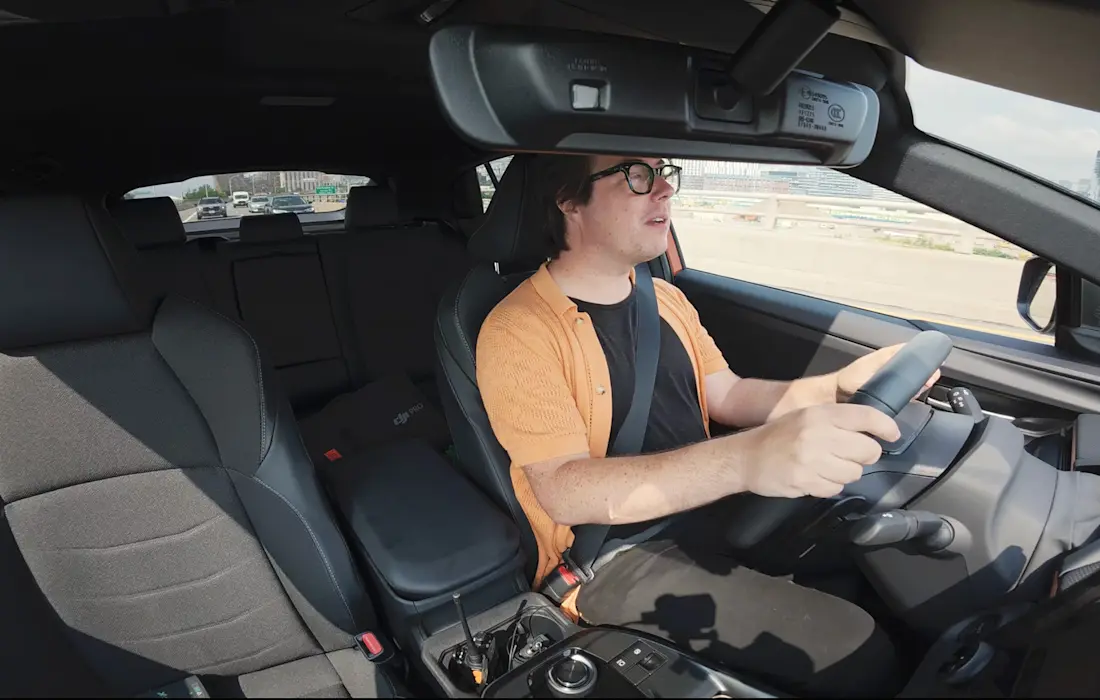
With our collective departure set for roughly 10:00 a.m., Kyle immediately set off late enough to miss the worst of Toronto morning rush-hour traffic, which is a bit of a misnomer since there are typically only one or two hours a day at best when traffic in Toronto isn’t utterly miserable. The downtown surface streets and highway system don’t have carpool lanes to give the EV a leg up, so even though his start downtown looked promising, it wasn’t long before Kyle needed to take a deep breath and accept that Toronto traffic will catch up sooner or later.
Shaun’s start was arguably worse. His plane is stored in a hangar situated well west of downtown Toronto, requiring an hour-and-a-half drive in the wrong direction before he’d even begin his journey toward Quebec City. Worse still, upon arriving at the hangar, a weather system had closed in, making it unsafe for take-off. For the time being at least, Shaun and his speedy aircraft were going nowhere.
Meanwhile, as Kyle wasted time in traffic and Shaun waited out the weather, I walked over to Union Station and discovered the train departing at 10:38 a.m. was scheduled to arrive in Quebec City more than 11 hours later at 9:48 p.m. after switching trains in Montreal. Weirdly, the 11:38 train was scheduled to get in at the same 9:48 p.m. arrival time since it didn’t detour through Ottawa, but still needed a train change in Montreal.
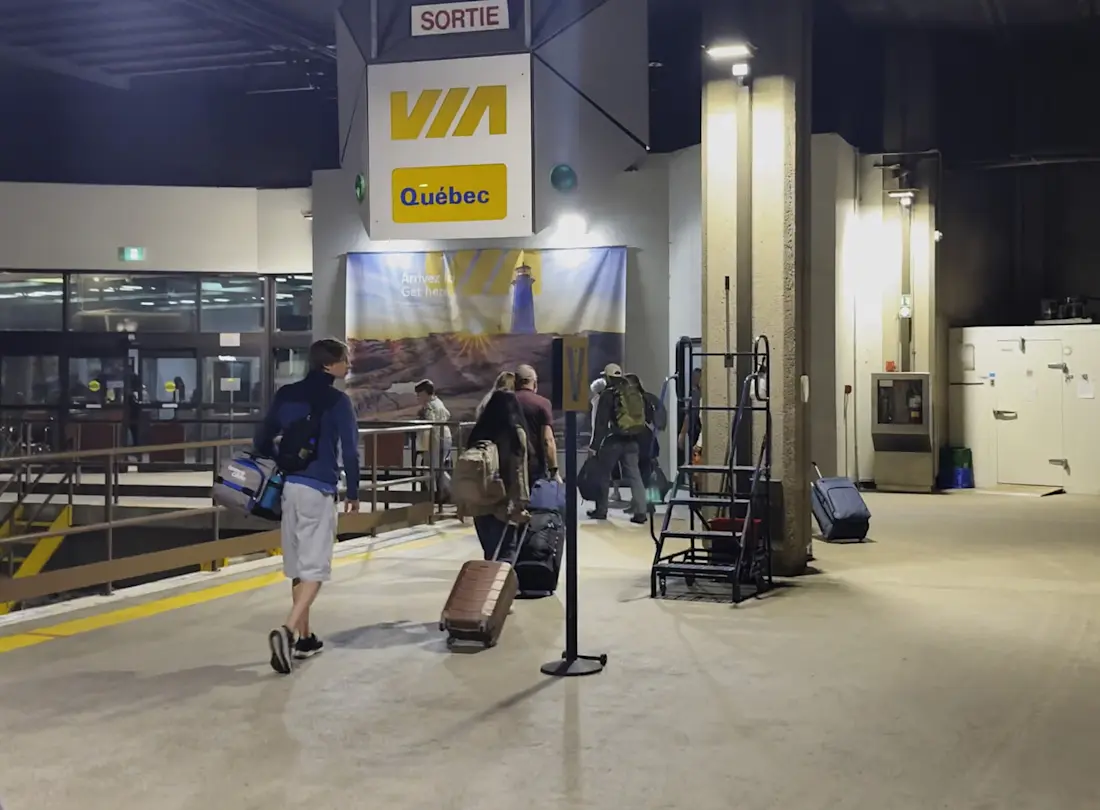
I opted for the later train and wandered into the VIA lounge that offered quiet seating, free non-alcoholic beverages, and a bowl of apples.
Eventually, our livestock-like queue of passengers boarded the train, found our seats, and the VIA rumbled out of the station, heading east. It wasn’t long before we were cruising along at more than 140 km/h, then 150, and as we paced alongside highway 401 for a while, I could see we were easily moving faster than the traffic that was (supposed to be) limited to 110 km/h. And then we slowed and stopped at the first of eight scheduled stops between Toronto and Montreal. Each time, passengers would get on and off, and we’d slowly roll out and gradually build speed again.
Once outside Toronto, Kyle merrily cruised along with a nice, consistent speed. Earlier in the morning, I drove the Uncharted into downtown from west of the GTA and accidentally on purpose “forgot” to plug it in, meaning at the start of the race, Kyle was already at a disadvantage. While the Subaru should be good for a range of more than 420 km, the plan was to never drop below roughly 20 per cent to enable the fastest charge rate. A Tesla Supercharger station just off the highway in Brockville, Ont., would help keep Kyle and the Uncharted moving along more than a half-hour ahead of the train, plus offer a chance for a snack and a stretch of the legs.
This was a gamble for Kyle since there was still more than 460 km remaining to get to Quebec. In theory, if he pushed the limits, it should be within the Uncharted’s range, especially considering the mild weather.
By this point, Shaun had hauled his plane out of the hangar, taken the time to give it the typical pre-flight inspection, fuel up, and take to the skies within a brief break in the weather. The same weather system that delayed him earlier threatened to prevent a landing in Quebec City, adding additional pressure to his journey and prompting him to push the old plane a bit harder than he might have normally.
Predictably, by late afternoon, even after his extensive morning delay, Shaun was enjoying some poutine in Quebec, taunting Kyle and I with text messages.
The weather system had reached Montreal as the train departed, and while a little thunderstorm doesn’t bother the railway, I was still surprised by how unsettled the ride was, regardless of what the weather was doing. Imagining the gentle rocking as the train rumbled along on its rails, I found it often shook and jerked so erratically, that it was difficult for me to work on my laptop without suffering motion sickness. Similarly upsetting, I paid handsomely for an unappealing sandwich and what could be the most unpleasant cup of coffee I can recall enduring.

The storm played havoc for Kyle since rolling through water on the road and even driving through such heavy rain can increase the drag and resistance on a car. Over hundreds of kilometres, the incremental affect cumulates into an appreciable range reduction. This, of course, doesn’t only apply to EVs, but when trying to stretch the range without the delay of a second charge, it was enough to stress the heck out of Kyle before he had to succumb to stop just east of Montreal. By this point, his progress was roughly neck-and-neck with my train that had endured multiple (if brief) unscheduled delays along the way. Sadly, it’s a common occurrence thanks to a track system owned by CN Rail that prioritizes its freight trains over VIA’s passenger service.
Kyle needn’t have worried since a mere 15 kilometres from the station the train was stopped due to yet another unforeseen situation – this one causing more than an hour delay, resulting in my arrival at the station after midnight, exhausted, grumpy, and hungry with all the cafes closed for the night.
The Winner and Final Thoughts

Despite the weather delays, Shaun was the only one of the three of us to enjoy his poutine before the cafes closed. Of course, the weather caused some stress, plus this solution only works if one possesses the requisite pilot’s license and access to a plane. There’s also the little detail of cost, which in fuel alone, cost Shaun roughly $700 each way. That’s expensive poutine. Its environmental impact is atrocious, too, at approximately 400 kg CO2e.
The train cost more than $300 including the entry fee to the VIA lounge and the modest onboard meal and snacks. While the stress of piloting the machine was not on my shoulders, the repetitive and sometimes-lengthy delays really wear a passenger down. Plus, ultimately taking more than 12 hours to do the trip was miserable and, frankly unacceptable. At least my carbon footprint on the train was only about 75 kg CO2e.
While Kyle’s journey in the Uncharted did meet some unexpected weather-related challenges, he was largely in control of his own schedule, could stop for whatever food or bathroom breaks he wanted, and enjoyed the luxury of cranking up his tunes or podcasts. Even at its costliest rate when quick-charging, Kyle only spent $35 to recharge the Uncharted. And his environmental impact? One-15th that of the train and 1/80th the plane’s impact.
Ultimately, if a personal aircraft isn’t in the cards, an EV like Subaru’s Uncharted provides freedom, flexibility and cost savings that make it a winner in our books, even on a road trip.

All Articles
See all
Shortest-Lived Car Brands of the Past 50 Years
The automotive brands that barely survived.
 Michael Karant

AutoTrader Find of the Week: 2015 Mitsubishi Lancer Evo GSR Was the End of an Era
The Evo X Final Edition marked the end of a JDM legacy and an entire era of sports car philosophy.
 Chris D’Alessandro

Own the Road with AutoTrader, Episode 117: Geely is Coming to Canada – Here's What We Know
One of China's biggest automakers is coming to Canada. Here's what that means for you.