
4 Features from the Ferrari Luce’s Interior We Want in Regular Cars
 John LeBlanc


Touchscreens have become the main way we interact with new cars. They help automakers cut costs, offer smartphone-like experiences, and support advanced software. This trend started with electric vehicles like Tesla, which use large screens instead of physical buttons for tasks once done by tactile switches, dials, or knobs. But after five years of development, the interior design of the forthcoming Ferrari Luce EV attempts to reverse that course. This is a welcome shift, as the reliance on touchscreens and touch-sensitive controls has not just become an annoyance to drivers but a legitimate safety concern.
Partnering with LoveFrom, a creative agency founded by former Apple design chief Sir Jony Ive and industrial designer Marc Newson (best known for his 1999 Ford 021C concept), the objective of the interior design of the Luce (which means “light” or “illumination” in Italian) is to combine high-tech features with tactile, driver-friendly controls.
Here are four features from Ferrari’s new interior design that we’d love to see in more mainstream cars.
1. Easy-to-Read Driver Instrumentation

Many new cars overload their displays with too much info and flashy graphics, leaving drivers who just want to see their speed or engine RPMs feeling overwhelmed. To rectify this challenge, the Luce’s cabin is arranged into clear zones for controls and displays. Its driver’s binnacle is a great example of the design’s simple-is-better approach.
Inspired by the instruments in classic Ferraris, the driver instrumentation pod features three main dials, with the larger centre dial showing the most important info. The needle is a physical, anodized aluminum piece, lit by 15 slim, overlapping OLEDs (organic light-emitting diodes) whose pixels can be turned on or off individually. Ferrari says this creates a perfect black with infinite contrast and a Parallax effect, the visible shift in an object’s position when seen from different angles. And similar to an older Porsche 928 or Honda CRX, the Luce’s steering wheel also moves with the instrument binnacle, improving the driver’s view of the instruments so they’re not blocked by the steering wheel.
2. Fewer Screens, More Tactile Controls
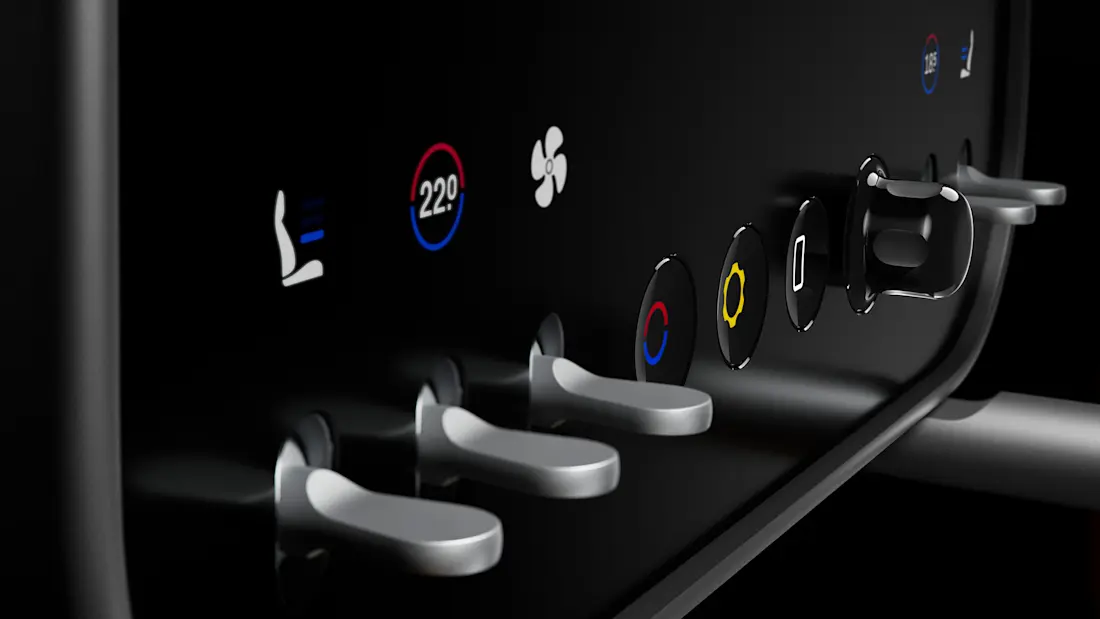
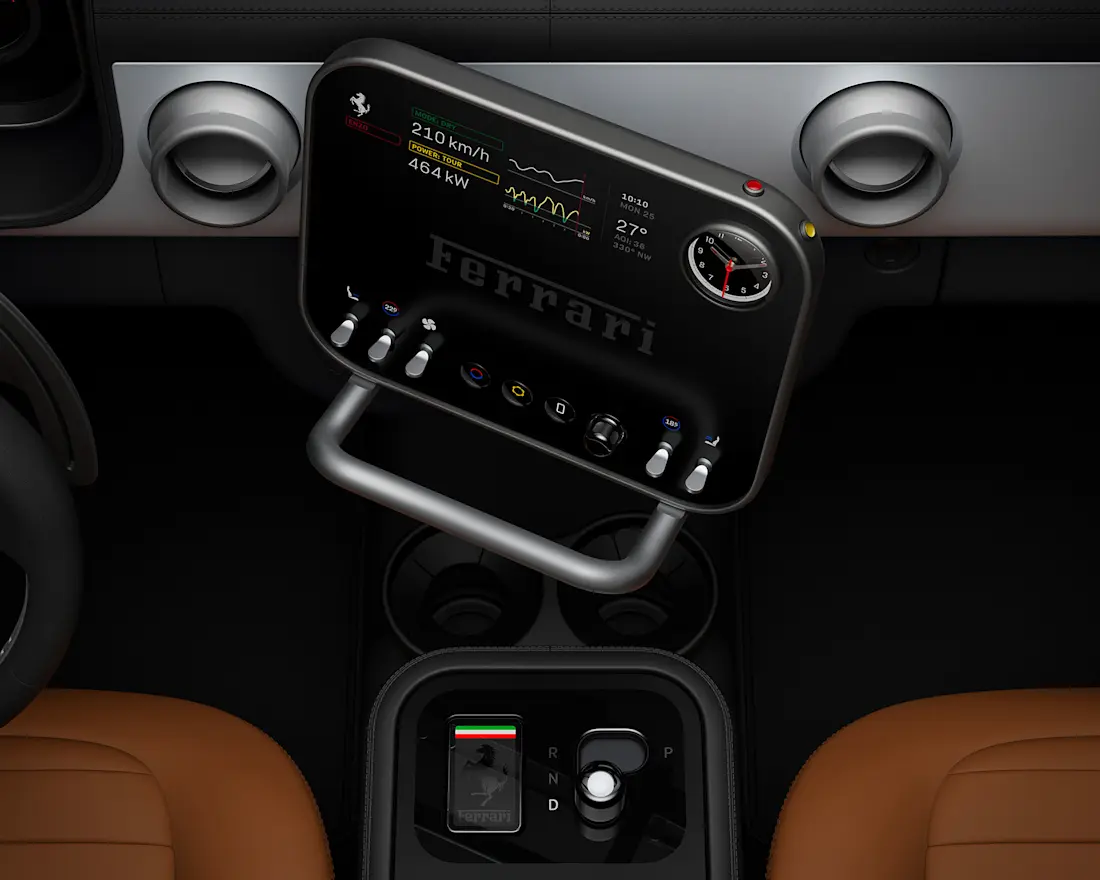
Many experts and safety regulators agree that new cars have too many screens, resulting in overly complicated and confusing controls that are more distracting for drivers. However, tactile controls give instant physical feedback and let you operate them without looking, thanks to muscle memory. They’re also more reliable in tough conditions, like winter driving, when gloves and mitts are almost mandatory for Canadians. Even though the Luce design team owns several classic cars, including a Bentley Continental S3, Bugatti Type 59, and Ferrari 250 GT Europa, their love for old-school toggle switches isn’t just nostalgia: they truly believe these controls work better. Unlike most EVs that rely on massive, cabin-wide touchscreens, the Luce’s interface is simple and focused on what really matters. Instead of replacing traditional controls with touchscreens, the designers chose tactile interaction, featuring switches and knobs for climate control and driving modes.
In contrast to modern cars with either one big or several screens, the Luce’s relatively small 10.12-inch central infotainment display performs multiple roles. Mounted on a ball-and-socket joint, it can pivot toward the driver or passenger so passengers can adjust comfort and entertainment settings. In the top-right corner of the central screen, a multigraph shows four features: a clock, a chronograph, a compass, and launch control info. It works through a unique mechanism with three motors and several gear sets. Also of note: a palm rest prevents the driver from accidentally touching the screen.
3. Minimal Lighting
Car interiors can definitely have too much lighting at night. While ambient lighting and lit dashboards are common today, too much bright or badly placed light can impede safety. Inspired by the automaker’s aviation roots and fighter jet cockpits, Saab’s Night Panel from the 1990s was an innovative dashboard feature that lessened driver distraction and eye strain at night by dimming or turning off all non-essential instruments, providing information only on a "need-to-know" basis. The Luce's design takes a similar approach.
The future Ferrari EV’s steering wheel-mounted controls for wipers, lights, and turn signals are "secret until lit." That means they stay hidden to keep a clean look and light up only when needed, simplifying the dashboard and supporting the design’s "hands-on-the-wheel" approach.
4. Simplified Steering Wheel
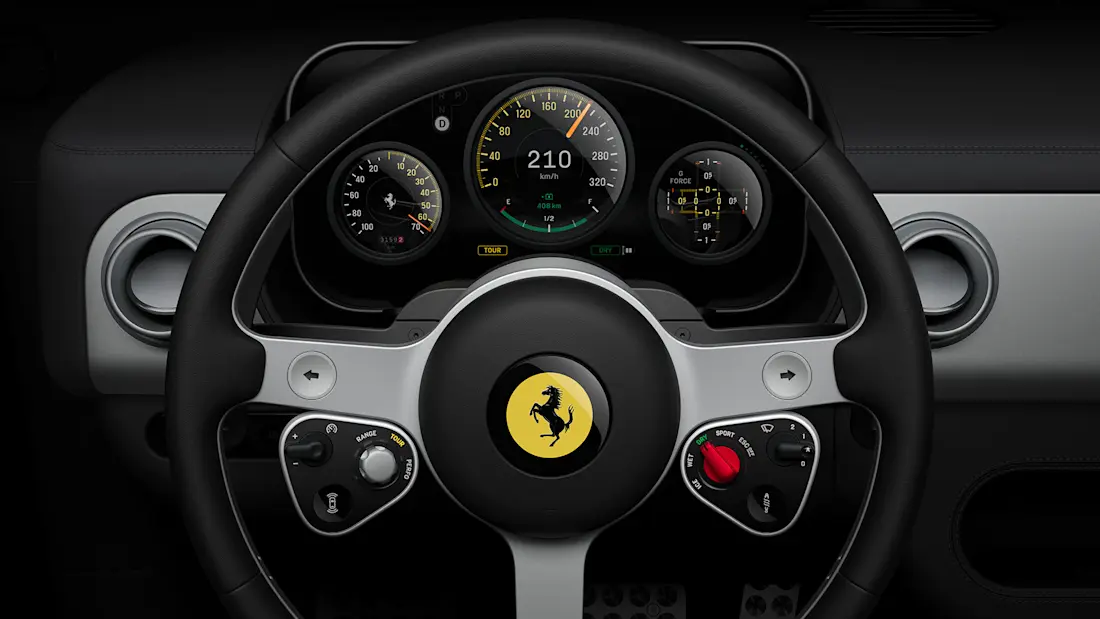
Complicated steering wheels, with lots of buttons, finicky haptic feedback, or unusual shapes like yokes, can be dangerous. They increase driver distraction, reduce handling capability in emergencies, and may interfere with safety systems like airbags.
To alleviate this modern problem, the Ferrari Luce’s design team chose a simple three-spoke shape, inspired by the iconic 1950s and ’60s wooden three-spoke Nardi wheel. Controls on the steering wheel are organized into two analogue control modules. Ferrari says every button was developed to deliver the best combination of mechanical and acoustic feedback, based on more than 20 evaluation tests conducted with the automaker’s test drivers.
We’ll have to wait until May 2026 for the exterior design of the new Ferrari Luce EV. In the meantime, we have to admit, it’s a bit ironic that Ferrari’s move back to an analogue interior was spearheaded by the lead designer of the first iPhone, which had minimal physical buttons and relied on a touchscreen. Still, the design was iconic and signified a groundbreaking shift in the industry, so the intent and engineering need to be respected. We can only hope that the Luce’s safer and more tactile interior design elements will trickle down to mainstream cars.

All Articles
See all
SEMA Show Offers Toyota Opportunity, Insight
The annual show acts as a crystal ball to see what could be around the corner.
 Dan Ilika

Here's What It Takes to Break a Speed Record in the Desert
BYD’s electric hypercar is now the fastest car in the world — again.
 Chris Tsui

BYD Confirms Flash Charging is Coming to Canada
Tech promises a 10 to 70 per cent charge in five minutes, even in winter.
Chris Tsui