
Marketing Vehicles: How to Disarm with Charm
 Steven Bochenek

Considering the ubiquity of advertising, there are surprisingly few ways to attract audience attention and deliver a sales message. One of my favourites is to disarm with charm.
Here’s how it works. If I make fun of my apparently big nose before you make fun of my big nose, you can’t make fun of my big nose. I’ve disarmed you. Moreover, when I take myself down and laugh at something we both know you’re already thinking about — my big nose — you’re more likely to like and trust me.
Disarm with Charm? It Takes a Brave Client to Laugh at Themselves
One of the earliest and greatest examples of this technique appeared in the early 1960s, during the Mad Men era. New York agency Doyle Dane Bernbach (DDB) introduced Volkswagen to America using the disarm-with-charm technique. The VW Beetle looked nothing like an American car, and DDB’s work championed the brand’s big nose with disarming wit.
Take the example of a driverless Beetle just lingering in white space beside a lonely one-word headline: Lemon.
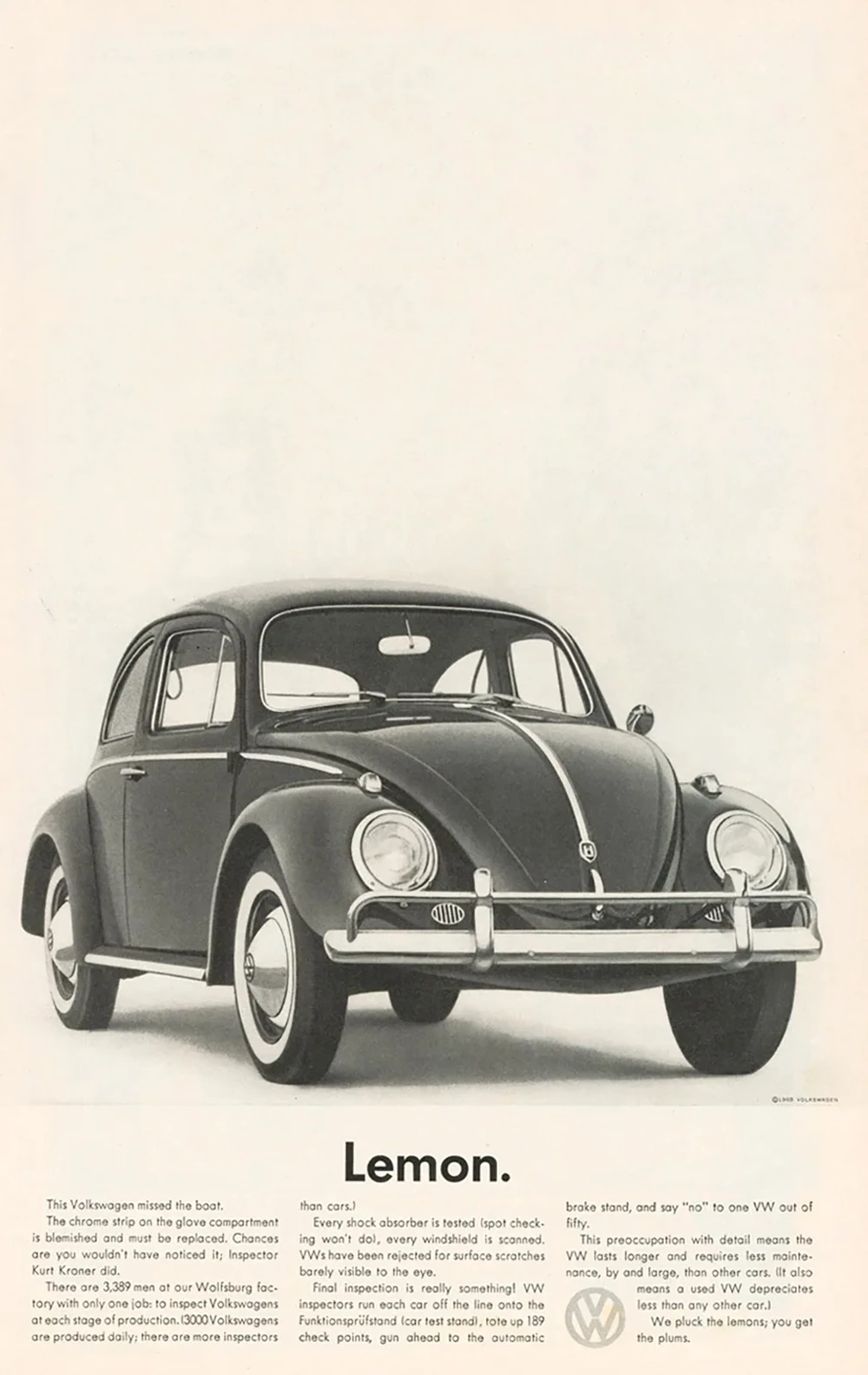
In the 1950s and ‘60s, lemon was the worst insult you could apply to a car.
It would be like declaring your product a pile of garbage. There was method to these madmen’s madness. With such a provocative opener back in the days when magazines and newspapers were the internet, you’d probably take an extra 20 seconds to read more.
By disarming you with the provocative headline, the ad goes on to reveal a larger truth. In this case, the Beetle shown was only a lemon by VW’s own exacting standards.
How? The factory had 3,339 inspectors inspecting just 3,000 cars produced daily. In the depicted lemon’s case, a chrome strip on the glove compartment was discovered to be blemished. Oh my! These guys take their production as seriously as they don’t take themselves. Nobody likes a braggart, but we love people with a sense of humour. Here, they make fun of their big nose and invite you to investigate why, thereby learning all about their fussy production methods. Genius.
Note too how DDB made the ad unignorable using negative space. That is, including fewer elements in the layout to call attention to the work by its simplicity and lack of colour. Amid the splashy magazines of the day, it stood out like, well, a big nose, which was a visual heresy at the time (and, sadly, since).
Many students and historians of advertising consider the DDB VW campaign the dawn of modern advertising.
That’s mostly because the campaign doesn’t treat you like an idiot. That the brand dares to prostrate itself over such a minute detail as a chrome strip quietly screams quality. But only a clever person like you would notice that and close the loop.
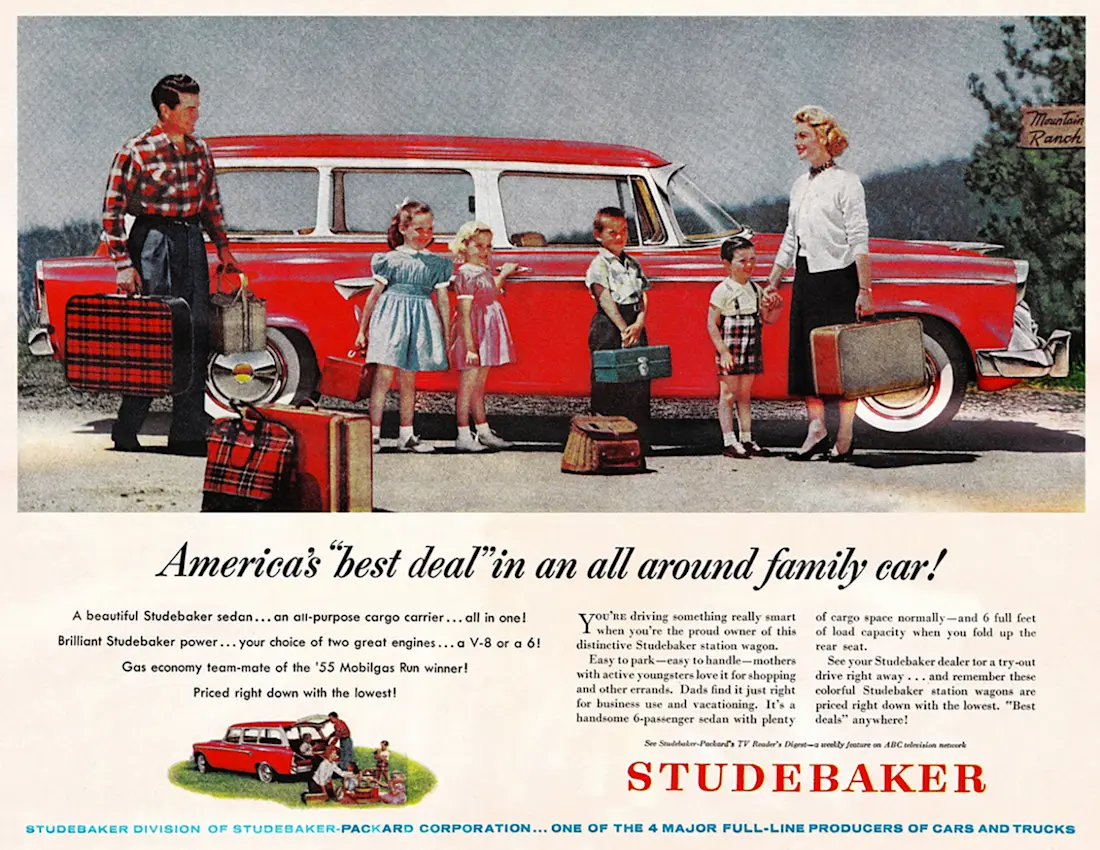
Even visually, the lemon ad had the temerity to laugh at itself. No illustration of a prosperous nuclear family welcoming the breadwinner home to their white-picketed property, piloting a heroically depicted Beetle in full colour.
Just a black-and-white photo of the car with loads of headroom. That’s the space above the “head” of the photo’s subject. It makes the subject look less than. Google the Snapple Lady from the 1990s TV campaign and you’ll see the exaggerated headroom floating above her while she reads fan mail from eccentric Snapple drinkers. It’s impossible to feel threatened by her. She’s speaking up to you.
The VW lemon ad’s layout signals that this object is not threatening. Exactly unlike the red lion dominating much of this Studebaker ad.
Do Such Subtle Techniques Really Work?
How many Studebakers did you see on your commute to the office this morning? How many Volkswagens?
Here’s another early 1960’s example of VW making fun of itself. Note the tiny Beetle almost lost in negative white space/headroom, anchored by the payoff headline “It makes your house look bigger.” How dare they? A kickoff for an argument in value, this ad is also a sharp kick in the shins to its much larger competitors, which make your house look small!
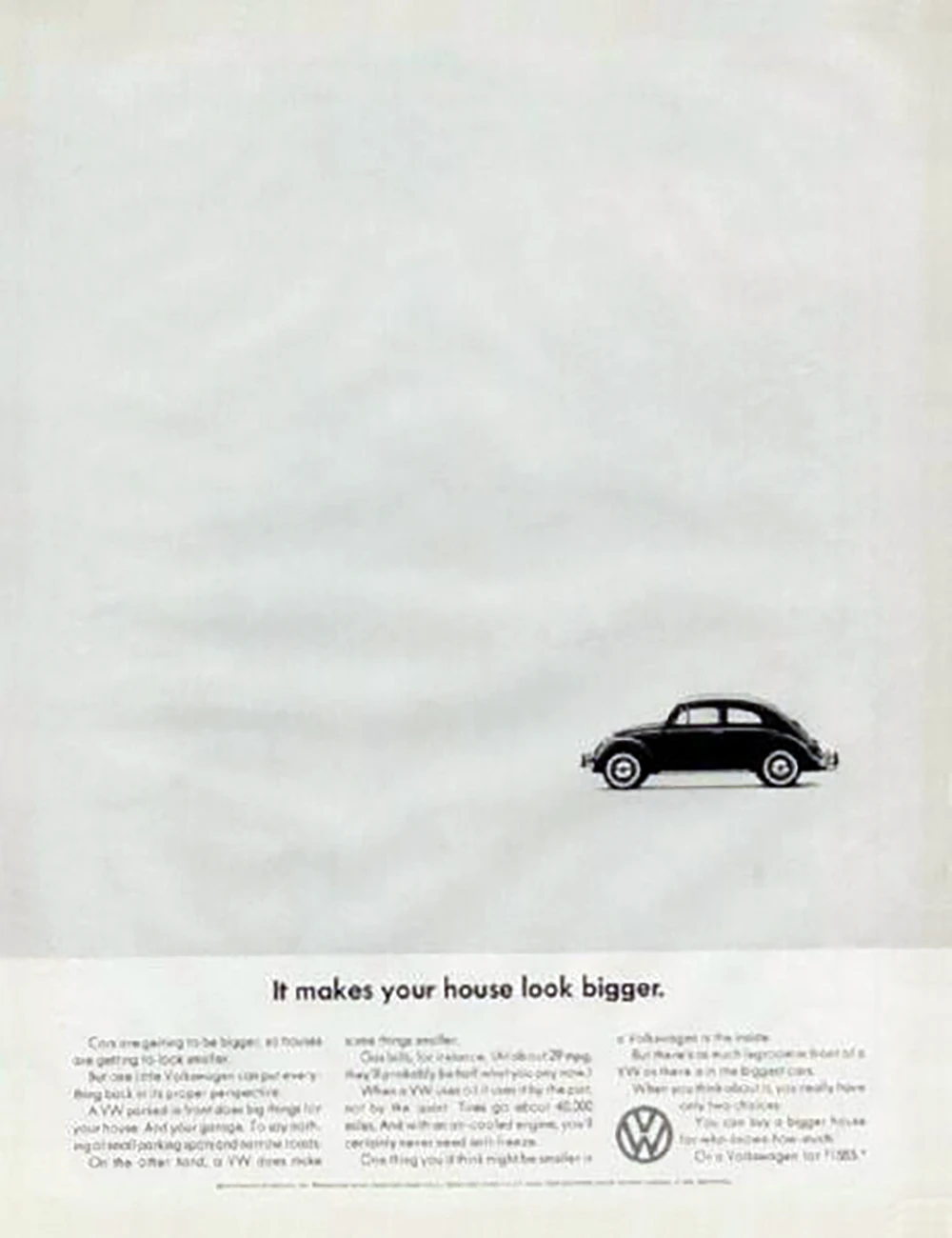
The headline is so un-American in so many ways. Perfectly timed for the rebellious Baby Boomers about to come of age. They didn’t want to drive what their parents drove, but also couldn’t afford a huge American car anyway.
Spending less on a car was suddenly a cool way to rebel against your parents. VW became the darling brand of the hippie movement. (Just search Westfalia van and surfing. The rest of us will wait here for you.)
VW Has Continued Using Self-Aware Humour to Sell Since
When VW reintroduced the Beetle to a nostalgic set of Boomers in the late 1990s, it employed such cheeky nostalgic headlines as “Goes from 0 to 40 as fast as you did;” “More power. Less flower;” and an especially cheeky hat-tip to ad weenies like yours truly, the headline “Lime” anchoring a green Beetle. That year, during the 1998 Toronto International Film Festival, it showed a new Beetle with plenty of headroom, declaring, “What it really wants to do is direct.” So insider TIFF. Hilarious.
But we digress. Let’s move back to the dawn of modern advertising and the disarming technique. As a child, I remember noticing a VW ad answering the age-old question, “How does the guy who drives the snowplow get to work?” By the mid-1970s, VW had an established brand and didn’t need to make fun of its big nose.
We’ll talk more about the process of branding and utility of brands in the next couple of articles. For now, let’s just talk about DDB’s revolutionary work. By the time I was discovering how the plowman got to work, DDB and VW had moved on from the disarm technique but still used charm.
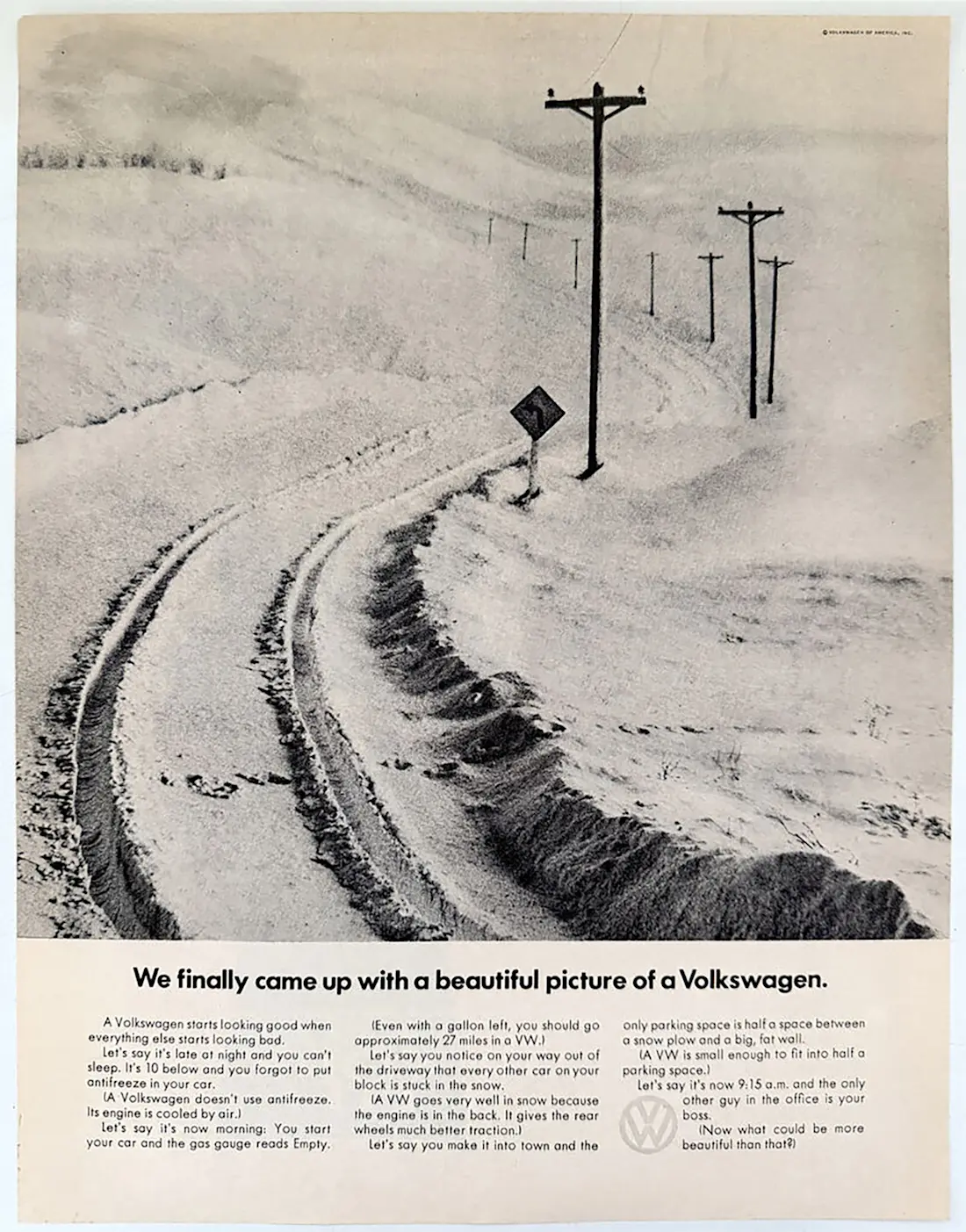
As an adult, I always wondered around when that transition happened. So imagine my delight last month when I stumbled across the 1960s DDB ad below, which cleverly bridges the above (and later) message of the snowplow driver while still making fun of the brand’s big nose.
And VW did this all without even showing the car. So daring and brave.
This ad below is thumbing said big nose at all those other cars that can’t navigate the roads in winter despite their girth. An engine in the rear adds weight to the thrust of its back wheels. I encourage you to read all the payoff copy which, prejudice by prejudice, counters any reasons for not buying a VW despite its appearance. Brilliant.
Welcome to the age of modern advertising. Sadly, most brands have yet to join us.

All Articles
See all
Own the Road with AutoTrader, Episode 118: The Backlash Against Touchscreens and Return to Buttons
Safer, easier to use, and better looking, buttons are making a comeback.

Planes, Trains and (Electric) Automobiles: A Race to Determine the Pros and Cons of Each
Discovering the best way from Toronto to Quebec City with the Subaru Uncharted.
 Jeff Wilson

AutoTrader Find of the Week: 2004 Porsche Cayenne Turbo is the Cure For Boring
For when practicality doesn’t interfere with fun.
 Chris D’Alessandro