
Marketing Cars: Back-to-School Time is a Great Time to Talk About Safe Driving
 Steven Bochenek

The very idea of losing a child is so terrifying that English lacks a word for it. Amid our vast mélange of Latin and Anglo-Saxon, the death of a child is demonstrably too awful to name. So, is it any wonder that governments and insurance bureaus lobby the public to promote safe driving? Summer is coming to an end, which means it’s back-to-school time, when many young Canadians are driving to university or college, and more kids are in the vulnerable position of walking to and from school. This is an ideal time to talk about safe driving.
New drivers, especially young men, are exponentially more likely to have collisions and die, bereaving their parents. Powers that be want to alert all of us, but especially them, that they’re not invincible. Let’s look at some Canadian advertising that does just that.
From Québec, While Viewers Freak Out, Victims of Silence Speak Out
This article focuses heavily on this killer campaign from a decade ago by Quebec agency LG2 for the Société de l'assurance automobile du Québec (SAAQ).
To target a younger audience, they made a series of short videos to play in nightclub bathrooms. Approaching a mirror, would-be handwashers see ghostly videos, which they have little choice but to watch.
A speaking actor, life-size but ethereal grey in the mirror, is made up to look like a ghost. Face-to-viewer, they speak about their final seconds, lost to some texting, speeding, or drunken bonehead. It’s in French, but you don’t need to understand many of the words to fill in the blanks.
It’s creepy to watch. Imagine seeing it at some nightclub around Halloween at the Montreal-friendly time of 3 a.m. From the campaign Victimes du Silence, watch Des fantômes pour sensibiliser, which loosely translates to ghosts raising awareness, below:
From the Same Campaign, Another Victim of Silence Ad Wordlessly Speaks Volumes
A fact of production: As soon as unionized actors speak on camera, their pay increases significantly. In Quebec, the cost doubles when they have to speak in both English and French. Can they get around that problem?
A rule of advertising: Show, don’t tell. Nobody will take the time to understand your sales message, even if it could save a life. Ever heard of the KISS principle? Keep It Simple, Stupid. If you can tell a powerful story with a voiceover or pictures alone without being boring, your message is more likely to connect.
Counterintuitively perhaps, small budgets and tight regulations can inspire good creative thinkers. Look what else the campaign produced without uttering a single word in French or English. By simply switching the super at the end (a few seconds’ work), they doubled their target market. Bravo. Watch the ad below:
Who’s the Dummy? A Clever Experiment for Our Feeds
“In Quebec, roughly one third of people who die in passenger-vehicle crashes were not wearing their seatbelt,” the agency’s press release reported.
Some young people (mostly men, no surprise) can’t be bothered buckling up if they’re taking a short trip. Indeed, if they think at all, it’s something like, “How much harm can a collision under 50 km do?”
Turns out, plenty.
LG2 brought two concerned parents and their son Christian to a government crash-testing facility to witness a sobering experiment. They spent a few minutes getting to know a crash test dummy modelled to look disturbingly like Christian before it was put to work, unbelted. Ten seconds and 47 km/h later, whammo! Crash Test Christian was unseated.
You just know that “Crash Test Christian died for real Christian’s sins” was one of the rejected headlines for the press release. Such interesting online stunts have become clients’ favourite form of advertising since the arrival of social media. Today, we’re all publishers and broadcasters, saving advertisers billions in media charges when we like or forward any sales message. Now, let’s take a break from videos and look at some print.
Don’t Weaponize Your Makeup: A Campaign from an Ontario Agency
Marketers love mnemonic devices like acronyms. Introducing SATT, standing for same ad three times. If you can find three similar yet different ways of expressing the same idea, like the haunted toilet people above, you have a campaign.
Humans like puzzles and riddles, which is why mixing visual metaphors is a great way to get attention. Before you can consciously ignore a sales message, an anomaly hooks your eye. You need to solve the puzzle.
For example, here’s a fully extended lipstick shaped like a bullet, triggering your curiosity. If it were a riddle, it’d say, what do you get when you mix lipstick and a bullet? Intrigued, you explore more.
"Applying makeup while driving can be deadly," the visual’s payoff reports, solving the puzzle, satisfying your curiosity, and hopefully affecting your behaviour next time you’re behind the wheel.
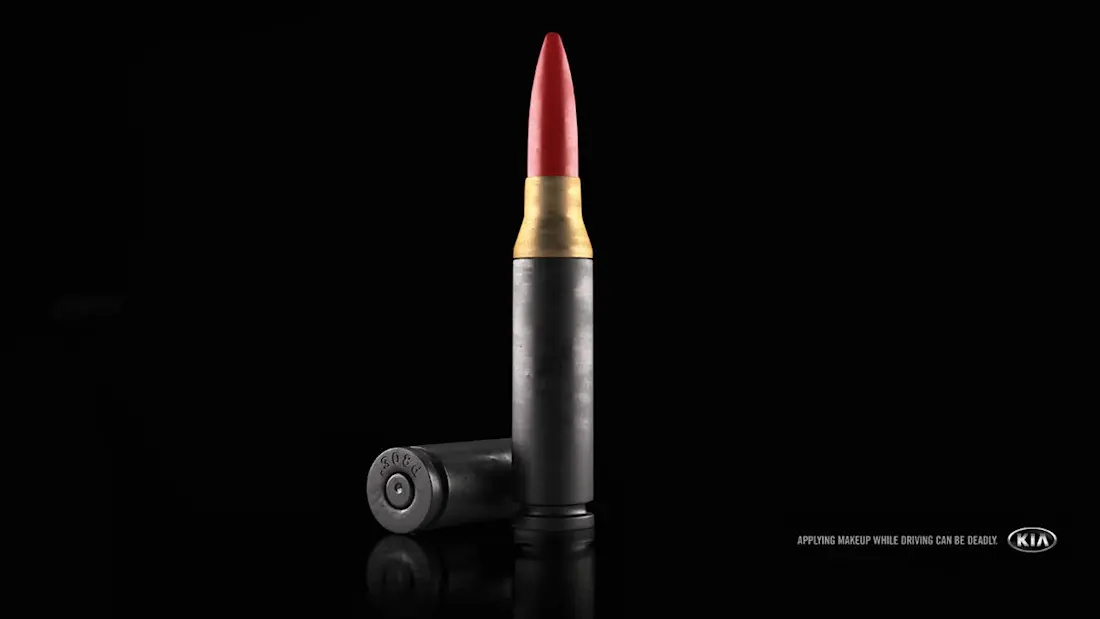
It’s part of a SATT campaign. In other examples, mascara is disguised to look like dynamite, and a blush compact mimics a landmine.
Don’t Tailgate; a Classic Driving Safety Message from British Columbia
According to Business Insider, studies show that 80 per cent of American men think they’re better-than-average drivers. That’s a statistical impossibility. The late comedian George Carlin personalized this stat, neatly observing how everyone slower than you in traffic is “an a**hole” and everyone going faster “is a maniac.”
Keeping that in mind, you know those maniacs invading your rear bumper in traffic because you’re only doing 10 km/h over the speed limit when they’d prefer 20 or 50? Rather than slowing to provoke them, just move over. And rather than cursing and waving your middle finger, think of this demonstration ad from Vancouver agency ReThink and smile.
Forgive the quality of reproduction; it’s from the ‘90s and the only copy I could find on the internet. The Insurance Corporation of British Columbia shows how annoying you are when you tailgate.
And Lest We Forget the Rest of the Provinces and Territories
The following message from the Canadian Automobile Association (CAA) has learned the lessons we’ve explored in this article: show, don’t tell; and don’t speak on camera if you’re delivering in multiple languages with a limited budget. Bravo, CAA. If only we’d all learn the lessons they’re advocating, especially our youngest, most vincible drivers.
All Articles
See all
Own the Road with AutoTrader, Episode 118: The Backlash Against Touchscreens and Return to Buttons
Safer, easier to use, and better looking, buttons are making a comeback.

Planes, Trains and (Electric) Automobiles: A Race to Determine the Pros and Cons of Each
Discovering the best way from Toronto to Quebec City with the Subaru Uncharted.
 Jeff Wilson

AutoTrader Find of the Week: 2004 Porsche Cayenne Turbo is the Cure For Boring
For when practicality doesn’t interfere with fun.
 Chris D’Alessandro