
Can Drifting a Polestar on Ice Help You Become a Better Driver in Winter?
 Michael Karant

Polestar Ice Experience Gallery


As Volvo’s luxurious, sporty sister company, performance is key to Polestar’s brand. Polestar started as Volvo’s performance division but has since branched off into its own company to focus on sporty electric vehicles (EVs). Its ambitions are the most obvious in the brand’s latest addition to its Canadian lineup, the Polestar 4.
The Polestar 4 certainly has the performance credentials, as the dual-motor, long-range model delivers an impressive 544 hp and 506 lb-ft of torque. Power is split 50/50 between the front and rear, and its design has concept-car sleekness.
Despite these credentials, it's unlikely a Polestar 4 will be someone’s track-day toy, but for someone who wants an athletic daily driver for all seasons, it checks all the boxes. This means the car has to be good in the snow, and as Sweden is one of the few European countries with weather comparable to Canada's, an ice track was the setting of choice for testing the Polestar 4’s winter capabilities.
As someone who drives a rear-wheel car year-round, I am no stranger to losing some traction on the rear end of my car. As a result, I approach winter driving either very carefully or by avoiding it altogether.
There are times, however, when abstaining from driving in snow is simply not an option. If that’s the case, the best approach to driving in winter weather is with confidence, which comes from knowing how a car behaves under certain conditions. There is no better way to gain insight into car control than driving it quickly on a closed course, especially on a surface with very little grip, where decisions must be made every few milliseconds.
Is Driving on Ice Different from Driving on Snow?
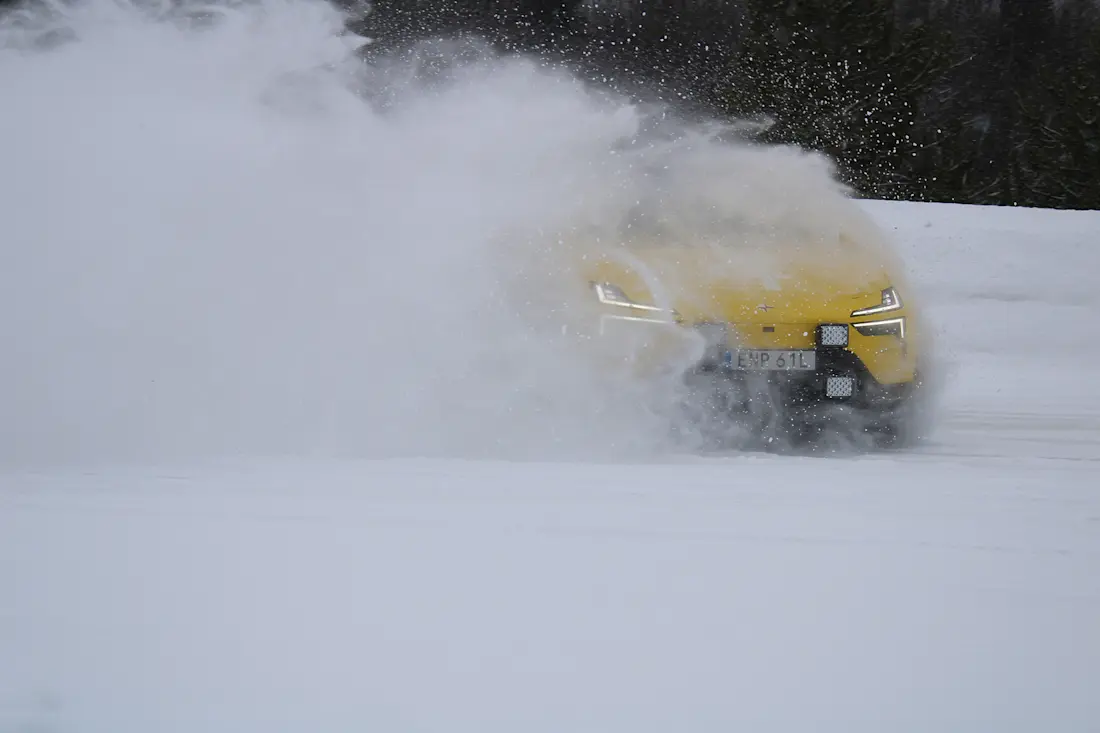
Even though driving on ice and snow is slightly different, there are more similarities when driving on the two surfaces than there are on tarmac. The biggest similarity is the lack of traction. Anyone who has driven on snow is familiar with wheelspin, which occurs when the tires lose traction with the road surface.
The purpose of the Polestar ice drive at Circuit Mécaglisse, located north of Montreal, Que., was to teach us how to drift on ice with an all-wheel-drive (AWD) vehicle, meaning the goal was not to counteract wheelspin but to use it to our advantage when navigating the frozen circuit. From the outside, drifting looks seemingly easy, but there are multiple points throughout the slide when you can lose control, whether it be the entry to the corner, midway through it, or on the exit.
The car can switch from understeering to oversteering at a moment's notice, which is what makes understanding what to do key to successfully counteracting these effects.
How to Stop
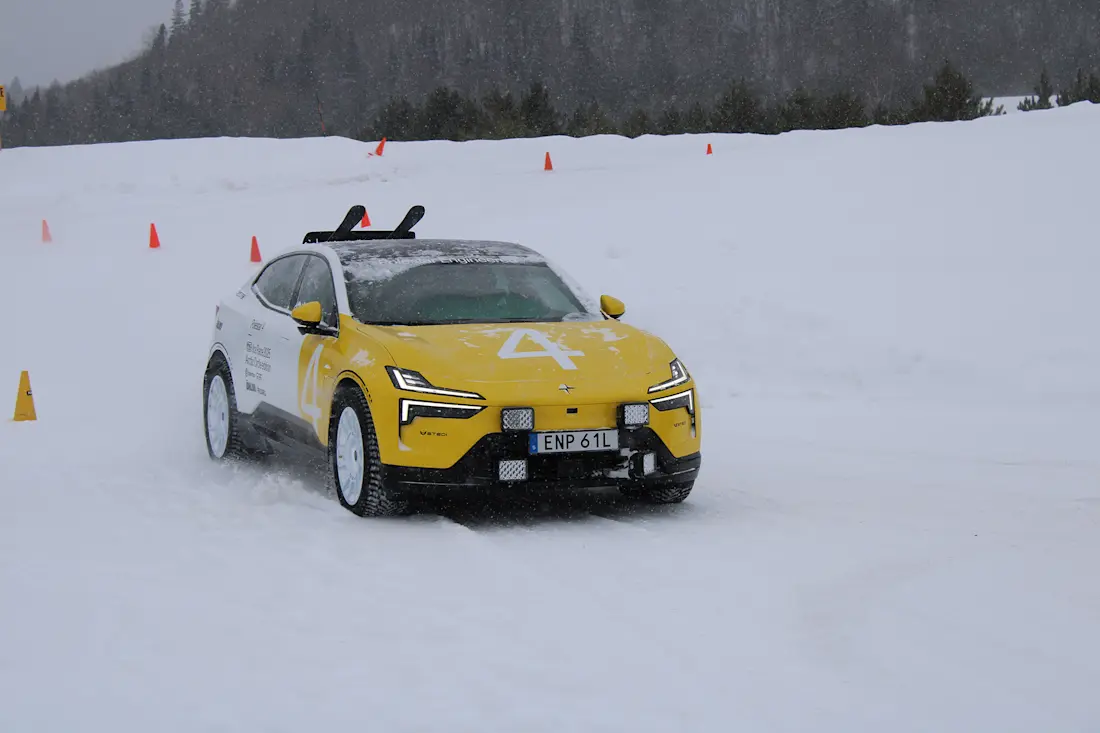
One of the greatest difficulties faced when driving on ice and snow is braking. When you press your foot hard on the brake pedal in the middle of a snowstorm, you quickly lose traction and the car slides forward as the wheels lock up. You essentially lose all control at this point. Then how are you supposed to slow down and control the car on such an unforgiving surface? The answer is steering and throttle, which sounds counterintuitive. Throughout this experience, we used the brake pedal very rarely, thanks to the Polestar 4’s one-pedal driving and regenerative braking. When slowing down, lifting your foot from the throttle and letting the car decelerate gives you the greatest control.
If braking is required, the key is to start braking far earlier than needed, and very gently. On ice, this is especially important. Even though the cars here were equipped with studded tires, braking hard meant sliding in whichever direction the car was travelling.
The Scandinavian Flick
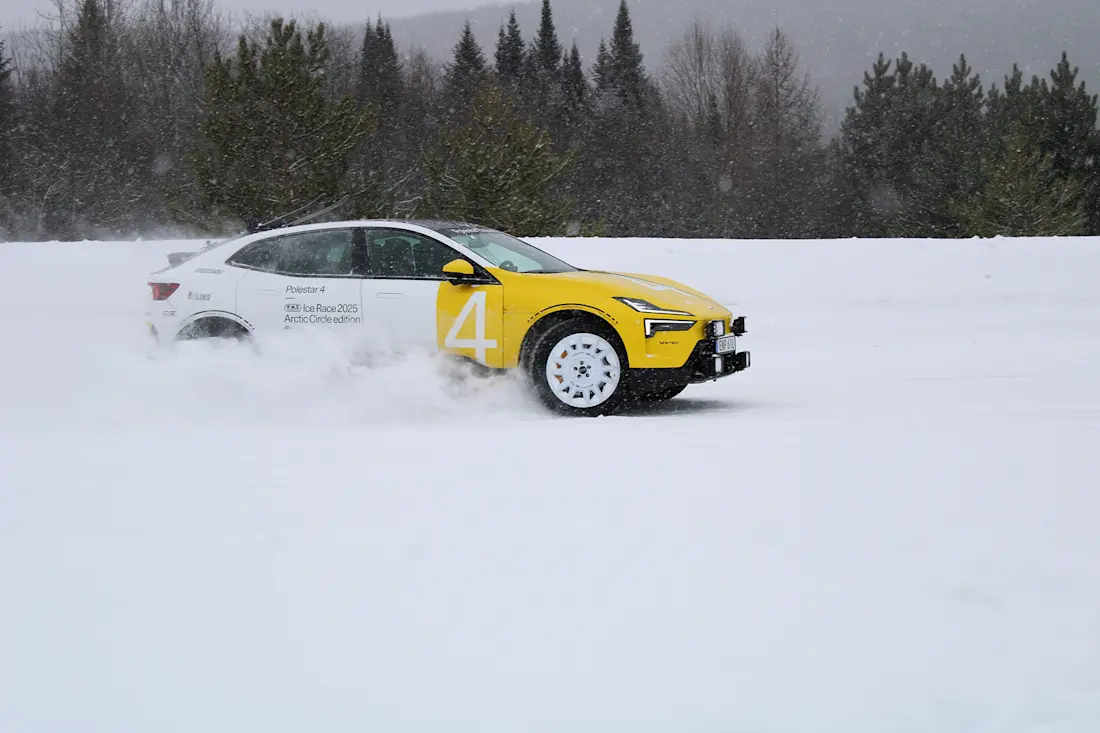
To take a tight corner with speed, we learned how to perform a “Scandinavian Flick,” a rally driving technique that involves sharply swinging the rear of the car into a drift, and holding said drift in through the corner.
The most counterintuitive part of this technique is that to maintain a controlled slide, you have to keep the power on, even if the car feels like if it's out of control. Keeping on the throttle keeps the car sliding to the outside of the corner, and in the scary situation of being too close to a wall, it's important not to release your foot off the throttle, as the car will stop sliding and head directly into the wall you are so scared of.
On a snowy public road, however, the goal is to control the car rather than hold a drift. If your car loses traction on the road, countersteering and releasing the throttle is often all that needs to be done to regain control and get the car back in line.
Donut Break

A different section of the event involved drifting a Polestar 4 around an ice rink. While driving around a simple circle may appear easy, you quickly learn how much steering and throttle the car requires to maintain momentum.
Feathering the throttle is important, as applying constant power makes the car keep going wider and wider around the circle. The way to maintain a consistent line is by easing off the throttle when the car runs wide and reapplying it when it is too close to the centre for the vehicle to slide out again.
Constant steering is also necessary, as it isn’t as simple as turning in one direction and holding it. The direction of travel constantly has to be adjusted from left to right as the car will run wide and then close to the centre.
In snowy conditions, feathering the throttle is essential, especially if you drive a more powerful or two-wheel-drive vehicle that can spin its wheels easily. Being steady with the throttle is essential to counteract wheelspin.
How the Car Helped
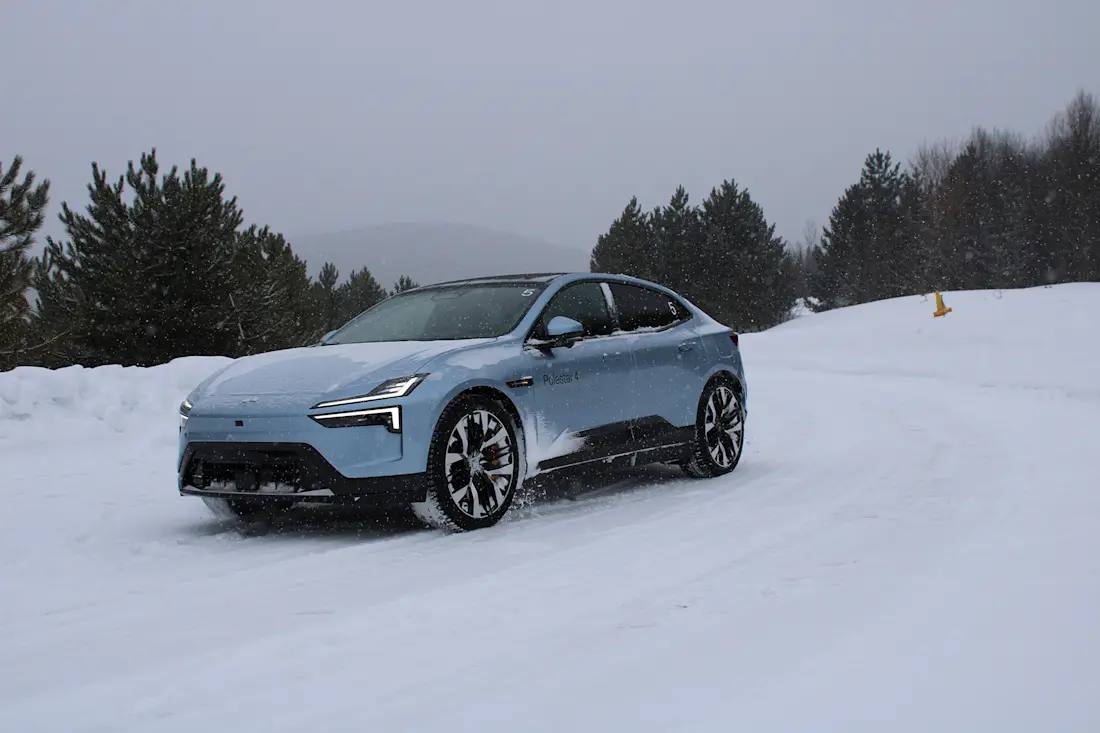
Naturally, drifting around the ice track wouldn’t have been as successful or fun if it weren’t for the car itself.
The Polestar 4 handled very predictably; it was easy to grasp how the car would behave in a fast corner, and the crossover remained very planted, especially with the traction control activated. As with most EVs, the power delivery was very smooth and readily available when needed, which certainly came in handy when trying to slide the car.
However, even in sport mode, with the traction control deactivated, the car isn’t going let you go over the edge. The traction was “off” only to the point where the car could be tossed into a sharp corner without crashing.
The vehicle’s weight was undeniably noticeable. At 2,355 kg, the Polestar 4 certainly isn’t light, which is most noticeable when sliding and the car’s weight is transferred to the outside of the corner. Despite this, the vehicle remained planted, thanks to the battery positioning the centre of gravity low in the vehicle.
One of the more impressive features of the Polestar 4 was its rear-view camera display where the rear-view mirror would typically be, a necessity since it has no rear window. Throughout the event, while every part of the car was covered by snow, the rear-view camera, placed in a small pod above the rear hatch, allowed for totally clear rearward visibility. The Polestar 4’s full performance potential could be really seen with the Polestar 4 Arctic Circle Special, a rally-ready version of the four-door. Although most of the changes are cosmetic, it also has a set of rally tires and a massive rally handbrake.
At the hands of a professional Formula Drift driver, the Polestar 4 was truly impressive, drifting around the icy course at speeds upwards of 80 km/h. Having witnessed this spectacle from the passenger seat — and having attempted it myself — I have full confidence that weathering a snowstorm in this EV is as simple as a walk in the park.

All Articles
See all
Own the Road with AutoTrader, Episode 118: The Backlash Against Touchscreens and Return to Buttons
Safer, easier to use, and better looking, buttons are making a comeback.

Planes, Trains and (Electric) Automobiles: A Race to Determine the Pros and Cons of Each
Discovering the best way from Toronto to Quebec City with the Subaru Uncharted.
 Jeff Wilson

AutoTrader Find of the Week: 2004 Porsche Cayenne Turbo is the Cure For Boring
For when practicality doesn’t interfere with fun.
 Chris D’Alessandro