
Truck Features to Look for if You’re Towing
 Benjamin Hunting


Modern half-ton pickups are increasingly stuffed with towing-specific features intended to match some of the task-focused equipment and software loaded into their heavy-duty siblings. Not all of this equipment is as helpful as it’s made out to be, but a large chunk of it does help improve trailer safety, while also offering a convenience boost that would have been unthinkable a mere decade ago.
Here’s a rundown on the towing gear I’ve found the most useful in today’s trucks — and which options I could do without.
Helping to Hitch Up
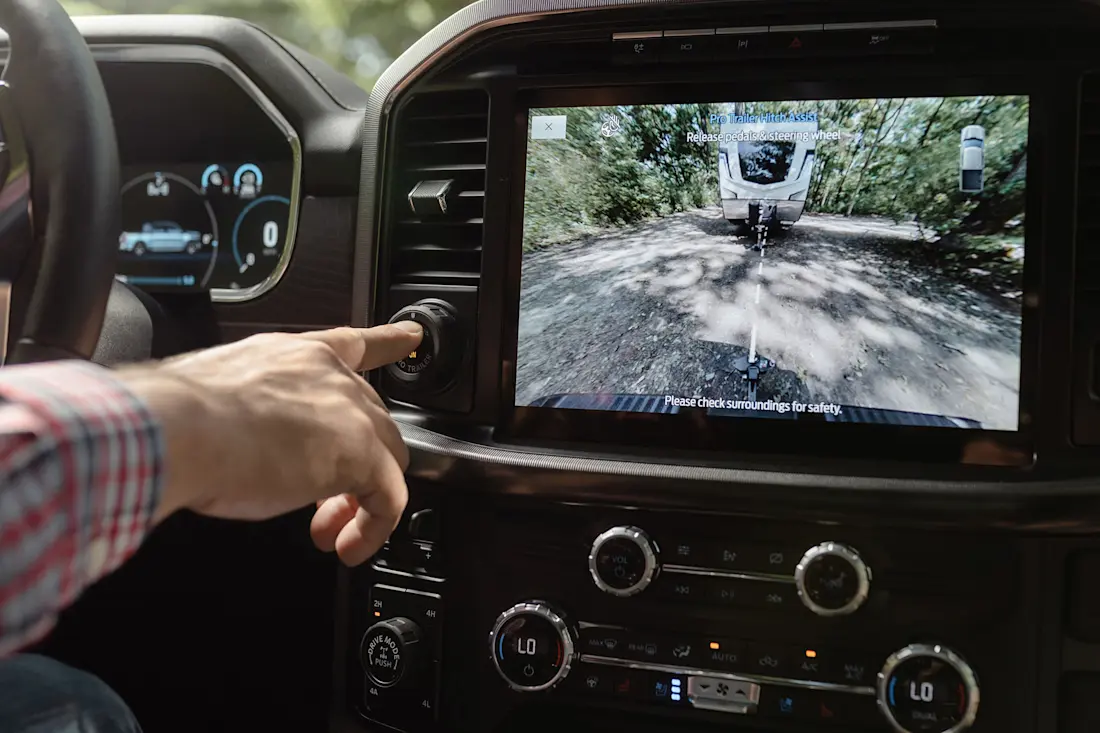
At a bare minimum, almost every truck out there comes with a feature that will help you line up your truck’s hitch ball with a trailer hitch. In fact, it’s so ubiquitous that you’ll often find this technology on models that don’t have any other towing upgrades installed. By overlaying the arc of travel of the ball on top of a video image provided by a pickup’s reverse camera, it’s much easier to back up right under the hitch.
What I like most about this feature is that you can safely and securely connect your tow rig when you don’t have someone around to help guide the hitch into the right spot. The only downside is that it tends not to work as well at night, when reverse cameras often have trouble producing the kind of clear, detailed image required for precision driving.
Another helpful feature that’s available from Ford on some versions of the F-150 measures trailer tongue weight once it’s connected. This is useful for balancing the position of a load, as you can move it closer to the rear of a trailer if the tongue weight exceeds factory specs.
Manoeuvring in Tight Spaces
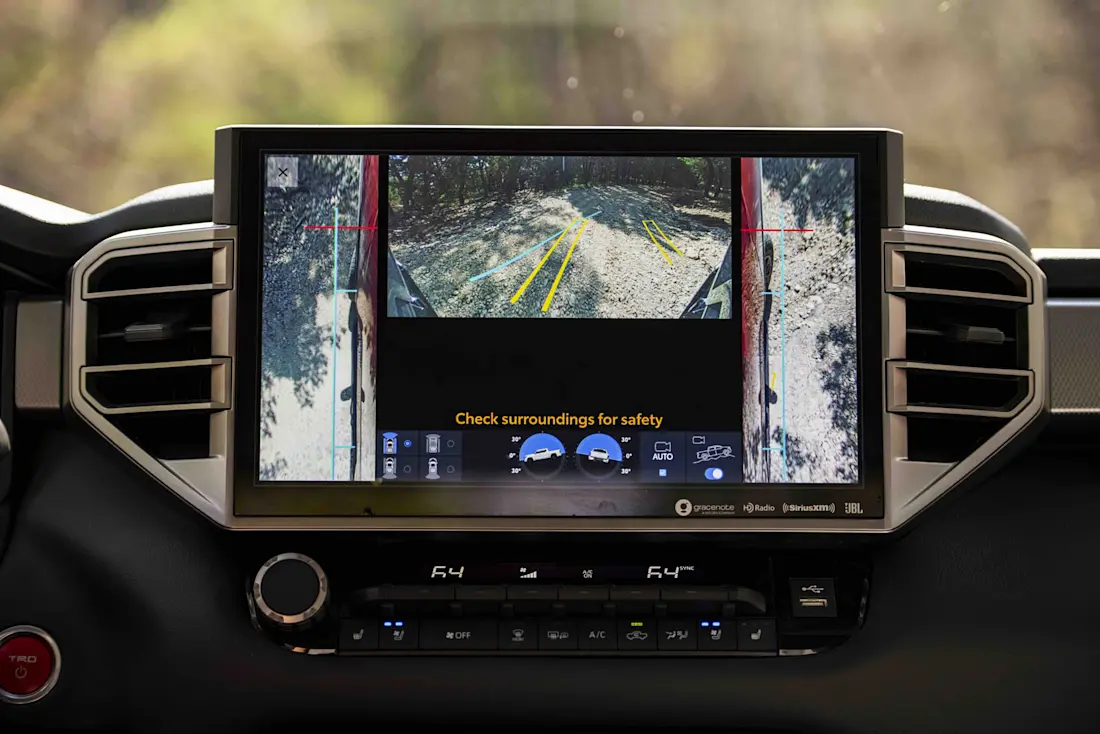
Modern vehicles feature a flotilla of sensors used by the long list of advanced safety systems that are included as standard equipment. On light-duty trucks, these sonar sensors, radar sensors, and cameras are often repurposed to make it easier to keep track of your trailer’s position, especially when squeezing through tight spaces.
The most basic versions offer manual control over various camera angles that show the area along either side of the truck/trailer combo or the truck bed (letting you see the trailer’s tongue angle). I appreciate these extra points of view when forced to navigate a packed parking lot, or turn a tight corner at low speed.
More advanced systems can link to parking sensors that automatically show the relevant views when they detect the truck or trailer getting close to an obstacle, or can even combine to show a top-down view of the truck and trailer that also illustrates the angle at which it’s turning. The latter can include arrow overlays, which I find particularly helpful at night when I might not be able to pick up the edges of my trailer in my mirrors.
There are also several manufacturers that provide some type of trailer steering feature that takes over the steering wheel inputs for you when backing up. These range from knobs or dials that you turn on the dash to direct the trailer’s direction, to hands-free software that will keep a trailer pointing straight as you reverse.
My experience with these systems has been hit or miss. Some of them require extensive calibration before they can be used, and not all trailers are properly detected during this process, which can be frustrating. You also need significant room in which to perform the manoeuvres needed to calibrate, which involves driving the truck and trailer forwards and backwards and executing sharp turns. It’s often impossible to get this done without access to a huge, empty parking lot, which you might not have handy when hitching up.
I did have a positive experience with the Toyota Tundra that I recently towed with, however, whose reverse assist calibration was quicker and more problem-free than any other truck I’ve driven in recent memory.
While it didn’t offer any specific steering assistance while reversing other than showing you the angle of the trailer itself, it did feature an automated straight-backup system that automatically kept the load pointing true while I was responsible for the gas and the brake. It was a big help when I got caught on a construction site with a single point of exit that happened to sit between two gigantic mounts of dirt with very little wiggle room.
Smoothing Out the Drive
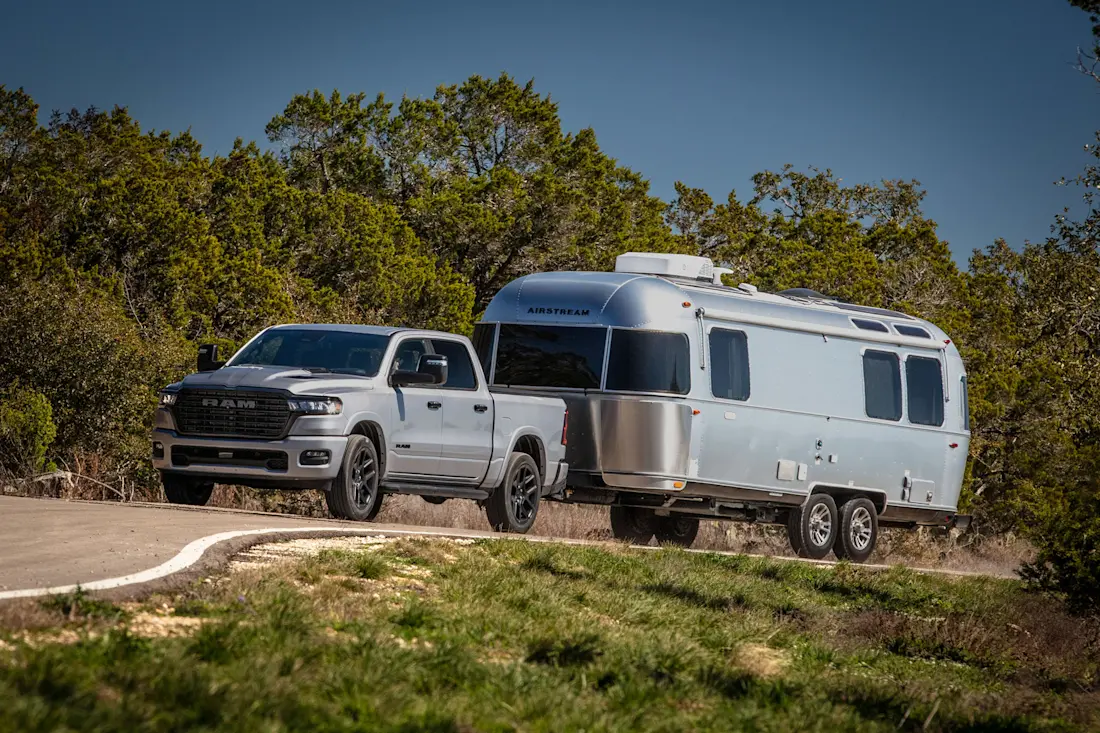
There are a few different ways truck brands are applying tech to make towing safer and smoother once you’re underway.
Some manufacturers offer an optional air suspension that can be used to level out the rear of a pickup after a trailer has been attached. It might be a four-corners system (like that found on some Ram models), or a rear-axle-only option (as with the Tundra), but the end goal is the same: raising the back of the vehicle to avoid squat.
I’m a fan of this type of air setup, and have something similar installed on my own tow rig. Some versions of these systems can even lower the truck’s ride height to make it easier to attach a low trailer. You’ll have to keep in mind, however, that suspension squat sometimes indicates that there’s too much tongue weight being transmitted by the load, and if that’s the case, you run the risk of burning out the air compressor and having the system fail after a few hundred kilometres of use.
I mentioned earlier how safety systems are tagged in to help improve trailer visibility. That same concept applies to trucks whose blind spot monitoring sensors can detect the length of the trailer and then extend their coverage along both the truck and the load. Some systems even incorporate a video element that will show a shaded area of the lane where the truck thinks the trailer could be at risk of a collision. I find this feature to be very helpful out on the highway, especially when passing at night, where again, it’s often difficult to see the full length of a trailer in a mirror (especially on half-ton trucks that don’t have extendable towing mirrors).
Perhaps the ultimate mental load reducer when it comes to towing is General Motors’ Super Cruise feature. While many trucks allow standard adaptive cruise control to function with a trailer attached, Super Cruise offers hands-free driving even while fully loaded. I’ve had some impressive experiences with this feature, having pulled trailers for more than a thousand kilometres with my hands in my lap. Yes, you still have to pay attention at all times, but having the truck handle lane changes for you on a very long trip definitely mitigates fatigue.

Keeping Track of Your Trailer
Not every useful piece of half-ton towing tech comes into play while you’re out on the road. There are a number of features available on light-duty trucks that are designed to make it easier to stay on top of trailer safety, while also keeping track of multiple connections you might make over the course of your ownership.
The majority of trucks now offer some type of tool to identify and catalogue different trailers as they are connected to the vehicle. More advanced systems allow you to select the weight capacity, braking type, and number of axles for these rigs and then assign them a specific profile that can be saved and reused.
Personally, I’m not sure how many light-duty truck owners are regularly towing multiple trailer types. It feels like a feature that’s more useful for fleet owners or commercial customers, but if you have a small utility trailer as well as a car or toy hauler, then you’ll appreciate the truck adjusting itself to the right parameters without you having to enter them in each time.
More universal are trailer apps that let you test your rig’s lighting, monitor tire pressures (using sensors inside the trailer’s wheels), and display checklists to go through prior to shifting into drive. No matter how many times you’ve hitched up, there’s always a chance that you’ve overlooked a small, but important detail during the connection process, and those checklists and light tests are something everyone can use each time they tow.
My one caveat with these trailer management tools is that each automaker implements them differently. Some make use of a truck’s infotainment screen as the primary interface, while others offer a phone app that can handle the same data. My least favourite trailer management style is when you’re forced to do everything through the pickup’s gauge cluster using steering wheel controls. This kind of cramped software setup is found on trucks from Toyota, which makes using an otherwise strong system more of a hassle than it is with rival brands.

All Articles
See all
Nissan Z MPG and Fuel Economy: Ratings and Running Costs
You found a Nissan Z on AutoTrader and the payment worked. The next question is what it'll cost at the pump, and whether the manual makes it worse.

Tips on EV Ownership and Driving in Canadian Winters
Beat the freezing temperatures, maximize your range, and drive with confidence.
 John LeBlanc

Hyundai Elantra Hybrid Reliability: Recalls, Warranty and Maintenance
Let's say you've found a three-year-old Elantra Hybrid on AutoTrader with sensible kilometres and a fair price.