
2026 Toyota RAV4 PHEV Review
 Jil McIntosh


Trader scores
This score is awarded by our team of expert reviewers after extensive testing of the car.
The 2026 Toyota RAV4 Plug-In Hybrid (PHEV) has been overhauled, with a new gas-electric system that provides more power and range.
The gas-only RAV4 has been discontinued, and the lineup now consists of a conventional hybrid version and the PHEV tested here, which can drive on electricity alone when charged, and then work like a regular hybrid once the battery is depleted.
The PHEV starts in SE trim at $50,680, including a non-negotiable delivery fee of $1,930. The XSE tested here is priced at $58,330, while its optional Technology package and two-tone paint added for a total of $61,835. The lineup tops out with the performance-tuned GR Sport at $60,335.
Design: 8.5/10
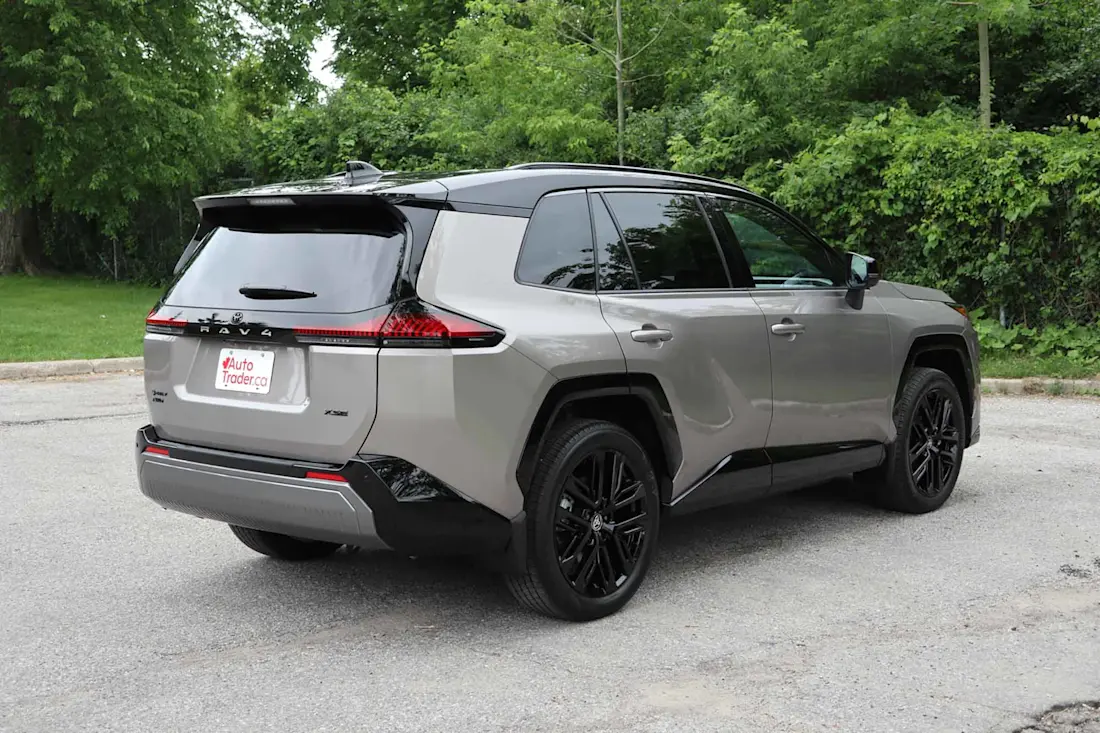
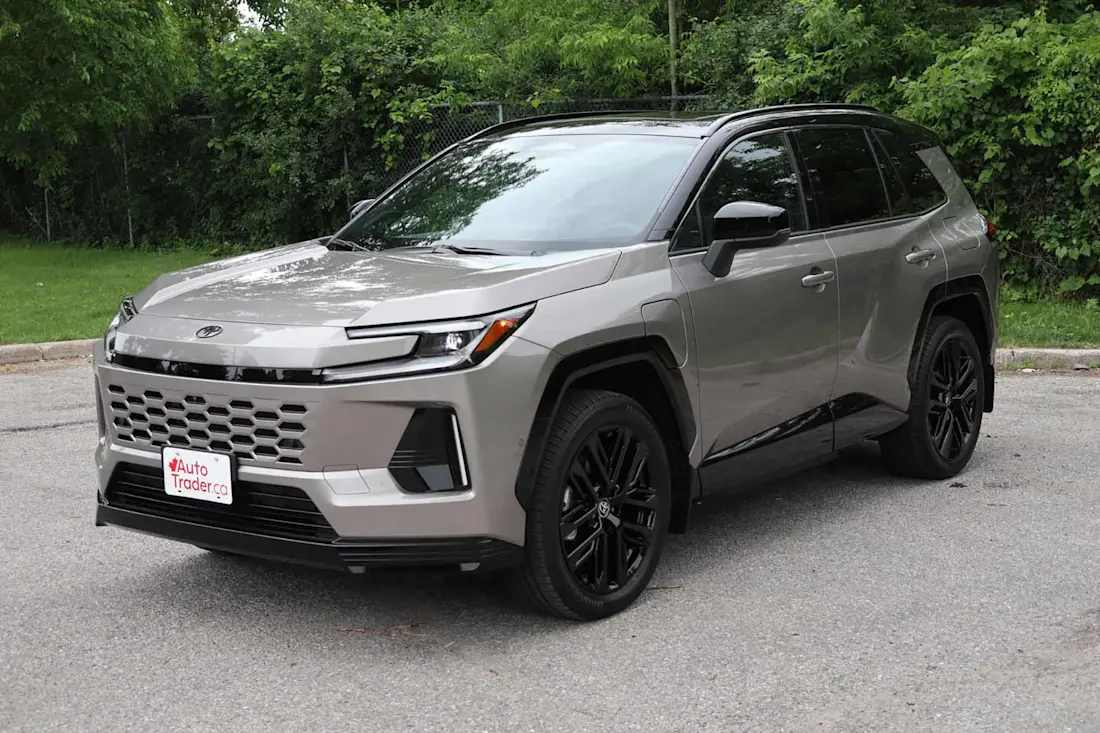
The RAV4 PHEV gets a bit more angular for 2026, with a new grille, body-side lines, and front and rear lighting. There’s major change in the cabin, with dash styling that borrows its overall design from the Tacoma pickup. Everything is big and chunky, including the rectangular drive mode buttons that poke out above the console. There doesn’t seem to be middle ground, as people I asked either really liked it or really didn’t. (For the record, I did.)
Safety: 8/10
Neither the United States National Highway Traffic Safety Administration (NHTSA) nor the non-profit Insurance Institute for Highway Safety (IIHS) had crash-tested the new RAV4 as of this writing.
Standard driver-assist features include emergency front braking, adaptive cruise control, lane departure warning, automatic high-beam control, lane-tracing assist, blind-spot monitoring with rear cross-traffic alert, front and rear parking assist with braking, and the back-up camera that’s mandatory on all new vehicles.
The XSE and GR Sport trims add a driver monitoring camera inside and a panoramic camera out back. The mid-level XSE can be optioned with a Technology package for $2,950, as was the case here. Along with convenience items such as a panoramic sunroof, hands-free tailgate, and and DC fast-charging capability, it includes front cross-traffic alert, a head-up display, advanced self-parking, and a camera-based rearview mirror — but, oddly, it can’t be added to the top GR Sport trim.
Equipment: 8/10
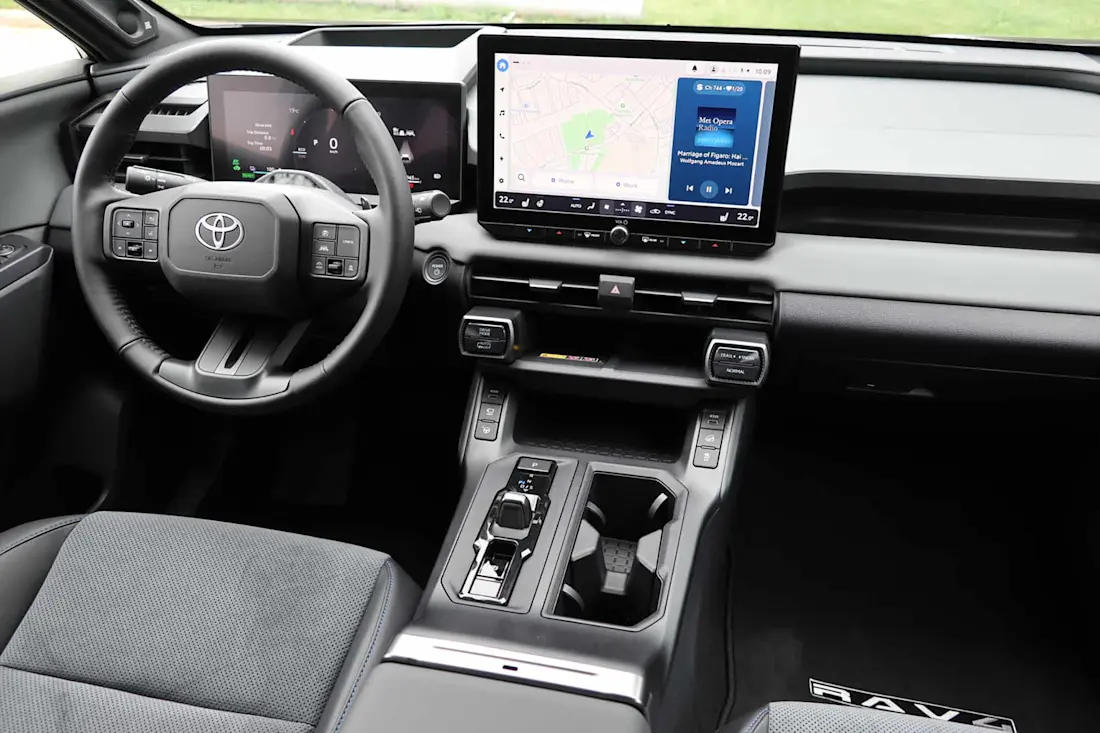
The entry-level SE trim’s features include 18-inch wheels, dual-zone climate control, a power sunroof, rain-sensing wipers, 10.5-inch touchscreen with wireless Android Auto and Apple CarPlay, 12.3-inch digital instrument display, heated front seats with power adjustability for the driver’s side, a heated steering wheel, and power tailgate.
The GR Sport is the priciest trim, with 20-inch wheels, a 12.9-inch touchscreen, faux leather-and-suede upholstery, a wireless phone charger, and paddle shifters. It’s the mid-priced XSE that gets the bulk of upper-end features. It gets the GR Sport’s items, and then adds a premium audio system, navigation, auto-dimming mirror, integrated garage door opener, heated and ventilated seats, a power passenger seat, driver’s-side memory, anti-theft alarm, card key, and cargo mat.
User-Friendliness: 8/10
The controls are a good blend of hard buttons and onscreen icons. There’s a dial for the stereo volume, and buttons for the cabin temperature and drive modes. The steering wheel controls are easy to use, and the screen menus are intuitive. I’d prefer a conventional gear selector, though. The RAV4 XSE’s optional Technology pack uses a shift-by-wire toggle and it’s simply not intuitive to push forward to go into reverse, especially in a multi-vehicle household where someone might forget and select the wrong gear.
Everyday Usability: 8.5/10
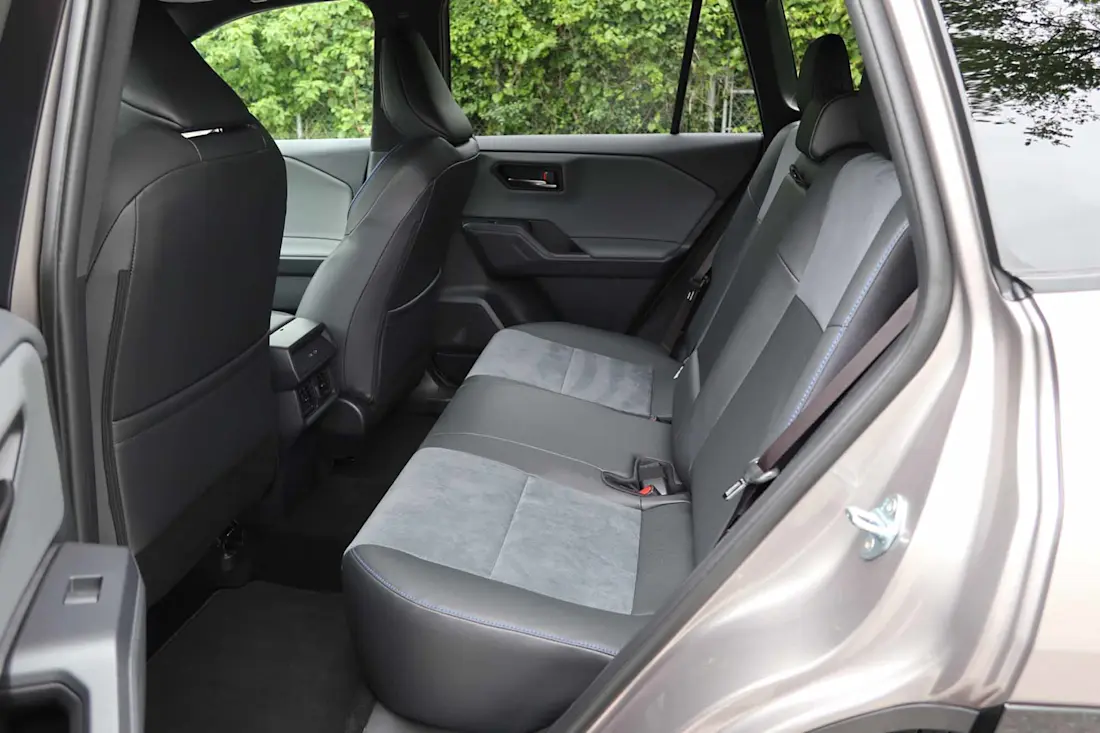
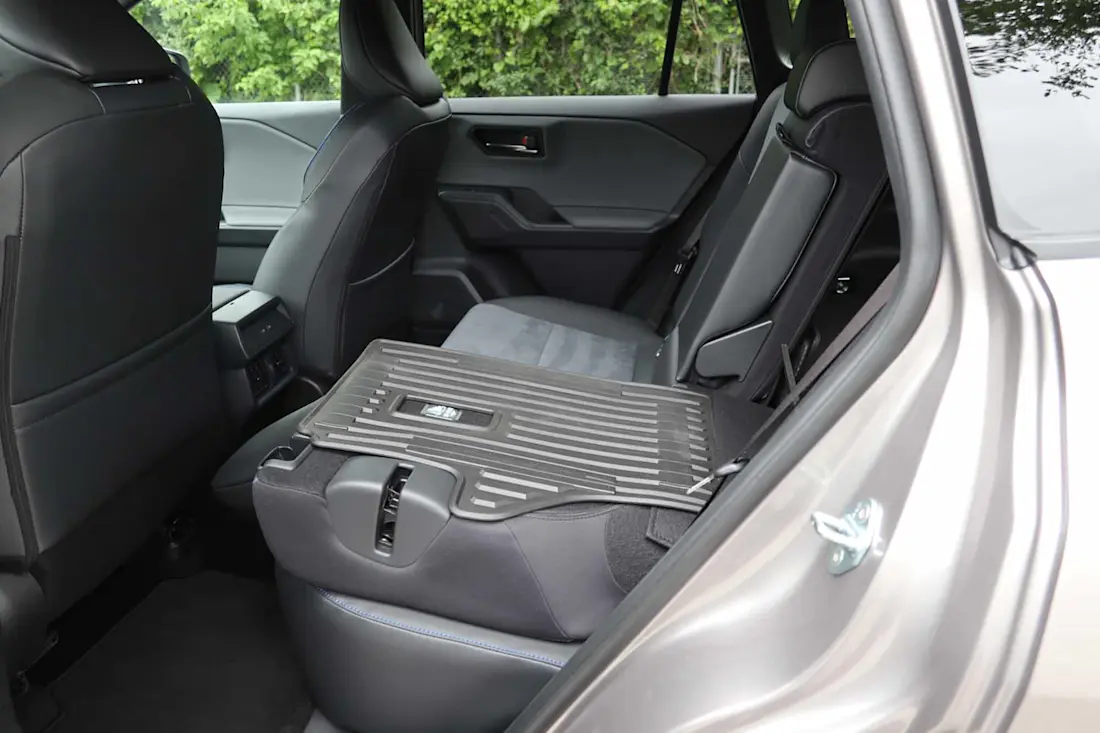
With 951 L of cargo space behind the rear seats, the RAV4 is midrange among competitors. The liftover is low and the cargo opening is wide, so it’s easy to get items in, and the standard cargo net helps to keep small items from sliding around. The doors open wide and it’s easy to get in, and while the hood is tall, visibility is still good. Towing capacity is a generous 1,588 kg (3,500 lb).
Comfort: 9/10
The RAV4’s front seats are well-bolstered and supportive, and stayed comfortable during a long drive. The rear seats aren’t as sculpted, but they still do a good job. Front and rear head- and legroom aren’t as generous as in most of its rivals, yet it still feels roomy. The ride is well-composed and the cabin is quiet as well.
Powertrain: 9/10
The RAV4 uses a 2.5L four-cylinder engine that, on its own, makes 183 hp and 172 lb-ft of torque. Combined with its redesigned-for-2026 hybrid system, that increases to 324 net hp and that’s considerably more than compact PHEV competitors, where the Mitsubishi Outlander makes 248 hp, and the Hyundai Tucson and Kia Sportage corporate cousins make 268 hp. The RAV4 mates that to an automatic continuously-variable transmission (CVT) and all-wheel drive is standard, with the rear wheels powered by a second electric motor as needed for traction.
As a PHEV does, the RAV4 can drive on electricity alone after it’s been plugged in and charged. It doesn’t push you into the seat when accelerating, but it’s quick and the power builds smoothly. When the charge depletes, the vehicle automatically reverts to conventional hybrid operation, switching between gasoline, electricity, or a combination of both, depending on driving conditions. You don’t have to plug a PHEV in, but there’s no point paying extra over a hybrid if you don’t plan to charge it regularly.
Driving Feel: 8/10
There’s not much steering feel, but the RAV4 overall is a pleasant driver for everyday use. It responds quickly to steering input and has a very tight turning circle, making it easy to manoeuvre in tight traffic and into parking spaces. The switch from electricity to gasoline is smooth and the engine is quiet. The advanced parking system that comes with the Tech package is pretty sophisticated. It takes over as soon as it’s activated, driving itself forward until it finds a spot, and then backs into it and puts itself in park.
Efficiency: 9/10

Natural Resources Canada (NRCan) rates the tested XSE trim at 5.4 L/100 km in the city, 6.5 on the highway, and 5.9 combined; the SE rates at 5.7 combined, and the GR Sport is 6.4. When plugged in and charged, the SE has 89 km of all-electric range; the XSE has 85 km; and the GR Sport has 79 km. Its PHEV rivals range from 51 to 72 km on a charge; and it’s also a considerable improvement over the 2025 RAV4 PHEV, which was rated at 68 km.
It takes three hours to charge on a 240-volt Level 2 home or public charger, or around 15 hours on a 120-volt household outlet. The Technology package adds fast-charging capability, which takes about 35 minutes to go from 10 to 80 per cent in ideal conditions, plus a 120-volt power outlet in the cargo compartment.
I plugged this tester in regularly, running exclusively on electricity until I realized I needed to see how it worked as a hybrid. Driving on the highway as you shouldn’t when aiming for maximum range, I got an impressive 75 km before the charge ran out and went to hybrid mode. When I topped up the tank for the week, my tally was 3.3 L/100 km.
Value for Money: 7/10
The RAV4 PHEV’s three trims range from $50,680 to $60,335. Among plug-in competitors, the Kia Sportage starts at $48,580, but the Mitsubishi Outlander starts at $52,123; the Hyundai Tucson at $55,499; and the Nissan Rogue PHEV, a one-year-only rebadge of the Outlander, at $60,793. The 2025 RAV4 PHEV started at $51,715 (all prices including delivery).
But the RAV4 PHEV also faces the equally-overhauled RAV4 Hybrid, and its five trims run from $39,430 to $53,930. My XSE tester started at $58,330, while the equivalent hybrid XSE is $5,500 less — although the difference tightens with the federal Electric Vehicle Affordability Program (EVAP), which offers a $2,500 rebate on the PHEV. NRCan estimates it will use $684 less in gasoline each year versus the hybrid, which doesn’t include charging costs.
The Verdict
By NRCan’s estimate, including the rebate, the 2026 Toyota RAV4 PHEV would make up its extra cost in lower fuel bills in approximately four and a half years. Buyers either need to look at long-term savings, or simply want an electric vehicle without range anxiety and are willing to pay for it. For them, this updated RAV4, with its driving performance, comfort, and long range is an impressive vehicle to consider.

Specifications
Trim Tested
2026 Toyota RAV4 PHEV XSE
Base Price
$56,400
Options
$3,505 — XSE Technology package, $2,950; Brown Sugar Metallic paint w/black roof, $555
A/C Tax
$100
Destination
$1,930
Price as Tested
$61,935
Displacement
2.5L
Cylinder Count/Configuration
I4 PHEV
Horsepower
324 net hp
Torque
N/A
Fuel Economy
5.4 / 6.5 / 5.9 L/100 km cty/hwy/cmb, 2.5 Le/100 km; 85 km est. range
Cargo Space
951 / 1,800 L seats up/down

All Articles
See all
2027 Toyota Land Cruiser Review
An unquestionably capable SUV with an undeniably cheap interior.
 Peter Bleakney

2027 Toyota Tundra and Sequoia First Drive Review
A new Trailhunter treatment highlights a more refined pickup and its sibling SUV.
 Kyle Patrick

2026 Toyota Crown Signia Review
Expensive though it may be, the Crown Signia is a superb vehicle all around.
 Chris Tsui