
2026 Toyota RAV4 PHEV First Drive Review + Video
 Dan Ilika
Now more than ever, much gets made about Toyota’s most popular model being assembled right here in Canada — but then an unprovoked trade war with your closest neighbour and ally has a way of bringing that sort of stuff into focus.
Against that backdrop, the timing of the redesigned sixth-generation RAV4 couldn’t be better, arriving as something of a beacon of Canadian prosperity when people are looking for them. Of course, it doesn’t hurt that the RAV4 remains really good at what it does, offering the efficiency of a now-standard hybrid powertrain alongside a sterling reputation for reliability.
But there’s another chapter in the story — one that starts on the other side of the Pacific Ocean, where the 2026 Toyota RAV4 Plug-in Hybrid (PHEV) enters the mix with the same enhancements as the Canadian-made version, albeit with the benefit of nearly 90 km of all-electric driving range to go with them. It may not evoke the same sense of national identity and pride as its conventional hybrid counterpart, but as far as personal choices are concerned, it’s hard to go wrong with this one.
A Price to Pay
Gallery


You’ll pay considerably more for the RAV4 PHEV, with the entry-level SE trim ringing in at $48,750 versus $37,500 for the cheapest Canadian-made model you can buy. On top of that, there are two non-PHEV trims that undercut the XSE that’s available with either powertrain; that one will set you back $56,400 if you want the added benefit of some all-electric range versus $50,900 without.
Beyond that is the PHEV-only GR Sport, which is $57,500, and then there’s the XSE’s optional Technology package that makes it the most expensive of the plug-in bunch at $59,350. And don’t forget about the mandatory freight charge of $1,930 that gets added to every RAV4.
Anyone who waited for this redesigned RAV4 PHEV rather than buy its predecessor will be rewarded with a starting price that’s considerably lower than last year, when the cheapest trim was $51,715 before the same freight charge. Meanwhile, the competitive landscape is made up of the mainstay Mitsubishi Outlander PHEV ($49,998-$63,048) and the mechanically and stylistically identical Nissan Rogue Plug-in Hybrid ($58,698), as well as the Hyundai Tucson ($53,299) and Kia Sportage ($46,395-$52,995) that share a plug-in powertrain.
A Modern Machine
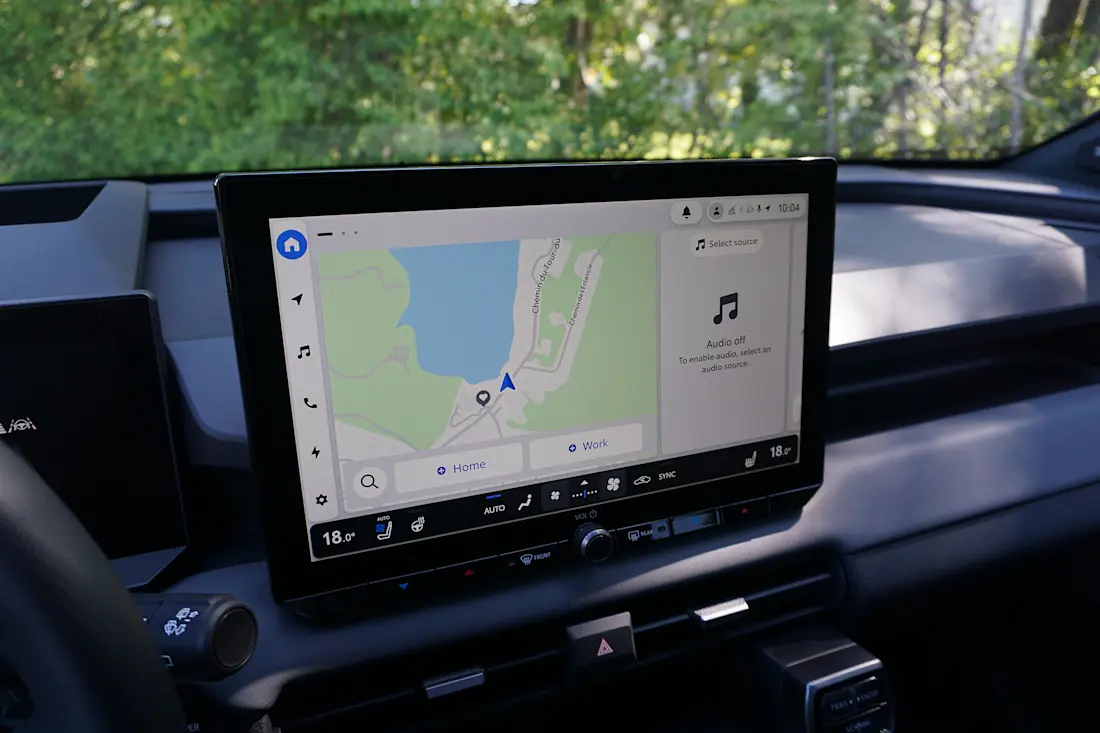
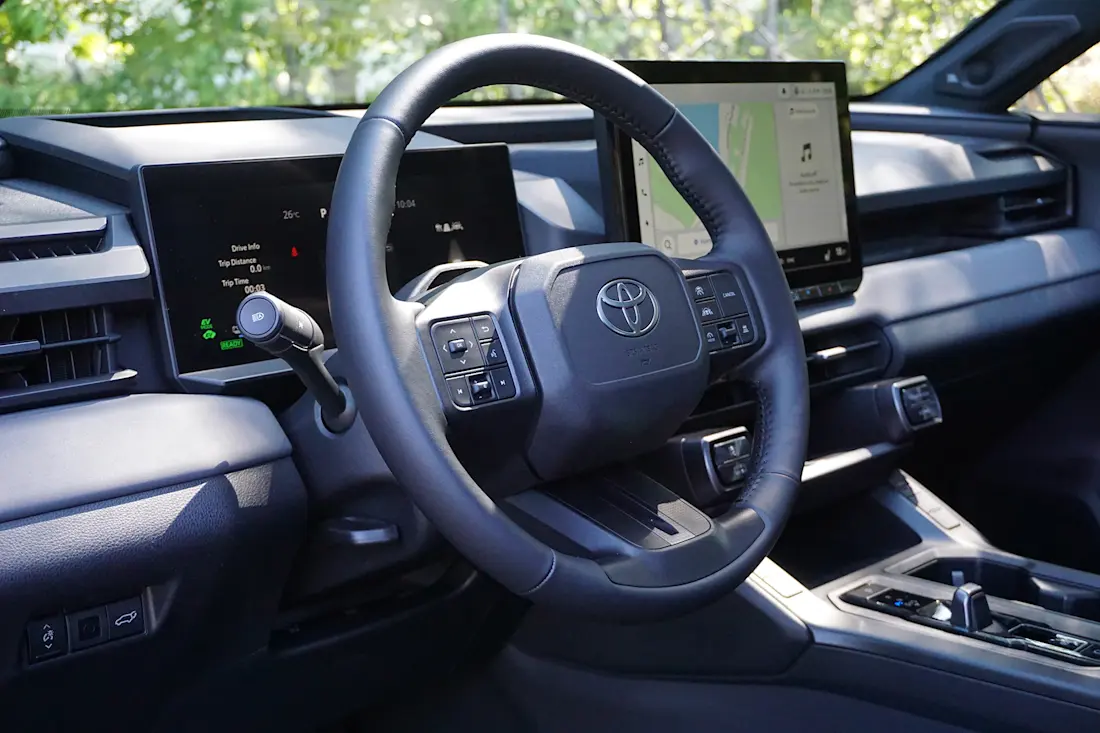
Looking past the PHEV components (more on those shortly), that money buys a well-equipped crossover with (most of) the right creature comforts to keep up with the competition. Every trim has a fully digital 12.3-inch instrument display that can be cycled through a number of views, including the integrated (subscription-based) navigation. That works in conjunction with either a 10.5- or 12.9-inch touchscreen that has wireless Android Auto and Apple CarPlay capability, plus an all-new software running in the background.
Dubbed Arene, that operating system goes beyond the infotainment interface and is used to run all the computerized components that make the RAV4 function. It also incorporates over-the-air updates and 5G connectivity — both Toyota firsts.
Beyond that stuff you can’t really see, the infotainment system seems to take a little longer to boot up than before but works seamlessly otherwise, with a smartphone-like structure and voice recognition that comes with the same subscription-based suite of connected features as the built-in navigation. While Toyota decided to ditch most of the physical climate controls of old in favour of touchscreen integration, the fixed row of icons that spans the bottom of the screen works well enough.
The climate system is of the automatic variety with two temperature zones, by the way, and that’s standard fare. So, too, are heated front seats and a steering wheel to match, while the XSE trim with and without the optional Technology pack adds ventilation. Perhaps the lone oddity is the absence of heated rear seats; those can’t be had at all in the RAV4 PHEV, although they come in the most expensive conventional version.
There’s an entire advanced safety and driver-assistance suite, too. Lane departure warning and keeping help, forward collision warning with pedestrian and cyclist detection, automatic emergency braking, blind-spot monitoring with rear cross-traffic alert and safe exit assist, and adaptive cruise control is all included, while the RAV4 PHEV XSE’s Technology pack adds a few others, including traffic jam assist that can handle steering, braking, and accelerating in congestion at low speeds.
Especially Efficient
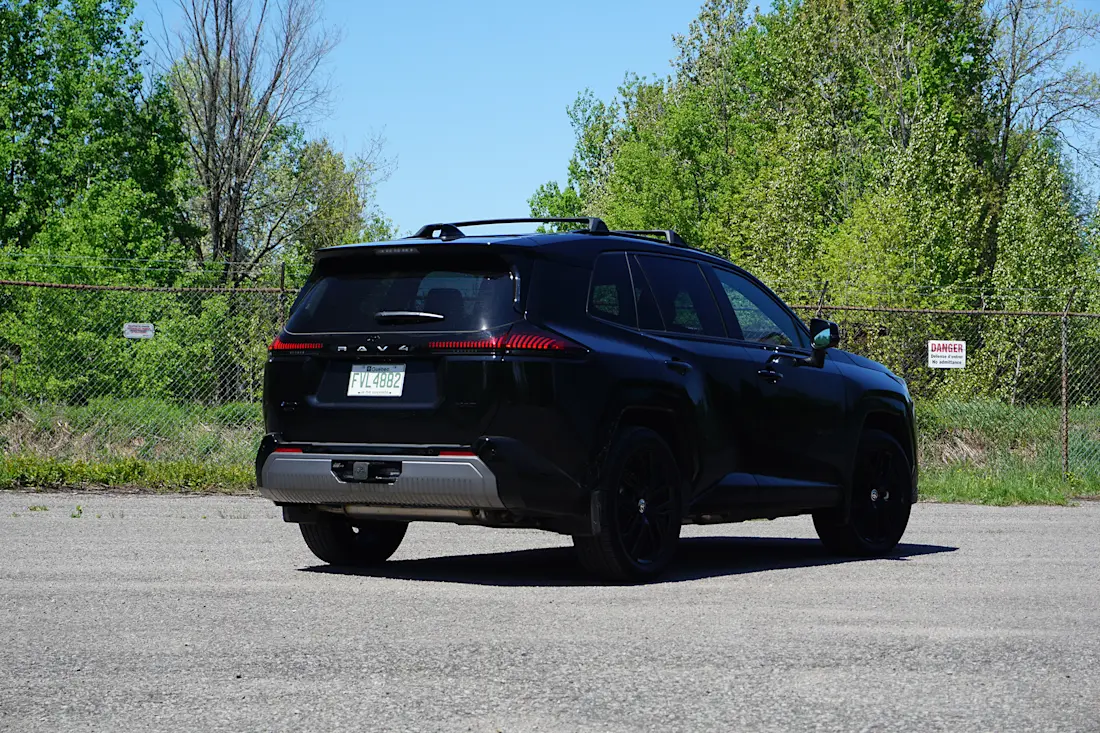
The 2026 RAV4 PHEV uses the sixth iteration of the automaker’s plug-in powertrain, which is largely the same as before, just more efficient and refined. Like the conventional version, it uses a 2.5L four-cylinder gas engine, plus two electric motors under the hood — one to drive the wheels, the other to feed the battery. Output from that electric setup has increased to 150 kW from 134 last time, while the rear-mounted motor is the same 40 kW as before.
While that rear-mounted motor — which provides the traction needed for all-wheel drive — is separate from the rest of the powertrain (and doesn’t contribute to the combined output rating of 324 net hp), it’s fed by the same 22.7-kWh battery pack. Its extra capacity compared to the last RAV4 PHEV (17.4 kWh) along with the improved thermal management and silicone carbide semiconductors used in the powertrain contribute to an all-electric range of between 79 and 89 km, depending on trim. That’s up from 68 km last time.
Once the battery’s drained, the powertrain works like that of the conventional hybrid, sipping fuel to the tune of 5.7 to 6.4 L/100 km combined — barely more than the Canadian-made RAV4 can manage in the same conditions. And it isn’t just the official numbers that are impressive but the ease of efficiency, with the two examples tested here exceeding expectations during this media drive event, and by significant margins. Cruising the Quebec countryside, hybrid-only indicated averages hovered around 5.0 L/100 km without much effort at all.
A Docile Daily Driver
Beyond its newfound range and efficiency, the redesigned RAV4 PHEV sounds heartier than before with a heavy foot on the throttle. No, that doesn’t mean you’ll find it satisfying to listen to the four-cylinder work to pass slower traffic, but it isn’t nearly as strained this time around. And while its predecessor was already quick thanks to the jolt of its electric motors, there’s an added sense of confidence that comes with this new one when pulling out to pass.
OK, fine — this is still a RAV4, and that means it’s (rather appropriately) docile to drive, which makes the GR Sport version something of a curiosity. And who knows — maybe you have your heart set on this sporty-looking crossover; but your humble author isn’t quite as convinced of its merits. Driven back-to-back with the XSE trim, there wasn’t much discernible difference in terms of performance. Sure, the suspension is a little more taut, but even the steering that’s supposed to be tuned for a bit more feedback felt mostly the same.
That doesn’t mean there’s anything wrong with either of them, as far as efficient, commute-friendly crossovers are concerned. But the big spoiler at the back of the GR Sport version — not to mention its gaping grille and aggressive overall aesthetic — is at odds with the obedient and otherwise agreeable nature of this best-selling model.
Final Thoughts

Built in Japan, the 2026 Toyota RAV4 PHEV is a friendly reminder that just like the company that builds it, this crossover is really good at what it does. Naturally, this new-generation RAV4 checks the usual boxes; it’s a bit more spacious than the last one, plus its styling is fresher and more modern. But what matters most with a plug-in like this is how much gas it burns and how far it can travel before it has to do so — two areas it sees marked improvement.
There are still plenty of merits to picking the Canadian-made version of this best-selling crossover that go beyond its country of origin. But if you don’t mind paying a little more for this plug-in, it should get you to and from work before the gas engine even kicks in, and that’s hard to argue with.

All Articles
See all
2027 Toyota Land Cruiser Review
An unquestionably capable SUV with an undeniably cheap interior.
 Peter Bleakney

2027 Toyota Tundra and Sequoia First Drive Review
A new Trailhunter treatment highlights a more refined pickup and its sibling SUV.
 Kyle Patrick

2026 Toyota Crown Signia Review
Expensive though it may be, the Crown Signia is a superb vehicle all around.
 Chris Tsui