
2027 Porsche 911 GT3 S/C First Drive Review + Video
 Dan Ilika
Don’t look now, but Porsche has done it again.
This is a brand that knows how to sow at least a little controversy with its cars, and its latest entry is a gleaming example. Because the 2027 Porsche 911 GT3 S/C, shorthand for Sport Cabriolet, seems on the surface like it’s the antithesis of what the car it’s based on has been about since its introduction all the way back in 1999. But then that approach is just plain wrong.
Sure, the GT3 has historically been the kind of car to drive to and from the track — the latter coming after a vigorous lapping session, of course. But as the times have changed, so has the GT3, with a wingless Touring version joining the lineup to serve as a road-focused expression of what’s arguably the purest performance car in Porsche’s lineup. What sets this convertible apart is its singular focus on delivering a fully immersive sensory experience.
What Is It, Anyway?
Gallery


Make no mistake about exactly what the 911 GT3 S/C is: a spiritual successor to the sultry 911 Speedster that was introduced as a limited-run model in 2019. But it’s much more than that, and while its body-in-white — the structural platform it starts with, complete with fixed rear fenders — is shared with the likes of the 911 Carrera convertible, the first-ever droptop GT3 borrows a bunch of lightweight components from the special-edition 911 S/T that preceded it.
That’s where the front fenders, hood, and door skins come from, all of which are made of carbon-fibre reinforced plastic (CFRP). Likewise, it shares its magnesium wheels with the 911 S/T, while carbon-ceramic brakes are equipped as standard. That combination alone reduces unsprung mass by about 29 kg (64 lb), according to Porsche, while even the battery is one kg (2.2 lb) lighter than the one in the 992.1 version of the GT3.
As with the 911 S/T, Porsche even put fabric door pulls inside the GT3 S/C. It’s unlikely they do much as far as weight reduction, but they’re unquestionably cooler than conventional handles. More than that, they’re a fitting addition from a brand like this one that’s notorious for its attention to detail. Then there are the optional lightweight seats with their exposed carbon-fibre rear shells ($7,470) that are limited in their adjustability but offer a one-size-fits-most embrace.
Drop That Top
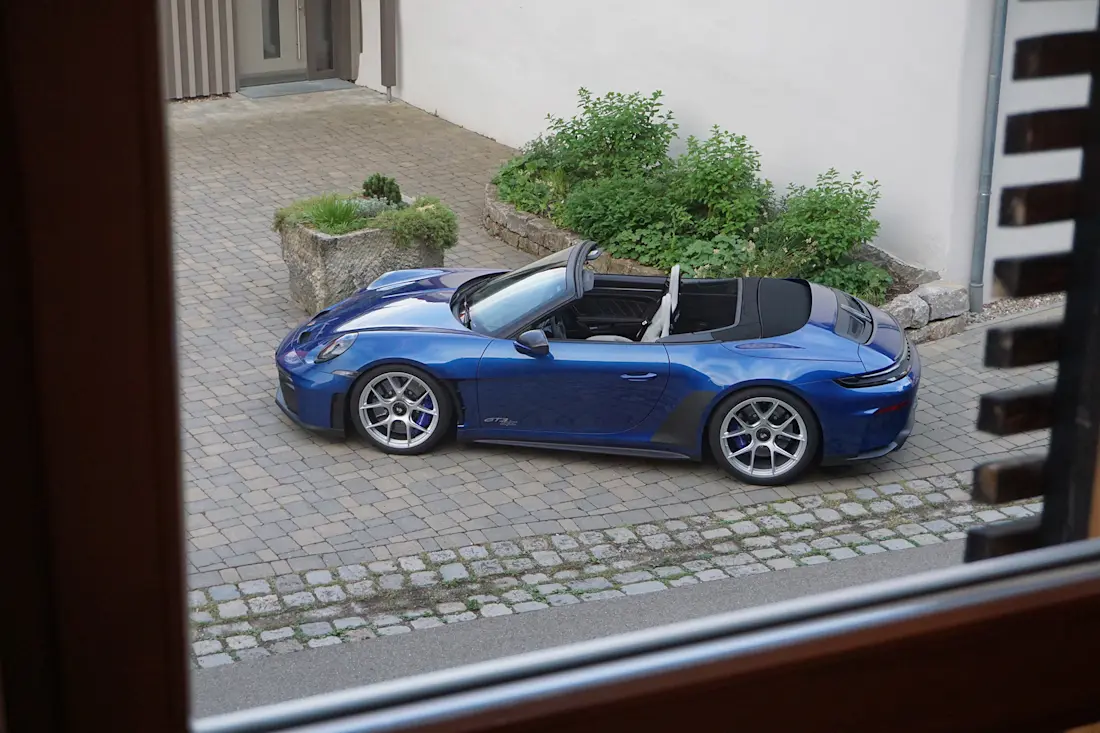
While the 911 Speedster was fitted with a sleek double-bubble decklid, the GT3 S/C has a much more conventional look. That doesn’t mean it’s anything short of stylish, although at least from afar, it could easily be confused with one of its less exclusive (and expensive) siblings. And while the soft top itself is, indeed, shared with others in the 911 convertible stable, its magnesium construction is in keeping with this car’s priority of limiting its curb weight.
All told, the fully automatic roof weighs 30 kg (66 lb) more than the Speedster’s setup — a rather reasonable gain considering the convenience that comes with it. Whereas its predecessor requires a somewhat complex combination of automatic and manual steps to open or close its top, the job here can be done in about 12 seconds at speeds as fast as 50 km/h.
Porsche’s people are also quick to point out that no additional chassis braces or stiffeners were required in the construction of the 911 GT3 S/C, something of a surprising proclamation but a welcome one considering the weight such components would come with. Even more shocking is how taut this car feels during quick changes of direction, this in spite of lateral rigidity that measures about a third of that of the hardtop GT3, according to the automaker itself.
Scintillating Sounds
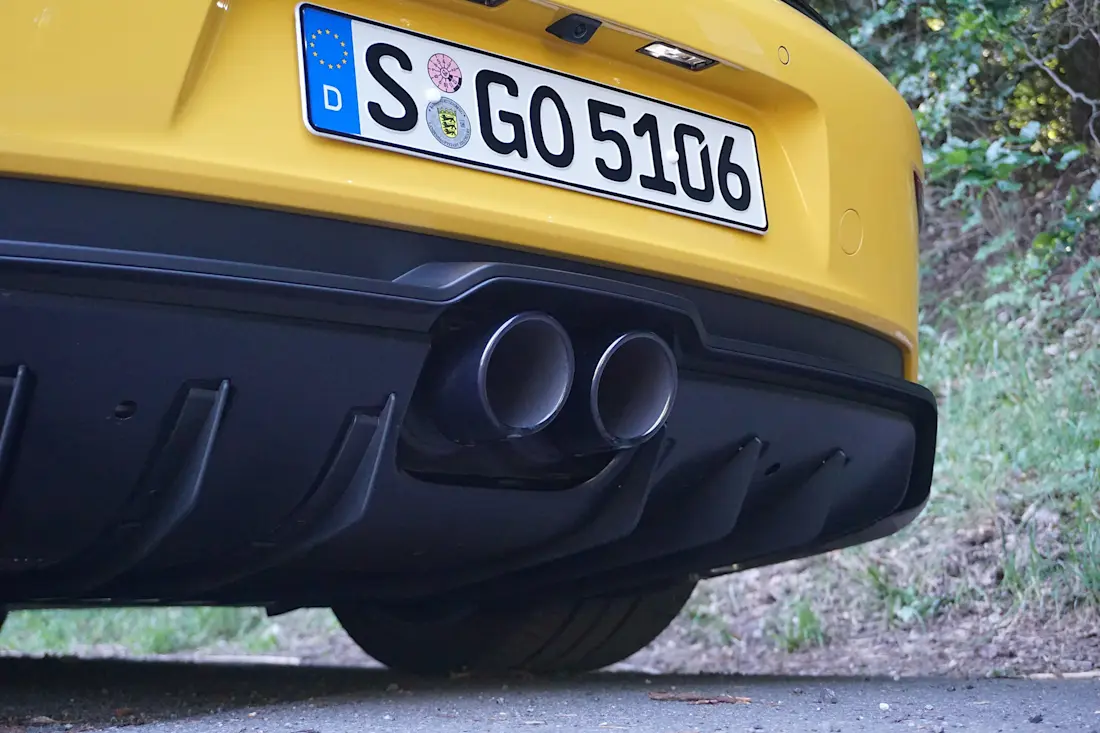
The whole point of a car like this is to keep the top down and soak in the sultry sounds that come with its six-cylinder symphony. But it’s not any ordinary engine nestled in the rearmost reaches of this 911, at least not by modern standards. That’s because while most of the rest of the lineup has turned to turbocharging, and even a bit of electrification, the GT3 is still nobly served by a naturally-aspirated powerplant. Not only that, it’s exclusively mated to a manual transmission.
It’s a wonderfully antiquated setup — not that it hasn’t been thoroughly modernized, for better or worse. For example, the exhaust system features four separate catalytic converters — the result of ever-more stringent regulations around the globe that mute the scintillating sounds at least a little. That’s especially true with the top up, where the engine communicates what’s happening with more mechanical noise, like a thousand angry industrial sewing machines working at once.
Drop the top, however, and the 4.0L engine makes wonderfully raspy sounds that are particularly rewarding as it gets closer to its 9,000-rpm redline. Frankly, it feels like it could easily wind out even further, with an exceptionally generous powerband that plays nicely with the close-ratio transmission. While the 502 hp and 331 lb-ft of torque on tap here fall well short of what the 911 Turbo S makes, this naturally-aspirated engine is nearly perfect in every way.
A Driver’s Car
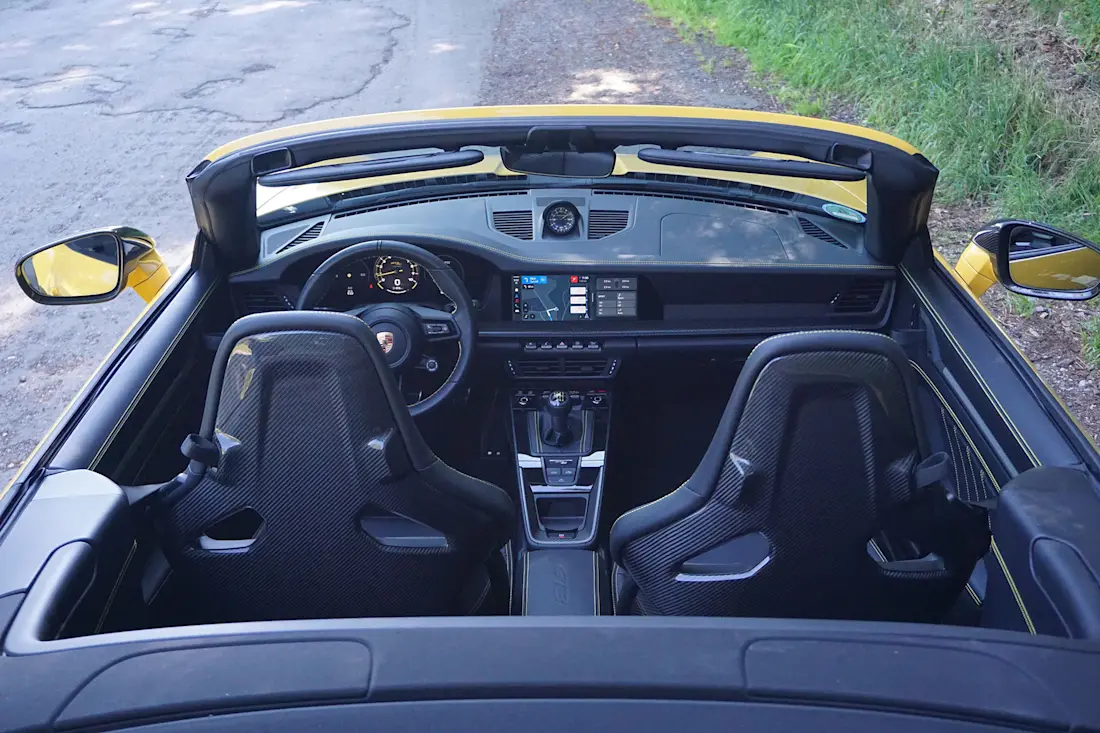
Sure, the six-speed manual means the 911 GT3 S/C isn’t the most accessible variant in the lineup. Chalk it up to more weight savings, since Porsche’s infamous dual-clutch automatic transmission is about 20 kg (44 lb) heavier. It also happens to be an absolute joy to operate, with the same short-throw shifter from the 911 S/T and a perfectly weighted clutch to match. This being a modern sportscar, there’s selectable auto rev-matching, too.
The transmission’s ratios — not to mention the sounds of the engine revving ever-higher — mean it’s at its best when kept in a gear or two lower than would otherwise be required, especially during stints of spirited driving. This car’s soundtrack is best enjoyed at engine speeds beyond 4,000 rpm anyway, with the accompanying dopamine hit downright addictive.
The suspension, which is grafted in its entirety from the GT3 Touring, is far from softly sprung, although it offers a kind of everyday compliance while never wavering on this car’s commitment to performance and poise. While not quite race-ready at all times, the setup is perfectly suited to the character of this convertible, with just a bit of nose dive when braking. But then that allows the car’s weight to transfer forward and better rotate on its front axle when cornering.
Final Thoughts
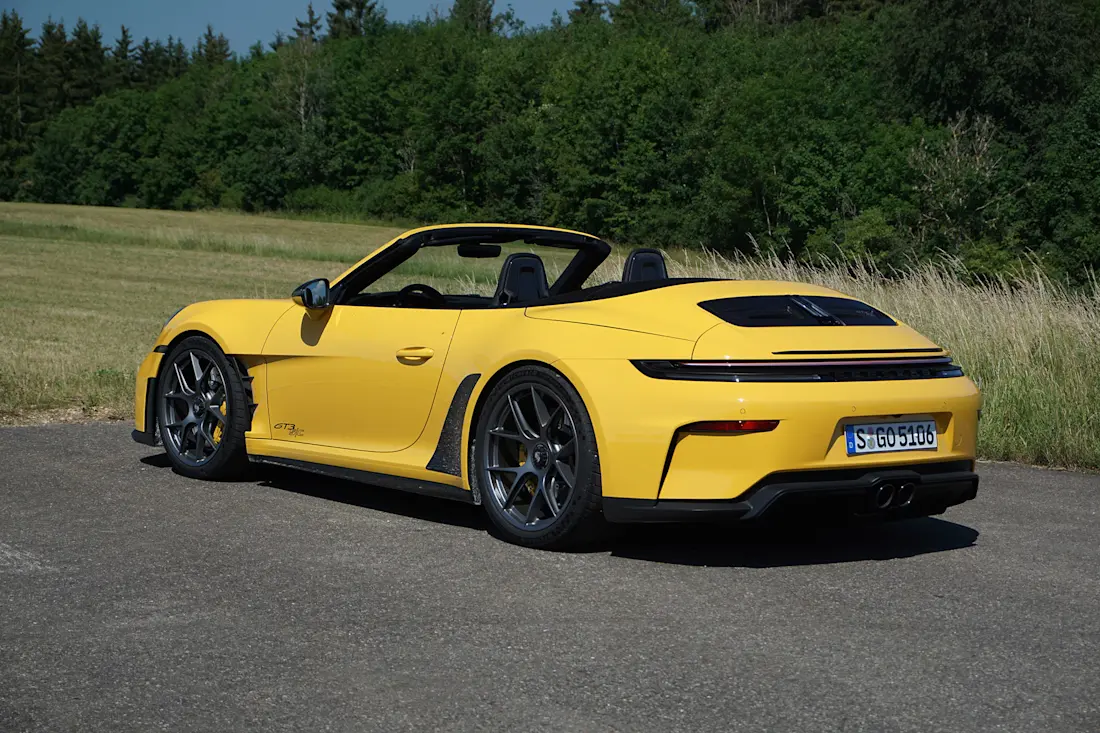
Strip back all the modern touches and technology and the 2027 Porsche 911 GT3 S/C is pure nostalgic joy on four wheels. It’s a distillation of the driving experience that’s increasingly difficult to find these days, and it happens to sound utterly perfect with the top down. While the coupe it’s based on is outstanding, this is the convertible we didn’t know we needed until now.
Unlike the Speedster or S/T variants that came before it, the GT3 S/C isn’t a limited run model — although the brand has certainly priced it like one. Starting at $313,300 before extras, it commands a whopping $68,000 premium over either hardtop version that’s sold alongside it. But then for those with the means, it’s tough to put a price on this kind of sensory experience, with Dolby Atmos-like levels of immersion with the top down and ribbons of open road ahead.

All Articles
See all
2026 Porsche 911 Targa 4S Review
A dream at every speed.
 Sébastien Bell

2026 Porsche Cayenne Coupe Electric First Drive Review
A swoopy sportback version joins the Cayenne Electric lineup for the stylistically inclined.
Dan Ilika
2026 Porsche Cayenne Electric First Drive Review + Video
The most powerful production Porsche to date is an automotive marvel.
Dan Ilika