
2026 Toyota RAV4 vs Honda CR-V Hybrid Comparison Test + Video
 Jodi Lai
The Toyota RAV4 and Honda CR-V have a rivalry that’s the automotive equivalent of Nike versus Adidas, Coke versus Pepsi, or Drake versus Kendrick Lamar.
OK, this famous face-off is far less dramatic than a rap beef, but both compact crossovers have been in a decades-long battle to try to get into more driveways. Always going back and forth, trying to one-up each other, the clash between these Canadian-made models is entering a new chapter. And while both the 2026 Toyota RAV4 and the 2026 Honda CR-V are exceedingly good at what they do, there’s one clear winner here.
Design


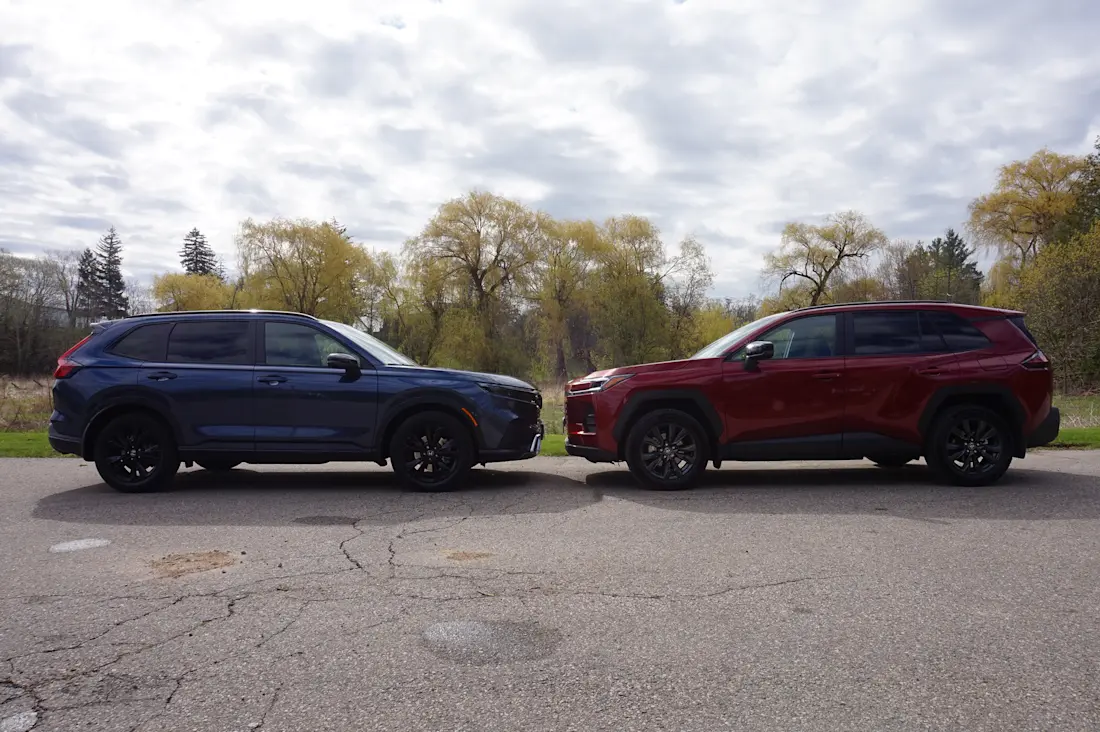
The Honda CR-V has an inoffensive design that’s beginning to look a bit boring next to many of its competitors, but it remains clean and unfussy, which means it should age well. The cabin, too, is a bit dark and boring, and you have to spring for the top trim to get a slightly more expressive interior. The honeycomb vents are a nice touch, but there isn’t much that stands out otherwise. However, the quality of many of the interior materials is nicer than what’s in the RAV4, which was recently redesigned.
While the previous-generation RAV4 became a victim of its own popularity because it was so ubiquitous, the fresher style of the new one helps it stand out more and offers a chunkier, more modern — and more rugged — look than its counterpart. But then the interior is quite bland, and there’s too much black plastic trim that cheapens the look and feel. The Woodland trim offers a bit more colour. with orange interior accents, but the rest of the lineup suffers from a bleak-looking cabin.
Toyota RAV4: 8/10; Honda CR-V: 9/10
Everyday Usability
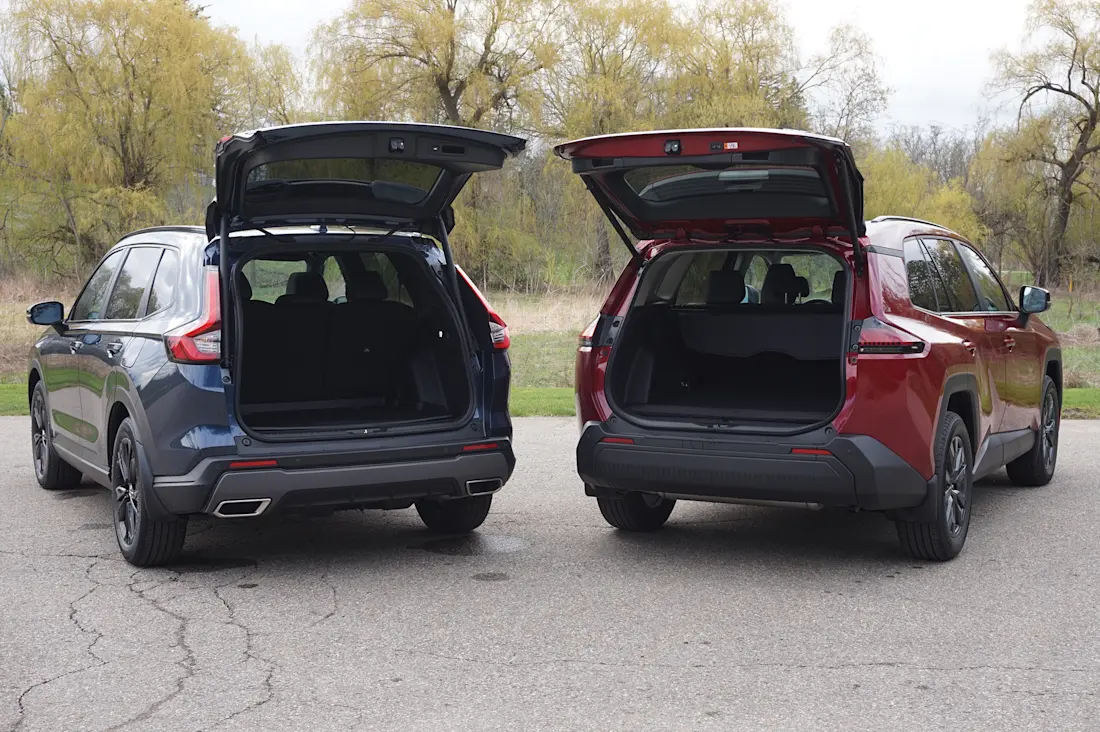
Both models are equally matched in terms of practicality. The CR-V has 1,028 L behind the second row and 2,030 L with it folded, but it doesn’t offer a flat load floor when the seats are stowed; instead, there’s a lip that makes loading large items awkward.
The RAV4 has 1,070 L behind the back seats and 1,994 L with them folded for a flat cargo area. Both have wide trunk openings and low liftover heights, and decent interior storage with cubbies and door pockets, but the RAV4 has more space for small items. Meanwhile, the CR-V’s doors open wider than the RAV4’s, which helps make it easier to enter, exit, install child seats, or help kids get buckled in.
Toyota RAV4: 9/10; Honda CR-V: 8/10
Powertrain
The Toyota RAV4 is available only as a hybrid or plug-in hybrid (PHEV) this generation. It’s powered by a 2.5L four-cylinder that outputs 236 net hp (Toyota doesn’t publish hybrid torque figures). All-wheel drive (AWD) is also standard, with a separate electric motor on the rear axle that provides extra traction when needed without a significant penalty on fuel economy. It’s a brilliant setup.
The Honda CR-V Hybrid is powered by a 2.0L four-cylinder engine and twin electric motors for a total system output of 204 hp and 247 lb-ft of torque. Both crossovers use automatic continuously-variable transmissions (CVTs), and both the RAV4 and CR-V Hybrid come standard with AWD, although Honda uses a mechanical system.
Toyota RAV4: 8/10; Honda CR-V: 8/10
Fuel Economy
The Toyota RAV4’s fuel economy is officially rated at 5.2 L/100 km in the city, 6.1 on the highway, and 5.7 combined. After 740 km of testing, the indicated average was an impressive 5.0. The Honda CR-V Hybrid, meanwhile, is rated at 6.0 in the city, 6.9 on the highway, and 6.4 combined. After real-world testing, it clocked in at 6.2.
Toyota RAV4: 9.5/10; Honda CR-V: 7/10
Driving Feel
The RAV4’s powertrain is smooth and efficient, the steering feels responsive, the chassis is well-sorted and more geared towards comfort, the braking feel has improved, and it’s easy to park and manoeuvre. The power delivery isn’t exciting, but it feels peppy in the city and doesn’t struggle to pass slower vehicles or get up to speed — though it gets pretty noisy when your foot is to the floor.
As smooth as the RAV4 is, the CR-V Hybrid is even smoother and more refined, as it flips between gas and electric power imperceptibly. It’s also quieter inside. The steering is light but direct, everything comes together and works exactly like it should, and though it makes less power than the RAV4, it doesn’t feel underpowered at all. It offers a fantastic balance of comfort and control.
Toyota RAV4: 8/10; Honda CR-V: 8.5/10
Comfort
The Honda’s suspension soaks up a lot of road imperfections and its seats are nicely cushioned. It also offers what feels like more headroom in the front and back, although their spec sheets say otherwise.
The RAV4 is also comfortable, with a softer suspension absorbing impacts with ease, but it inches ahead in terms of overall comfort over the CR-V because it offers more features like a larger sunroof that makes the cabin feel more spacious, ventilated front seats, and power-adjustable seats lower in the lineup.
Toyota RAV4: 8.5/10; Honda CR-V: 8/10
User-Friendliness

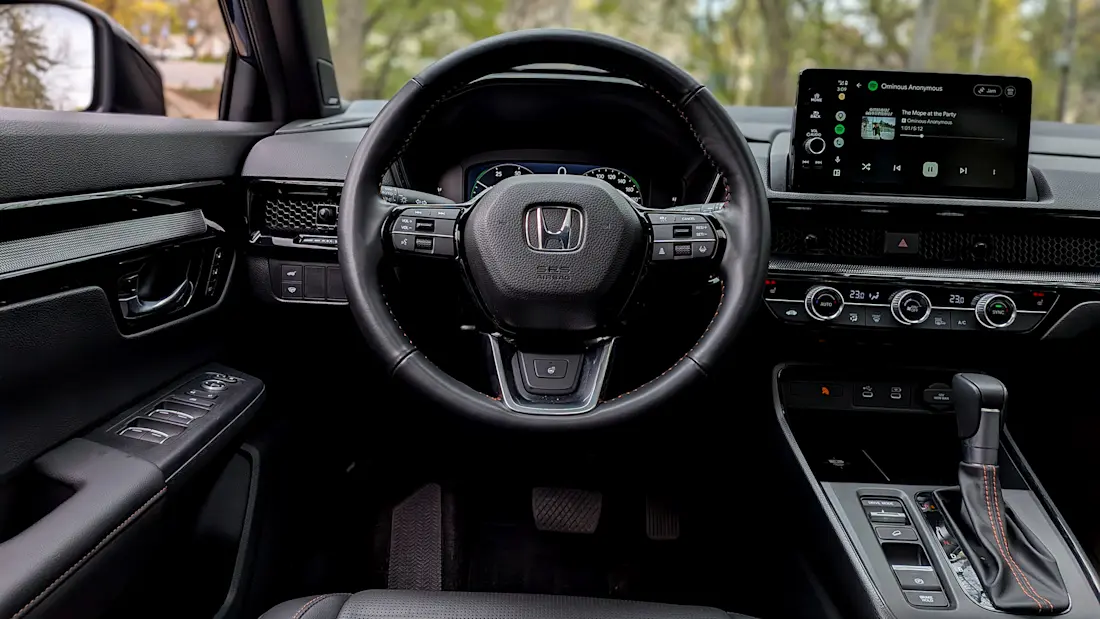
The RAV4’s straightforward interior will be easy enough for anyone to figure out. It has a decent amount of physical controls, and the new Google-powered infotainment is a huge improvement over the clunky system it replaces. Standard wireless Apple CarPlay and Android Auto improve usability for both crossovers.
The CR-V, however, has better usability in spite of its smaller screen simply because it has more physical buttons for the climate control and helpful shortcuts for the touchscreen that make it less distracting to use while driving. The touchscreen itself is also quick to react, though the graphics look a bit dated.
Toyota RAV4: 8/10; Honda CR-V: 9/10
Features
The Honda feels a bit stingy on features, especially because it costs more but doesn’t offer additional goodies to help soften the blow. The basics are all there, but even the top trim CR-V can’t compete with lower-trim RAV4s on features.
The RAV4 offers all sorts of desirable features that the CR-V doesn’t even offer including dual wireless phone chargers, surround-view cameras, a panoramic sunroof, ventilated front seats, an integrated onboard dashcam recorder, a huge and colourful head-up display, a camera-based rearview mirror, and more.
Toyota RAV4: 8/10; Honda CR-V: 6.5/10
Safety
The CR-V’s safety suite isn’t the most innovative or fresh, but it does a perfectly adequate job of offering the basics. Features like standard collision warning and mitigation technology, as well as lane departure warning and keeping assistance, adaptive cruise control, and a rear seat reminder all work fine but tend to be overly sensitive, which makes them less useful and more annoying. The reverse camera is also poor quality and not really up to modern standards.
Toyota’s safety systems also used to suffer from being overly sensitive, though that issue has mostly been fixed with this new RAV4. The only exception is that the rear seat reminder is inconsistent and should be upgraded to a better sensor-based system instead of one that uses door opening as a trigger. Toyota packs even its base RAV4 full of safety features, including blind-spot monitoring with rear cross-traffic alert and safe exit alert, automatic high-beam control, adaptive cruise control, lane departure warning and tracing assist, and road sign recognition.
Toyota RAV4: 8/10; Honda CR-V: 7/10
Value
Unlike the RAV4, the base CR-V isn’t available as a hybrid, so Honda forces customers to leap into a more expensive mid-range trim to get better efficiency. This means buyers must spend $45,900 (excluding non-negotiable delivery fees and taxes) to get the more efficient powertrain, whereas the base RAV4 (which is standard as a hybrid) can be had for $37,500.
In this comparison, the second-from-base RAV4 trim outmatches the top CR-V tested here for features. A top-trim RAV4 is a few hundred dollars more than its Honda counterpart, but hits back by offering more features for not a bunch more money. The Toyota easily wins on the value front.
Toyota RAV4: 8/10; Honda CR-V: 6/10
The Verdict
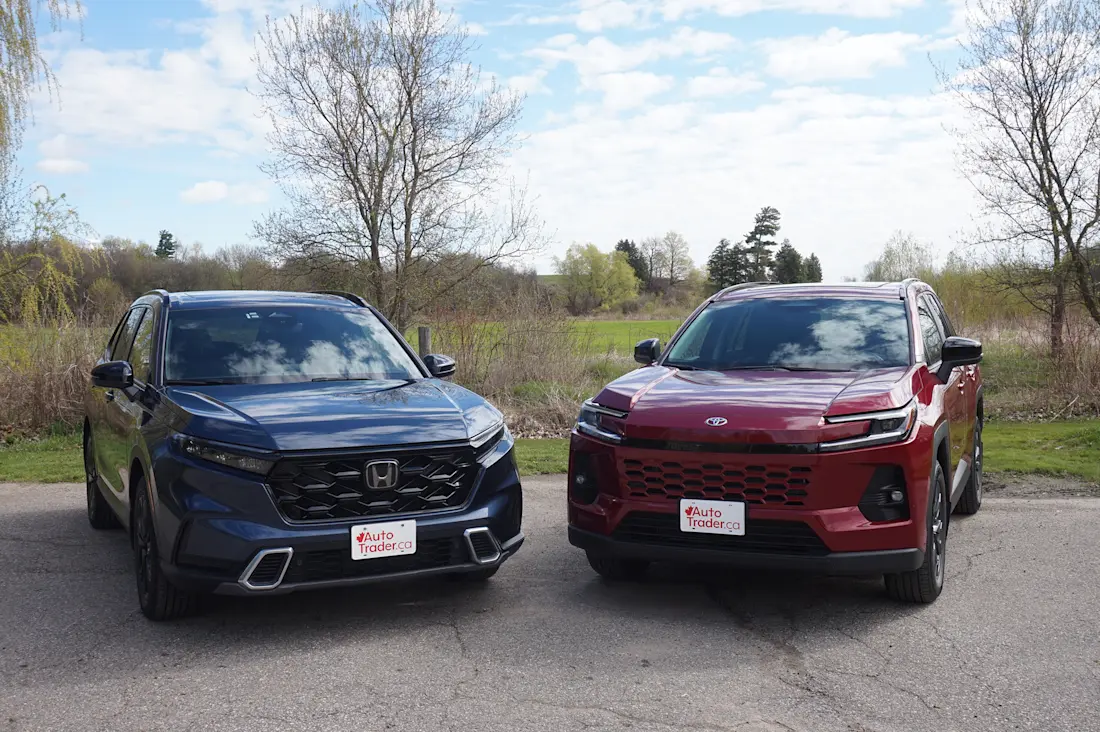
While the 2026 Honda CR-V Hybrid is excellent, the Toyota RAV4 benefits from being newer and offering more value. While the RAV4 isn’t perfect or particularly groundbreaking, it’s incredibly well-rounded, more efficient, offers more value for the money, and does its intended job with no surprises, making it the winner in this close comparison.

All Articles
See all
Most Fuel-Efficient SUVs in Canada for 2026: Gas, Hybrid and PHEV Options
Compare the best options for Canadian drivers, including price, efficiency, practicality, strengths and trade-offs.

Best Hybrid Trucks in Canada for 2026: Towing, Fuel Economy, and Value
Compare 2026 hybrid trucks in Canada

2026 Subaru Outback vs Subaru Trailseeker Comparison Test
Subaru is offering shoppers two unique takes on its most iconic formula.
 Kyle Patrick