
2026 Toyota Tacoma TRD Pro vs Ford Ranger Raptor Comparison Test
 Kyle Patrick


You want a dune-jumping, fun-loving truck, but it’d be best if it didn’t require a garage extension. No worries: Ford and Toyota have got you.
Modern full-size trucks are almost comically large now, and that’s before we get into the embiggening process inherent to their off-road trims. The Ram TRX is 2,235 millimetres wide — and weighs only slightly less than its namesake.
Those wanting something at least slightly more manageable have the options of the Toyota Tacoma TRD Pro and Ford Ranger Raptor. While similar in size and price, these two rough-and-tumble rigs approach the mission in very different ways.
Styling
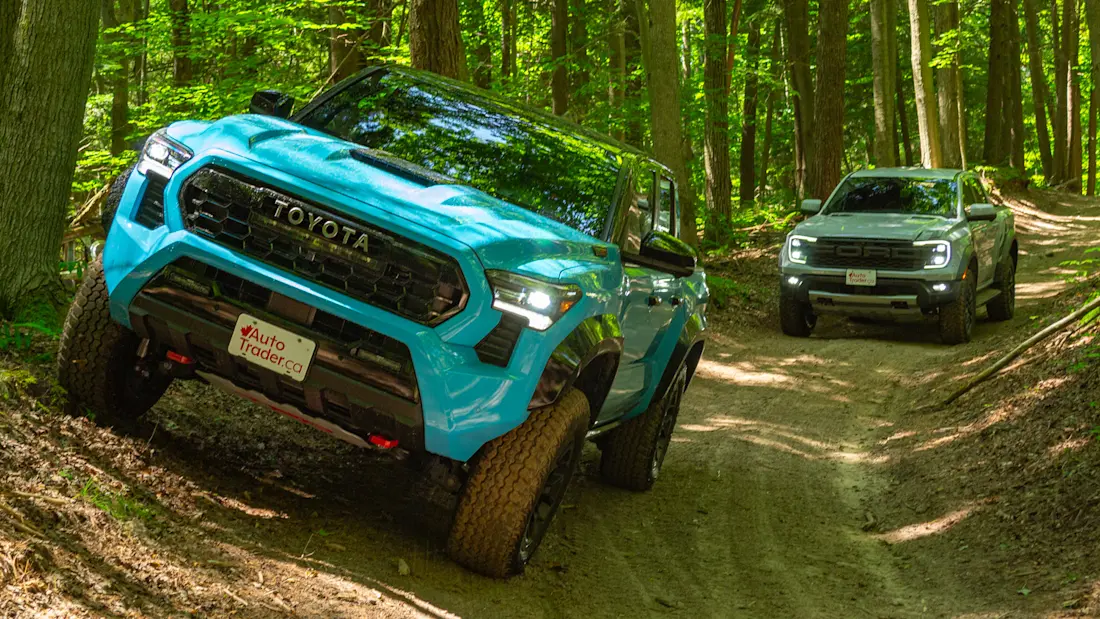
It’s impossible to ignore the impact of the Tacoma’s Wavemaker paint. It is bright and silly and right on target with who this truck is made for. If you’re going to go for the most aggro Taco out there, why not get it in the colour you can spot from anywhere? The rest of the package is strong, too: pumped-up fenders, an aggressive (if non-functional) hood scoop, and chopped back bumpers replete with real metal skid plates all add up to one mean truck.
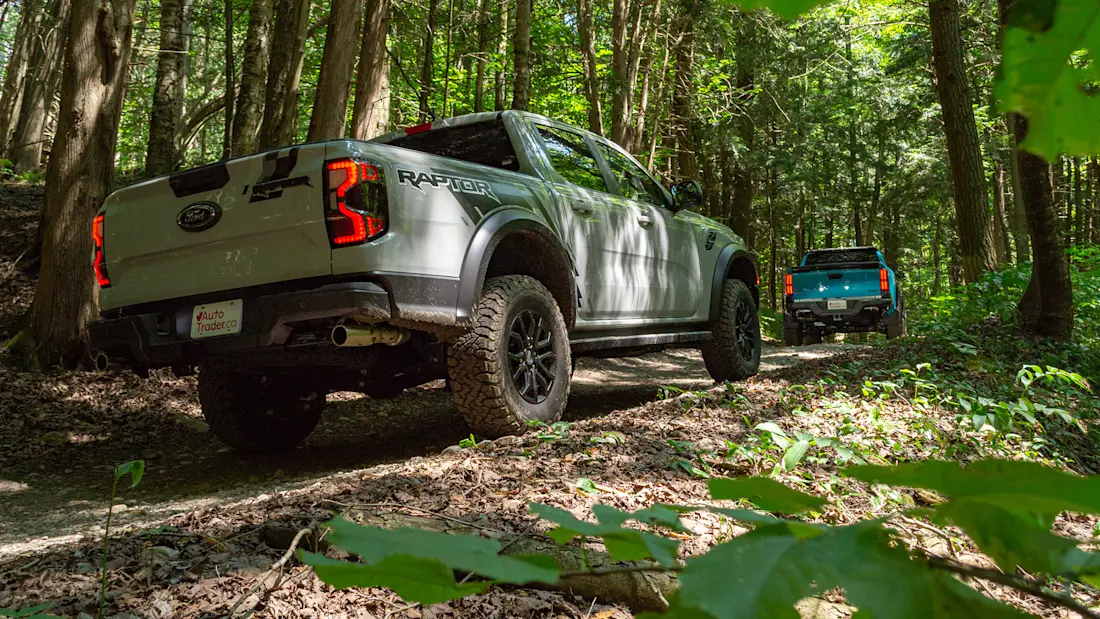
By comparison, the Raptor doesn’t look like a predator. Okay, the flat gray paint doesn’t help, but the Ford’s top-level treatment is altogether more subtle. It has wider flares but the matte plastic itself is no different from an XLT trim model. Only the small vents aft of the front wheels and the big ‘FORD’ grille are the obvious giveaways — and this tester’s optional graphics package, of course.
Inside, the Tacoma is all about big, blocky shapes and bursts of red, with unsubtle ‘TOYOTA’ badging sitting proud of faux carbon fibre trim on the dashboard. The technical pattern on the seats is eye-catching, and mirrored on various cabin bits. The Ford again takes a slightly more mature approach, with bright orange highlights peppered around its cleaner dashboard design. A technical, quasi-suede material along the dash cuts down on reflections and feels good to the touch.
Toyota Tacoma 9/10; Ford Ranger 7/10
Practicality
Both of these pickups come exclusively with five-foot beds, though the Toyota’s is fractionally longer (1,532 over 1,514 millimetres). The Ford’s bed is wider however, but its liftover height is also slightly higher. Towing capacity when properly equipped is capped at 2,500 kilograms (5,510 pounds) for the Ranger, while the Tacoma maxes out at 2,722 kg (6,000 lb).
Given their mission statements, both the Ranger and Tacoma come with suspension lifts for more ground clearance — and a taller climb into the cabin. The Tacoma has the advantage not only in clear air below its body (292 versus 272 mm), but also in most of the important off-roading angles. Team Toyota has 35.7-degree approach, 24.6-degree breakover, and 22.6-degree departure angles; the Blue Oval side counters with 33.0, 24.2, and 26.4 degrees, respectively.
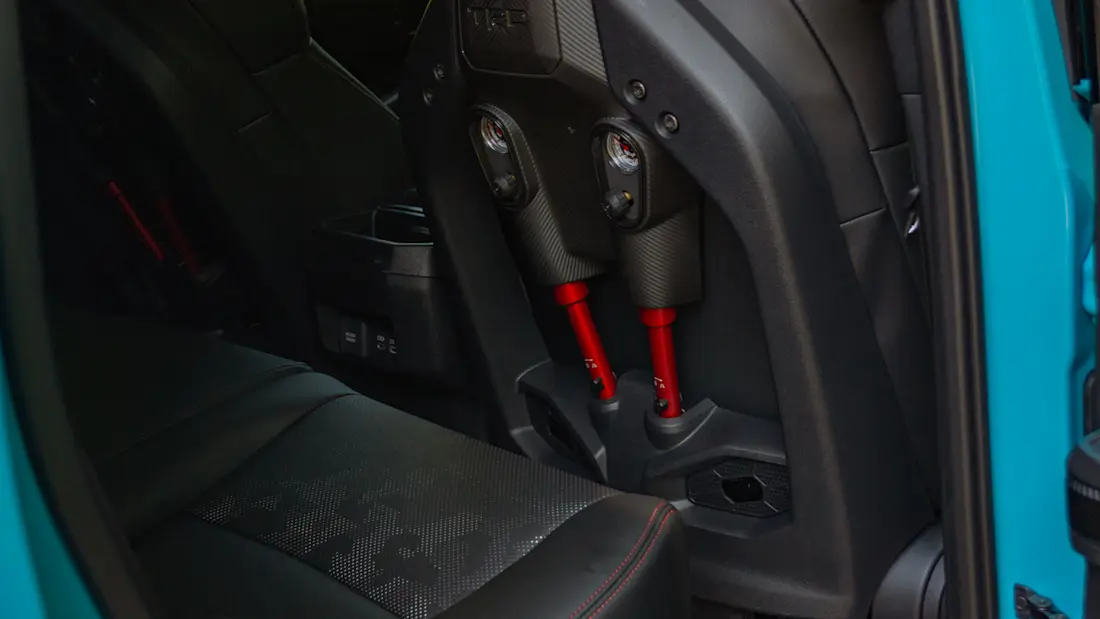
These two mid-sized trucks are broadly similar in terms of front-seat space, though the Ford has a huge headroom advantage by dint of its metal roof. Those who like a bit of sun and air from above will appreciate the Tacoma’s sunroof. Backseat room isn’t exactly a strength for either of these pickups; the Ford technically has more space (879 beats 856 mm), but that’s only part of the story. The Tacoma’s trick IsoDynamic seats might give its driver a more secure perch on the trails, but the hard knobs and shocks threaten backseat riders’ knees.
Toyota Tacoma 7/10; Ford Ranger 8/10
Features
Both the TRD Pro and Raptor come with the requisite additional bash plates along their underbodies to protect important parts like the oil pans and differentials. Heated front seats are standard on both trucks, while the Tacoma adds on useful ventilation as well. Sorry, backseaters: neither truck features heated or ventilated thrones back there.
There are however multi-camera setups in both trucks, providing adventurers with clear views of the truck’s surroundings. Both also include 10-speaker sound systems; Bang & Olufsen for Ford and JBL for Toyota. Only the latter has a removable speaker built into its dashboard however, which makes it a useful accessory for camping. Toyota also includes a digital rearview mirror.
Buyers get selectable two- and four-wheel drive in these trucks, with both 4HI and 4LO as well. The Ford’s trailer backup and hitch assist features are game-changers too, making it easy-peasy to line up a trailer and navigate around obstacles.
Toyota Tacoma 8/10; Ford Ranger 8/10
User Friendliness
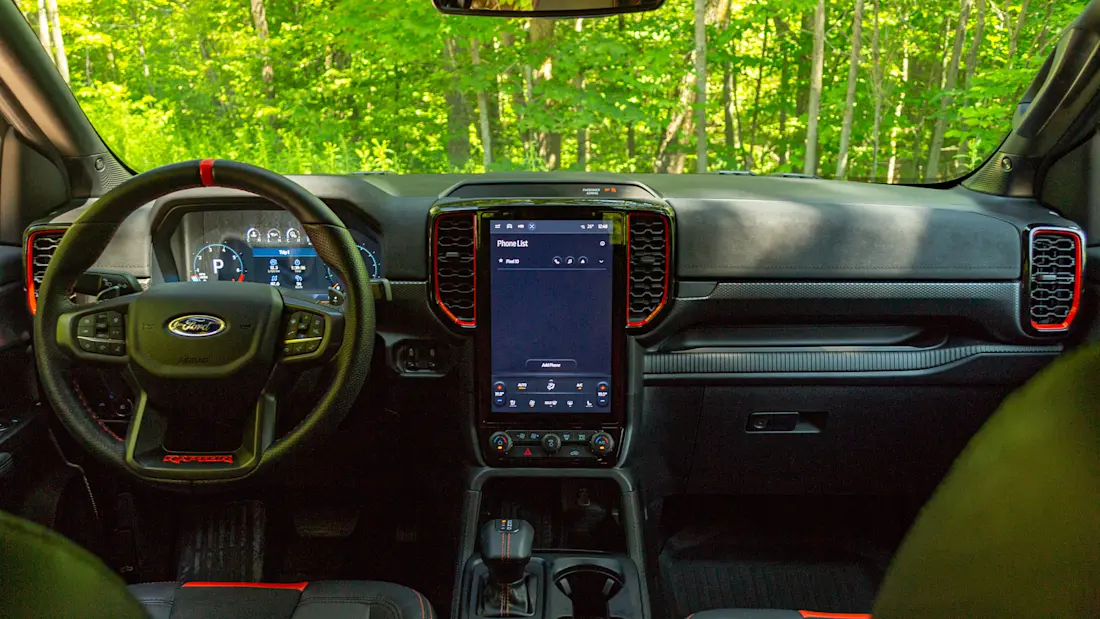
Good news: both Ford and Toyota understand the importance of physical controls in trucks. The Ranger and Tacoma feature chunky rotary dials for climate functions as well as basic audio functions. The Tacoma inches ahead here with more buttons for its heated and ventilated seats, and for keeping its heated steering wheel control as a separate, dedicated button. Toyota also earns major kudos for the multi-modal rotary selector beside the shifter. Not only does it fit in the transfer case modes but drive modes, Multi-Terrain Select, and the crawl control functions — all in one easy-to-use feature. Toyota still uses a classic PRND shifter too; the Ranger has an awkward setup that has us thumbing the manual shift buttons every time we want to shift into drive, as the lock is actually on the leading edge of the mouse-shaped shifter.
Where the Ford claws back points is in its touchscreen and in-cabin storage. The portrait-style screen is easy to use thanks to a clear menu structure, while response times are speedy. There’s never much time spent digging for any particular feature, and Apple CarPlay and Android Auto work seamlessly. By comparison, the Toyota’s main screen is basic in operation. Its wireless phone mirroring is just as easy to set up, mind you. Ford knows a thing or two about building trucks, and has peppered plenty of thoughtful storage solutions throughout the Ranger cabin.
There are multiple USB-C charging outlets in both truck cabins, though the Toyota’s wireless charger setup is better at maintaining consistent contact. Also, while the Ranger features a 400-watt outlet in its bed, the Toyota’s hybrid setup allows for a 2,400-watt setup.
Toyota Tacoma 8.5/10; Ford Ranger 8/10
Comfort
There’s no denying it: so long as one never needs to haul folks in the back seat, the Toyota’s IsoDynamic seats are both cool and comfortable. The bolstering is just right, Toyota’s artificial leather is indistinguishable from the real thing, and the engineering really does take the sting out of what the trails throw out. That’s not to say the Ranger’s seats are lacking, either: the additional upper bolstering keeps bodies firmly in place, while the flatter cushion sacrifices little support for easier ingress and egress.
The Ford also has the better on-road ride. A calmer, smoother character over uneven surfaces and a (comparatively) quieter cabin makes it the stronger pick on the highway schleps between trail runs. The Toyota has a busier ride with small imperfections having more of an impact. That can prove fun on the trails but tiring off them.
Toyota Tacoma 8/10; Ford Ranger 8/10
Driving Feel
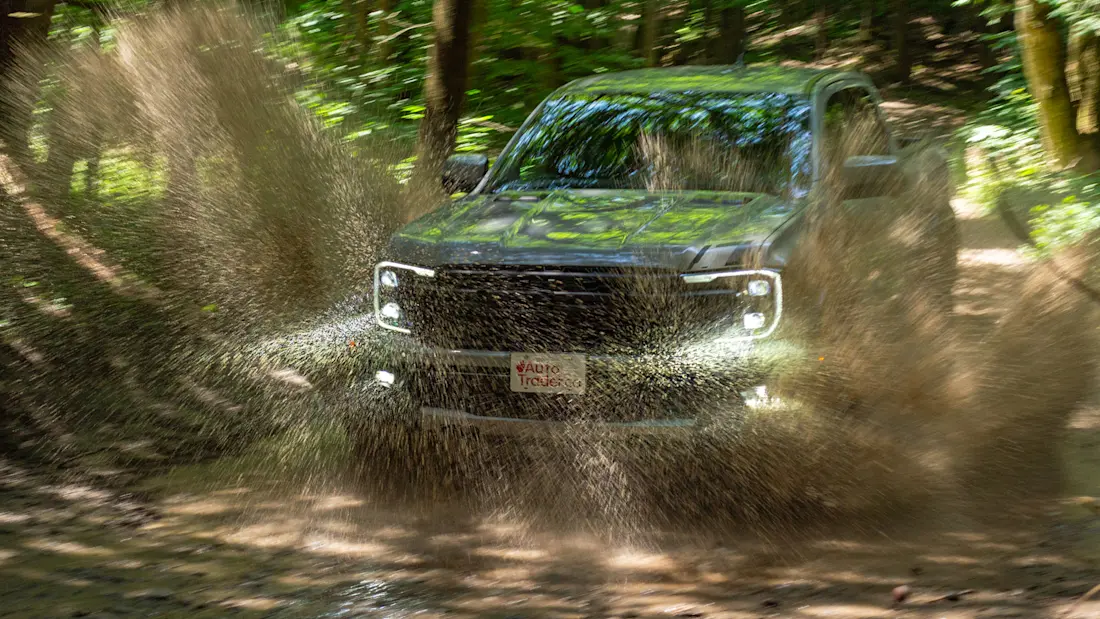
From behind the wheel, the Tacoma comes across as the larger of these two trucks, requiring slightly more care while threading between the trees. The steering is well-weighted and predictable, so it’s not a burden, but it lacks the easy-to-place agility of its competition. The suspension is on the stiff side but has excellent travel, especially at the rear where the Fox internal bypass shocks live. Based on prior high-speed off-road driving in the TRD Pro, this is where the Tacoma shines, easily taking larger yumps and bumps in stride while remaining locked on the intended path.
To be fair, the same is true of the Ranger. Put it in Baja drive mode and torque is split an even 50/50 between the front and rear axle, making it utterly predictable. The Ford also has Fox shocks, with the 2.5-inch internal bypass items featuring Live Valve technology which uses dedicated modules to monitor and adjust the damping in real time. There’s an eagerness in the Raptor that pays off with that classic “shrinks around you” feel. The steering is weightier and provides good feedback too.
The Ranger’s superpower is like its looks: surprisingly normal. While it can be capable of immense fun when given the right playground, it doesn’t punish its driver during everyday work, with a default drive mode that is no harsher than a regular Ranger. It’s an easier vehicle to simply jump in and play with; the Tacoma requires more fine-tuning with its myriad settings.
It’s important to note that while both trucks have rear locking differentials, the Ford also offers the same function up front, while the Tacoma counters with an electronic disconnect for its front anti-roll bar.
Toyota Tacoma 8/10; Ford Ranger 9/10
Powertrain
Toyota has brought hybrid power to its mid-sized pickup truck in an appealing way: by making it the more powerful engine. The i-Force Max is standard in the TRD Pro, a turbocharged 2.4-litre four-cylinder pairing with an electric motor sandwiched between it and the eight-speed automatic transmission. Horsepower is well shy of the Ford (326 hp), but torque is a Raptor-crushing 465 pound-feet. The electric assist fills any gaps the traditional powertrain might otherwise have, ensuring there’s plenty of torque at any combination of road and wheel speed. There’s even a good soundtrack too, like a GR Corolla that’s been gargling gravel. Uh, maybe I’m not doing it justice…
Ford sticks to traditional power here, a big 3.0-litre turbocharged V6 making a very healthy 405 hp and 430 lb-ft of torque. Like every other Ranger it routes that power to all four wheels via a 10-speed automatic. While other Ford vehicles with this ‘box can exhibit a lot of hunting for the right ratio, the Raptor never seems afflicted, easily selecting the right gear for the job. There’s an anti-lag feature unique to Baja mode but even without that, the EcoBoost motor is responsive. Drivers can use the manual overrides on the side of the shifter if they want, but it never feels entirely natural.
Toyota Tacoma 8/10; Ford Ranger 8/10
Fuel Economy
Neither one of these trucks is exactly easy on the wallet, but the Toyota has the hybrid advantage. According to National Resources Canada (NRCan) it clocks in at 10.5 L/100 km in the city, 9.9 on the highway, and 10.3 combined. NRCan still predicts $3,090 in yearly costs on regular fuel.
That comfortably beats the $4,200 the Ranger Raptor is expected to rack up in bills. The EcoBoost motor is unsurprisingly thirstier, scoring 14.8 L/100 km in the city, 12.9 L/100 km on the highway, and 14.0 combined. Like the Toyota, it runs on regular ol’ 87 octane fuel.
Toyota Tacoma 8.5/10; Ford Ranger 7.5/10
Safety
In addition to the very useful 360-degree cameras, both the Ranger and Tacoma come with a long list of driver assists and safety features. This includes full-range adaptive cruise control (with stop and go functionality), blind-spot monitoring, rear cross-traffic alert, lane keep assist, lane centering, and more. Toyota’s Proactive Drive Assist is present on the TRD Pro, acting as a sort of (overeager) adaptive cruise control even off the highway, lightly applying brakes on curves or if the truck senses a vehicle too close ahead. Of note: Ford’s cameras offer a broader view and stay on at higher speeds when off-roading.
The Insurance Institute for Highway Safety (IIHS) has awarded the Tacoma its Top Safety Pick designation; the Ranger misses out on the title.
Toyota Tacoma 8.5/10; Ford Ranger 8/10
Value
Neither one of these mid-sizers come with particularly mid-sized stickers, but then again, we live in an age of six-figure trucks.
The pre-options difference between these two could barely buy you anything from the McDonald’s value menu. Toyota charges $82,112 including a non-negotiable $1,930 delivery fee, and the only option on top of that here is the special blue paint (for $770). Meanwhile the Ranger Raptor starts from $82,115 (including its $2,495 delivery fee). This tester also adds the spray-in bedliner ($700) and Raptor graphics package ($1,000).
Toyota Tacoma 7/10; Ford Ranger 7/10
The Verdict
By the numbers, the Toyota wins here, though erasing the subjective styling category leaves these two pickups in a tie. Call it a matter of taste: we like the Ranger Raptor’s ease of use and its muscled-up, classic pickup feel. The Tacoma is a tougher vehicle to love at first, but worms its way into our hearts with more comfort, features, and a fuel bill that isn’t quite so painful. It looks like it wins after all — unless you’re regularly planning on putting adults in that back seat.

Specifications
Year Make Model Trim
2026 Toyota Tacoma TRD Pro
Engine Displacement
2.4L
Cylinder Count/Configuration
Inline four-cylinder
Horsepower
326 hp @ 6,000 rpm
Torque
465 lb-ft @ 1,700 rpm
Fuel Economy
10.5 / 9.9 / 10.3 L/100 km cty/hwy/cmb
Cargo Space
5’ / 1,532 mm bed
Base Price
$79,412
Options
Premium Paint ($770)
A/C Tax
$100
Destination
$1,930
Price as Tested
$82,982
Year Make Model Trim
2026 Ford Ranger Raptor
Engine Displacement
3.0L
Cylinder Count/Configuration
V6
Horsepower
405 hp @ 5,750 rpm
Torque
430 lb-ft @ 3,250 rpm
Fuel Economy
14.8 / 12.9 / 14.0 L/100 km cty/hwy/cmb
Cargo Space
5’ / 1,514 mm bed
Base Price
$79,620
Options
Spray-in bedliner ($700); Raptor graphics ($1,000)
A/C Tax
$100
Destination
$2,495
Price as Tested
$83,915

All Articles
See all
Best Hybrid Trucks in Canada for 2026: Towing, Fuel Economy, and Value
Compare 2026 hybrid trucks in Canada

2026 Subaru Outback vs Subaru Trailseeker Comparison Test
Subaru is offering shoppers two unique takes on its most iconic formula.
Kyle Patrick
Best Diesel Pickup Trucks in Canada: Towing, Fuel Economy and Value
For most Canadian buyers, the best diesel truck is a half-ton: the Chevrolet Silverado 1500 or GMC Sierra 1500 with the 3.0L Duramax. Natural Resources Canada (NRCan) rates it at 10.1 L/100 km combined in 4WD form (9.3 in 2WD), and the engine adds as little as $1,195 to the price.