
- Home
- Vehicle Research
- Hyundai
- Hyundai Ioniq
- 2017 Hyundai Ioniq

2017 Hyundai Ioniq : An overview
Find a complete overview of the 2017 Hyundai Ioniq, including key features and specifications, trims, inventory, alternatives, and other useful information. Read more
Review & compare
The 2017 Hyundai Ioniq has 8 trims. Below you will be able to review and compare them.
- 1 of 8
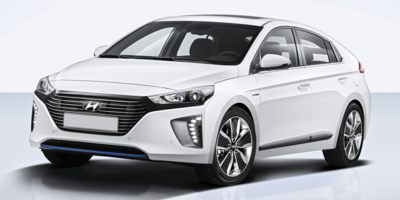
Blue 1.6 Hybrid
$24,299Gas/Electric Hybrid4.1L - 4.1L fuel / 100 kmFront Wheel Drive139 horsepower - 2 of 8
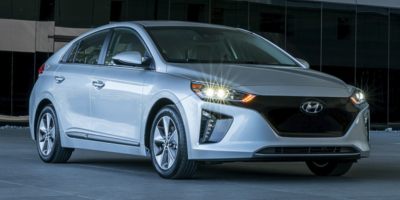
Limited
$29,749 - $41,849Gas/Electric Hybrid4.1L - 4.3L fuel / 100 kmFront Wheel Drive118 - 139 horsepower - 3 of 8
Limited Technology 1.6 Hybrid
$31,749Gas/Electric Hybrid4.1L fuel / 100 kmFront Wheel Drive139 horsepower - 4 of 8
SE 1.6 Hybrid
$26,499Gas/Electric Hybrid4.1L fuel / 100 kmFront Wheel Drive139 horsepower - 5 of 8
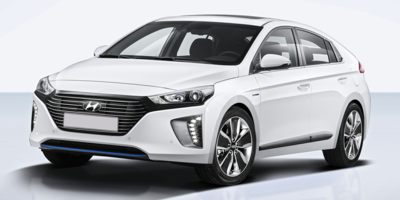
SEL 1.6 Hybrid
Price N/AGas/Electric Hybrid4.3L fuel / 100 kmFront Wheel Drive139 horsepower - 6 of 8
Limited 1.6 Hybrid
$29,749Gas/Electric Hybrid4.1L - 4.3L fuel / 100 kmFront Wheel Drive139 horsepower - 7 of 8
SE Cold Climate Package
$36,849ElectricConsumption N/AFront Wheel Drive118 horsepower - 8 of 8
SE 1.6 Hybrid
$26,499 - $35,649Gas/Electric Hybrid4.1L fuel / 100 kmFront Wheel Drive118 - 139 horsepower
2017 Hyundai Ioniq deals
- National
- Vancouver
- Calgary
- Edmonton
- Saskatoon
- Winnipeg
- Toronto
- Ottawa
- Hamilton
- Montréal
- Halifax
- St. John's
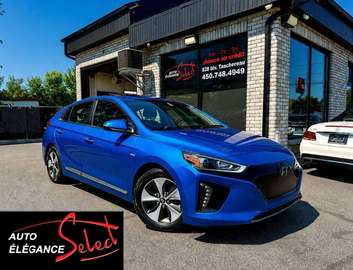
2017 Hyundai IONIQLimited à hayon 5 portes
$ 8,750- 228,800 km
- Electric
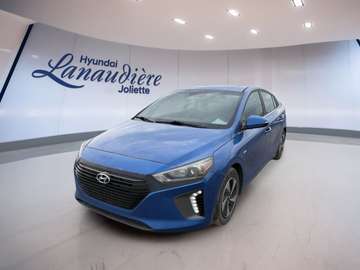
2017 Hyundai IONIQlimited / toit ouvrant / sièges chauffants
$ 8,995- 190,000 km
- Gas/Electric Hybrid
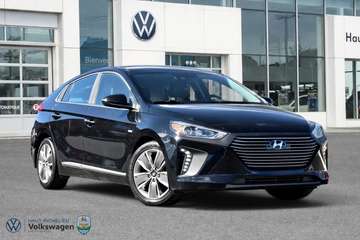
2017 Hyundai IONIQLIMITED + 1 PROPRIO + BAS KILO + TOIT OUVRANT + ÉCONOMIQUE + CUIR
$ 17,995- 35,695 km
- Gas/Electric Hybrid
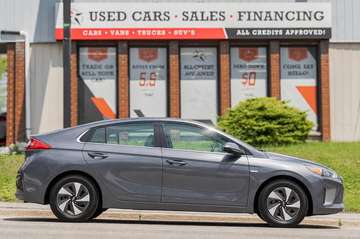
2017 Hyundai IONIQSE | Hybrid | Sunroof | Cam | CarPlay | Very Clean
$ 12,495- 129,039 km
- Gas/Electric Hybrid
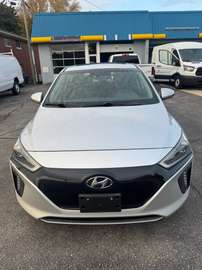
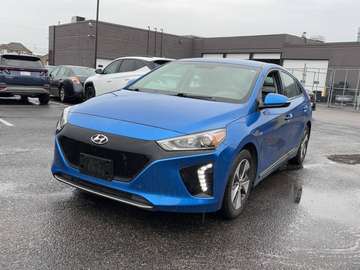
2017 Hyundai IONIQLimited
$ 8,501- 160,788 km
- Electric
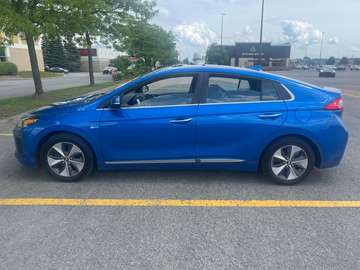
2017 Hyundai IONIQLimited
$ 9,999- 169,744 km
- Electric
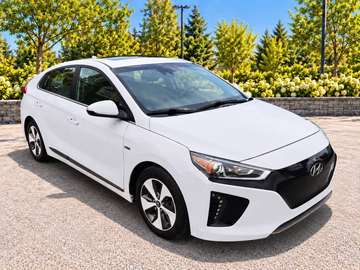
2017 Hyundai IONIQLimited
$ 12,800- 123,500 km
- Electric
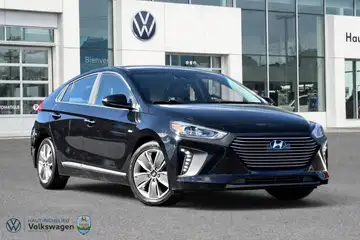
2017 Hyundai IONIQToit | Cuir | NAVI | Camera | Mags
$ 12,950- 169,929 km
- Gasoline




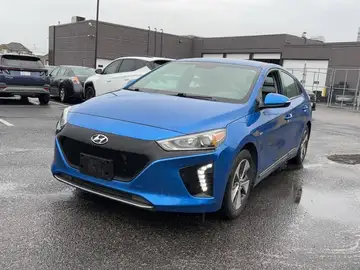


Whether it's Europe, Asia, or North America, Toyota's Prius has made its mark on motoring as a fuel-frugal champ. And while many brands have tried to dethrone the Prius, none have yet managed this feat. Hyundai, however, is looking to challenge the Prius's reign with the new and rather scientific-sounding Ioniq hatchback.
The Ioniq was designed from scratch to be a green vehicle and will be available in Hybrid, Electric, and Electric Plus (plug-in hybrid) forms. Its platform is shared with the Kia Niro, but where the Kia takes the shape of a wagon-like crossover, the Ioniq is a kammback hatchback, like the second- and third-generation Prius and the Honda Insight.
The three models feature varying details to reflect the powertrain configurations - for example, the electric model has a glossy black shield where the grille would otherwise be located on gas-fueled variants, and the lower valance trim is finished in copper rather than blue.
The Ioniq Hybrid and Electric Plus plug-in are the first to use the new ultra-frugal Kappa-family direct-injected engine. Output from this motor is a measly 104 hp and 109 lb-ft of torque, but come backed by an electric AC motor. In the case of the hybrid, it's a 43-hp motor that draws from a teensy 1.6 kWh lithium-polymer battery pack; the plug-in uses a beefier 60-hp motor and a bigger 8.9 kWh battery pack. As a plug-in, the Ioniq is estimated to have a range of around 40 km, which is good but not as good as the bigger, more expensive Sonata Plug-in Hybrid. Instead of a CVT or a complex array of planetary gearsets, both hybrid and plug-in use a six-speed dual-clutch transmission that drives the front wheels. Hyundai estimates that the standard hybrid model can travel up to 1,000 kilometres on a tank of fuel, and has a combined fuel economy rating of 4.1 L/100 km.
The Ioniq EV is the brand's first mass-market electric car. It boasts a 120-horsepower electric motor and a 28.0-kWh battery pack that drives the front wheels through a single-speed (direct drive) reduction gear. Impressively, the Ioniq is good for an estimated range of around 200 km. Aside from the Chevy Bolt, the Ioniq has one of the best all-electric ranges on the market, handily beating out the Kia Soul EV, BMW i3, Nissan Leaf, and Ford Focus Electric. As with many of its rivals, the Ioniq can be charged using a standard household outlet, or with a 240-volt fast charger in about 4.5 hours. The Ioniq also supports rapid Level 3 450-volt charging, which provides a full charge in as little as 35 minutes.
As an interesting technical footnote, all Ioniqs do without a conventional 12-volt car battery; all systems run off the high-voltage battery pack.
While Hyundai's tri-pronged approach to motoring may be unusual, the cabin is certainly anything but - a trait certain to appeal to those who find the futuristic styles of the Leaf and Prius off-putting. There's no unusual gearshift lever, and other than a reconfigurable instrument cluster, all controls and instruments seem conventional. All Ioniqs come standard with heated seats; heated rear seats and a heated steering wheel are also available. An 8.0-inch touchscreen infotainment system is also available, as are navigation and wireless device charging.
The Ioniq will also be offered with radar cruise control with emergency autonomous braking and pedestrian detection, blind-spot monitoring.
Trader Scores
This score is awarded by our team of expert reviewers after extensive testing of the car.
Interested in 2017 Hyundai Ioniq
Recall Information
More links
Similar vehicles to 2017 Hyundai IONIQ
- 2017 Honda Civic
- 2017 Mazda Mazda3
- 2017 Nissan Leaf
- 2017 Toyota Prius
- 2017 Ford C-Max
- 2017 Chevrolet Cruze
- 2016 Nissan Leaf
- 2017 Kia Soul
- 2018 Nissan Leaf
- 2015 Nissan Leaf
- 2017 Ford Focus
- 2019 Nissan Leaf
- 2017 Volkswagen Golf
- 2014 Nissan Leaf
- 2016 Toyota Prius
- 2018 Toyota Prius
- 2016 Ford C-Max
Popular comparisons for 2017 Hyundai IONIQ
- vs 2017 Honda Civic
- vs 2017 Mazda Mazda3
- vs 2017 Nissan Leaf
- vs 2017 Toyota Prius
- vs 2017 Ford C-Max
- vs 2017 Chevrolet Cruze
- vs 2016 Nissan Leaf
- vs 2017 Kia Soul
- vs 2018 Nissan Leaf
- vs 2015 Nissan Leaf
- vs 2017 Ford Focus
- vs 2019 Nissan Leaf
- vs 2017 Volkswagen Golf
- vs 2014 Nissan Leaf
- vs 2016 Toyota Prius
- vs 2018 Toyota Prius
- vs 2016 Ford C-Max


