
2027 Volvo EX60 First Drive Review + Video
 Dan Ilika
Amidst the controlled chaos of Barcelona’s morning commute, I feel a sense of serenity behind the wheel of the 2027 Volvo EX60.
Yes, that’s to be expected in an electric vehicle (EV) like this one, but there’s more to the story. It goes beyond the tasteful and tranquil interior, not to mention the supple suspension or the smooth and swift power delivery. There’s a tangible sense of peace and harmony here, too.
OK, the artificial intelligence (AI) integration courtesy of Google Gemini makes me a little uneasy — the idea of a virtual roadtrip companion strikes me as oddly dystopian — but dammit if it isn't insightful at times, offering advice about road rules in response to simple prompts. This is unfamiliar territory, after all.
As I head for the hills north of the city, that same sense of calm intensifies and washes over me like a warm Mediterranean wave. Where the EX90 has been hindered by its unfulfilled potential, its slightly smaller sibling comes through with what the brand boasted it would from the start.
New Platform, Who Dis?


It wouldn’t quite be right to call the all-new EX60 a mulligan, but it’s something of a do-over in Canada after the brand briefly sold the EX90 here before it was called off. Of course, that demise was brought about by reciprocal tariffs on American-made automobiles, but it also wasn’t quite ready for market when it launched — and it disappointingly remained that way.
That alone makes the EX60 a second chance for Volvo to deliver a better EV, and in many ways it succeeds at exactly that. It’s built on the third iteration of Volvo’s Scalable Product Architecture (SPA) platform, and is the first — and, as of this writing, only — vehicle to ride on SPA3 underpinnings.
Yes, that means it’s an evolution of the SPA2 setup used for the EX90 and the closely related Polestar 3 — as well as the Chinese-made ES90 sedan that isn’t sold here, although that could soon change after the federal government scaled back tariffs earlier this year — but Volvo promises it’s been improved in meaningful ways. That includes more efficient packaging than before, with its 95-kWh battery delivering more range than the 111-kWh unit under the EX90.
According to Volvo, the EX60’s dual-motor P10 variant that will be available in Canada at launch is good for an estimated range of 514 km compared to a maximum of 499 km for the EX90. Peak charging speeds are faster this time around, too, with the EX60 able to reach 370 kW in ideal conditions compared to 250 kW for its larger sibling.
The battery pack forms a foundational part of the SPA3 platform, serving not just as a fuel source but a structural component. It differs from most EVs architectures in that the battery pack isn’t simply positioned under the floor — it is the floor. Among the benefits, it means less material is used to make the EX60, while the battery’s energy density is higher.
The SPA3 underpinnings also allow the battery to sit lower than it would otherwise, which leaves more space inside for people and stuff. The cabin floor is flat all the way through, while the seats’ hip points feel more natural than they often are in EVs like this one, since they have to compensate for the high floors created by their batteries without reducing headroom as a result.
A Cocoon of Calmness

Although a rear-wheel-drive version of the EX60, dubbed the P6, will be available in other parts of the world, every Canadian example (at least at launch) will feature a dual-motor setup and all-wheel drive. Combined output is 503 hp and 524 lb-ft of torque — similar to the dual-motor Cadillac Lyriq. It’s enough to make this a properly quick EV, albeit one that doesn’t feel unnecessarily so.
Instead, the emphasis here is on smoothness rather than outright speed — although the claimed zero-to-100-km/h sprint of 4.6 seconds is certainly impressive. But so is the way the EX60 builds quickness confidently and not too violently, adding to the sense of serenity I picked up on immediately and basked in over the course of two days of driving around Barcelona.
The throttle is responsive and well measured, and while the brake pedal can feel a bit springy at times, it’s a non-issue with one-pedal drive mode engaged, allowing the vehicle to be slowed simply by easing off the accelerator instead. It’s a well-executed system, and it can even bring the EX60 to a stop as long as “creep mode,” the setting that allows an EV like this to roll forward like a conventionally powered vehicle, is disabled.
Every EX60 in Canada will come with adjustable adaptive dampers that can be cycled through a trio of settings: soft, normal, and firm. However, even the firm setting isn’t especially stiff, limiting body motion when cornering without leaving the ride feeling remotely punishing. Even with its enormous 22-inch wheels wrapped in low-profile tires, the EX60 is exemplary on the road — a claim the three-row EX90 can’t make with its available air suspension that has proven too harsh.
According to official estimates, the all-wheel-drive EX60 P10 that will be the first to hit the market later this year can travel 514 km on a full charge, while the more powerful P12 version that’s likely to arrive next year is expected to go 640 km. Those numbers aren’t based on generous European testing standards, either — they’re achieved using North American methods that more accurately reflect Canadian driving conditions and styles.
However, two days of testing saw significantly more range than those figures, with one P10 version showing 720 km with a full charge before I set off for my circuitous morning drive out of the city. Of course, those estimates are bound to fluctuate, but its ability to outperform expectations only adds to the EX60’s appeal as a viable alternative to a conventional crossover this size, including Volvo’s own XC60.
All Types of Technology
The EX60 is the first Volvo to feature a Tesla-style charge port, which means it can be hooked up to that brand’s network of chargers (although the fastest among them is only capable of 250-kW speeds). Connecting to a 400-kW station, which are few and far between, means making the benchmark 10 to 80 per cent boost in 18 minutes in ideal conditions, according to Volvo, while slower DC fast-chargers are likely to do the job in about half an hour or so.
Beyond the EV fundamentals, Volvo claims this is its “most intelligent” vehicle to date, and “truly software-defined” — industry lingo for a vehicle that’s heavily reliant on over-the-air updates to its various systems. It also features Google’s Gemini AI assistant, which can offer mundane banter on the go — the benefits of visiting Barcelona or Madrid, for instance — in addition to vehicle-specific information and adjustments. And Volvo claims more functions will be added.
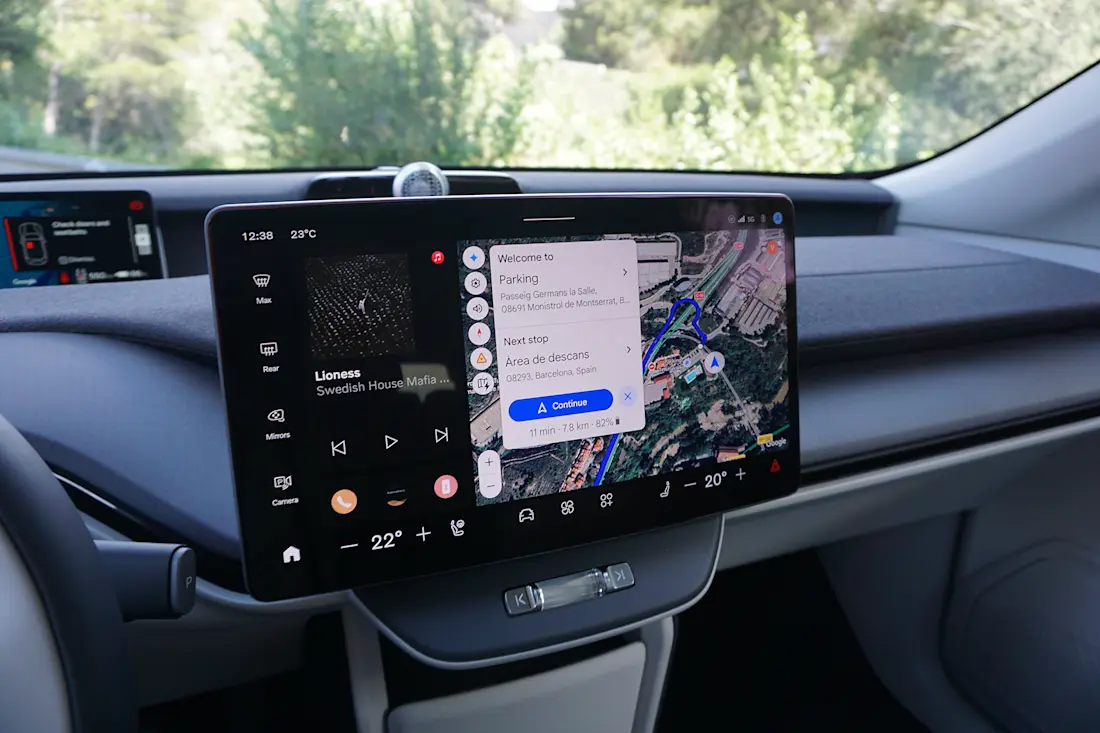
While the overall user experience is similar to the one in the EX90, the execution has been improved this time, starting with the switch to a landscape-oriented touchscreen. Better still, the 15-inch unit runs software that’s simple to use and makes logical sense. Want to access vehicle-related settings like drive mode or suspension softness? Tap the icon nestled at the bottom of the screen that looks like a vehicle to call up a sub-menu of features.
Meanwhile, the rest of the system works like a smartphone, with a menu of tile icons for the various applications, and integrated Google Maps navigation that can be viewed on both the big touchscreen and the 11.4-inch instrument display that sits high atop the dashboard. That’s another improvement compared to the EX90, which has its screen sitting on the steering column, with the switch putting important information a short glance away from the road ahead.
Volvo’s designers certainly know what they’re doing when it comes to styling a vehicle that suits the Scandinavian aesthetic and it shows. The cabin is the same sort of tastefully minimalistic space the brand has perfected through the years, with simple shapes and nice materials throughout. Of course, there’s been some reinventing of the wheel — including in the literal sense, as the steering wheel isn’t a wheel at all — but there’s an undeniable touch of class here.
Final Thoughts
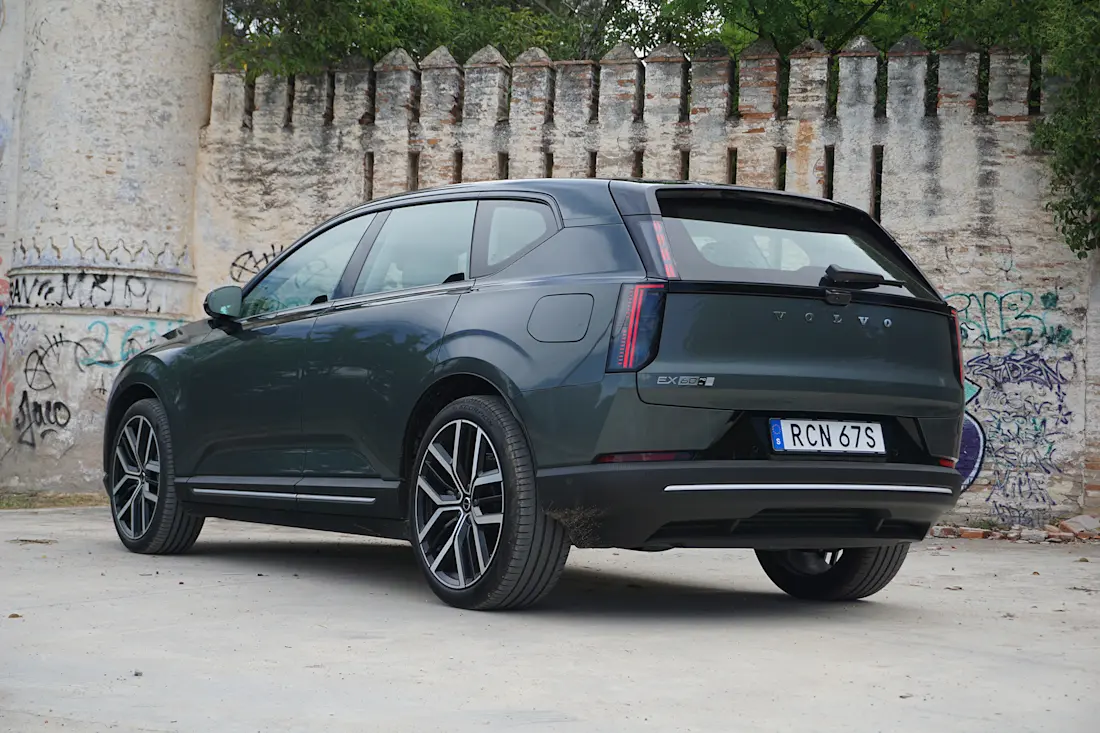
After some missteps in recent years, the Swedish-made 2027 Volvo EX60 arrives not just as a vastly improved product but one that resets the standard for premium crossovers this size regardless of how they’re powered. It’s also priced competitively, including within the brand’s own portfolio, starting at $77,500 before options, freight, and taxes for the P10 Plus, while the P10 Ultra is $84,000. (Freight adds an astonishing $3,100 to either of them.)
The similarly sized XC60 has a cheaper starting price, but its plug-in hybrid (PHEV) variant can cost quite a bit more, with the range-topping Polestar Engineered trim ringing in at $92,450 before extras and fees. Its stiffest competition likely comes from the equally new BMX iX3 that has official range estimates that surpass what was experienced here; but the EX60 is an impressively well rounded EV that manages to more than make up for Volvo’s past mistakes.

All Articles
See all
2026 Volvo XC90 T8 PHEV Review
With its available plug-in hybrid powertrain, Volvo’s updated three-row is in a class of one.
 Jeff Wilson

2025 Volvo EX90 Review + Video
This swanky three-row EV has a lot to live up to.
 Jodi Lai

2026 Volvo XC60 First Drive Review + Video
This compact crossover’s stay of execution is a strikingly familiar story.
Dan Ilika