
2027 Mercedes-Benz C-Class Electric First Drive Review + Video
 Dan Ilika
In overhauling the C-Class, Mercedes-Benz isn’t just electrifying this longstanding staple of its lineup — it’s elevating it, too.
Yes, the powertrain is important; but it also isn’t the defining characteristic of the redesigned 2027 Mercedes-Benz C-Class Electric, rare for an electric vehicle (EV) like this. Instead, those components form the foundation for a significantly more upscale experience than ever before, with first-time features that take the look and feel of this mainstay model to new levels of luxury.
A Second C-Class


This isn’t the only Mercedes model to make the switch to an electric powertrain in recent times. The smaller CLA-Class came before it, as did the GLC-Class crossover that’s launching soon. And like the latter, the existing gas-powered C-Class will be sold alongside this emissions-free version, with a facelift likely to come in the near future that will more closely resemble this one.
It’s part of an altogether different approach to design than the one Mercedes took with the existing EQE and EQS models — cars that will soon depart the Canadian market (although they’ll continue on elsewhere, including in Europe). Instead, the C-Class will follow a similar path to the CLA-Class, although the parallel production of two versions is different from that car, which comes with the choice of electric or hybrid power in the same package.
While that works for entry-level luxury models and their transversely mounted motors — that is, they’re configured across the engine bay and are accompanied by front- or front-biased all-wheel drive — a classically premium car like the C-Class calls for separate rear-biased architectures, one for gas power and the other electric.
In this case, even the all-wheel-drive C 400 that will first launch in Canada prioritizes powering the rear axle. In fact, according to Mercedes, the separate motor up front can automatically disconnect to reduce mechanical drag and improve efficiency. The system works entirely imperceptibly, just as it should. Instead, it functions in a boost capacity to aid acceleration or when more traction is required — say, on loose or slippery surfaces.
Next-Gen Electric
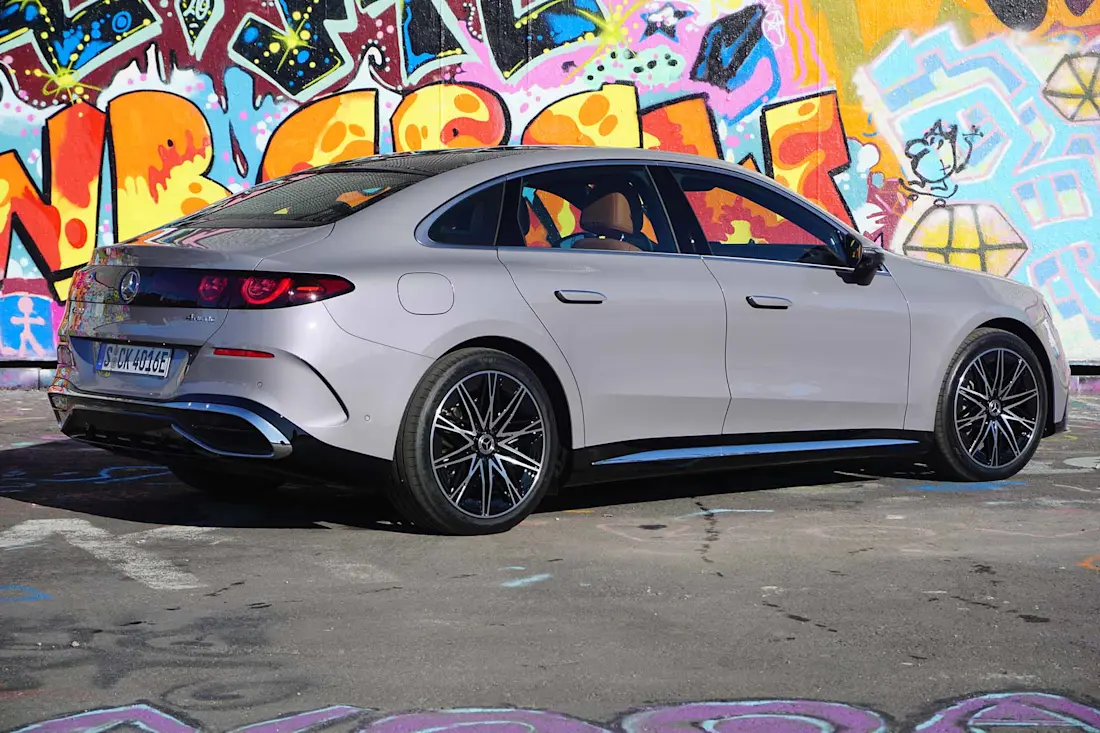
When they’re working in unison, those motors make a stout 483 hp and 590 lb-ft of torque — plenty of output, no doubt, although the execution is more dignified than the four-second sprint time from a standing start to 100 km/h would suggest. Make no mistake: this is a quick car, but it’s one that’s more at home calmly cruising around than racing between traffic lights.
That’s also how to make the most of its 94.5-kWh battery pack; and while official range estimates for the Canadian market weren’t available at the time of writing, it’s reasonable to expect figures near 600 km on a full charge. Notably, that’s less distance than the rival BMW i3 can cover, although a subsequent rear-wheel-drive version of the C-Class Electric could come closer to that car’s maximum range of roughly 700 km.
More than that, the C-Class Electric utilizes an 800-volt architecture and is capable of peak DC fast-charging speeds of 330 kW. That means the benchmark 10-to-80 per cent boost should take 22 minutes in ideal conditions, while as much as 325 km of range can be added in just 10 minutes, according to Mercedes — promising numbers across the board that surpass what the similarly sized EQE Sedan is capable of, and by significant margins.
For the sake of comparison, the EQE Sedan that launched in 2022 uses a 90.5-kWh battery and has an estimated range of 430 km. Meanwhile, its peak charging speeds are 170 kW, with an optimistic 10-to-80 per cent time of 32 minutes. If nothing else, those numbers show just how much progress Mercedes has made with its EV program in a relatively short period.
All the Latest Tech
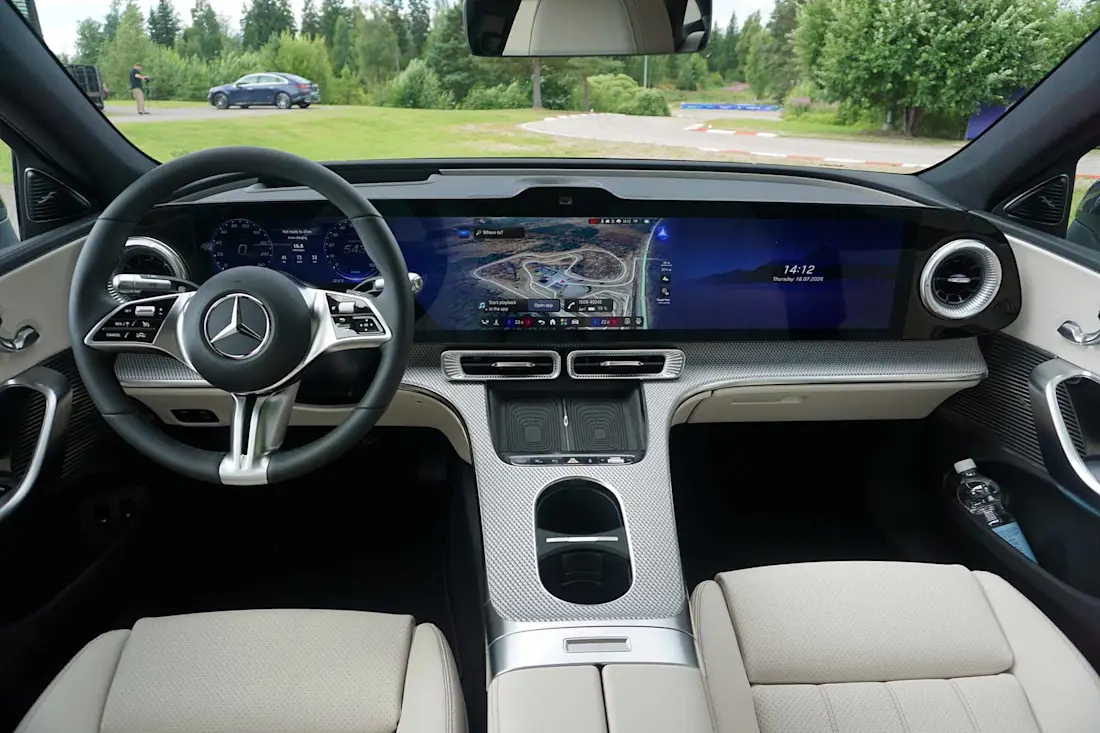
Beyond its EV essentials, the C-Class Electric has been loaded with the latest in-vehicle technology Mercedes has to offer, including its so-called Hyperscreen setup. The optional 39.1-inch panel that spans the dash combines three displays in one, with a dedicated passenger-side portion that’s obscured from the driver’s view and can be used to play games or stream movies on the go.
The Mercedes-Benz Operating System (MB.OS) software that runs it all also allows for a virtual assistance function that uses five different artificial intelligence (AI) agents — an auto industry first, according to Mercedes. That means a Google-based bot can handle smart navigation instructions, for example, while another uses ChatGPT for conversations.
While the similar system inside the all-new Volvo EX60 seemed quicker and more fluid with its responses during a recent test, the one here impressed with its on-the-fly ability to identify a song based on limited prompts — a few lyrics in one case; or asking about a movie title track in another — or find a local restaurant that served a specific dish. And, of course, it’s bound to get better with time through training and updates.
Beyond that, the C-Class Electric is a connected car that can share its intelligence with others. Of course, the caveat is that they must also be MB.OS-based models, but those that are will benefit from information gathered about road imperfections to adjust their suspension damping accordingly at specific geographic locations. (According to the automaker, the road information that’s collected is anonymized, and the feature can be disabled via a connected account.)
Elevated Comfort
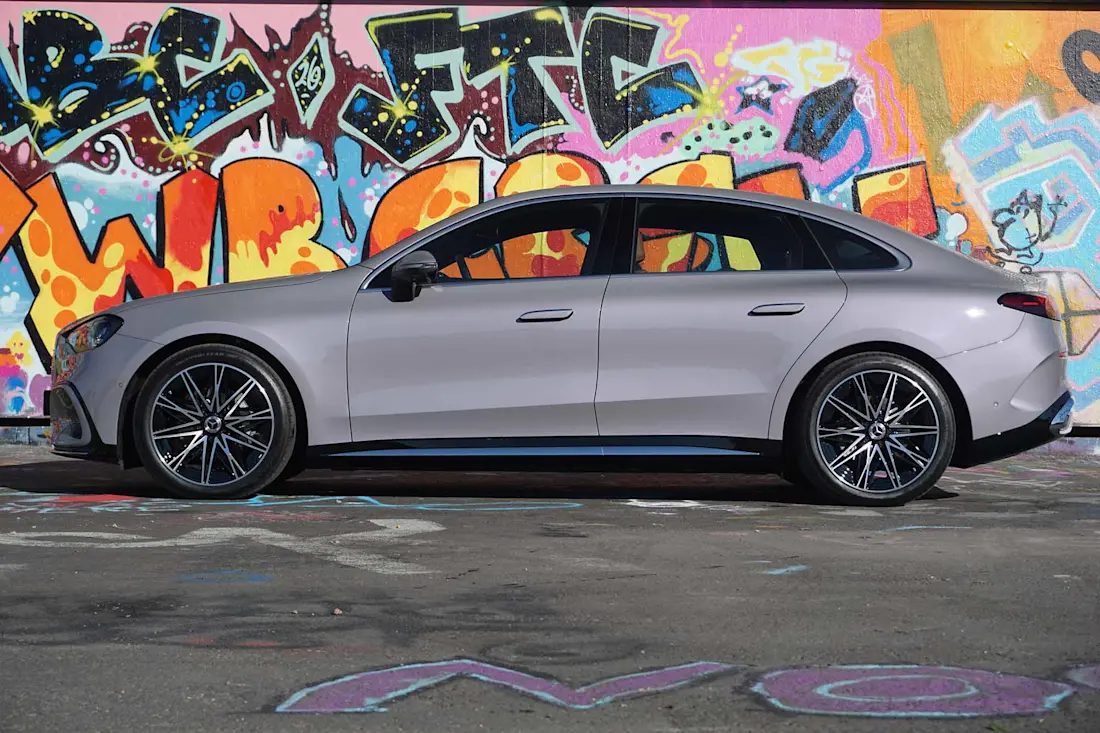
That intelligent suspension damping is just one of the ways the C-Class Electric elevates on-road comfort to levels usually reserved for the grandiose S-Class. (Yes, really.) Another is its optional air suspension that, while offered in this model before, can be combined with rear-axle steering for the first time. Together the systems enhance agility as well as this EV’s ability to soak up road imperfections before they reach the cabin.
OK, fine — the roads in and around the Finnish capital of Helsinki are surprisingly smooth for a place that freezes as deeply as anywhere in Canada during the winter months. But the rough surfaces that were encountered during two days of testing were tamed with the grace of an even more upmarket entry. It’s easily this car’s finest trait, and puts it in an unparalleled place atop its segment and beyond.
Where the suspension setup struggles at least a little is when it comes to controlling body motion. Set in its default comfort drive mode, the C-Class Electric has a tendency to tip and roll on winding roads, with quick changes of direction met with an absence of resistance. Coupled with the barely-there steering feel, this EV isn’t exactly the driver’s choice — but then that’s what the existing gas-powered AMG C 43 is for.
And in fairness, making the switch to sport mode reduces body roll to acceptable levels, plus it permanently engages the front motor for more traction and power. While the C-Class Electric remains better suited to relaxed rather than spirited driving, it can be adapted to the situation at hand. It also benefits from regenerative braking that can be adjusted to proper one-pedal driving using steering wheel-mounted paddles, harvesting energy at rates as much as 300 kW.
Final Thoughts
What remains to be seen is how much all that comfort and technology will cost. While pricing wasn’t yet available as of this writing, it’s conceivable that a fully loaded example could cost close to the six-figure mark. But there’s reason to believe Mercedes could keep the starting price in Canada somewhere more reasonable — say, around $74,000, splitting the difference between the existing gas-powered trims.
Either way, the 2027 Mercedes-Benz C-Class Electric is set to arrive at an interesting time — not just because of what it brings as part of the brand’s new generation of EVs, but also the rivals that will hit the market alongside it. Brands like BMW and Volvo have made serious strides in their own electrification efforts, making the path to success for Mercedes and its new C-Class anything but clear.
But then competition breeds innovation, and in the face of those improved rivals Mercedes has made a universally viable alternative to a gas-powered car, and all without eliminating exactly that from its lineup. Instead, this sedan stands apart as a smooth, efficient, and tech-filled flagship of the C-Class stable.

All Articles
See all
2027 Mercedes-Benz CLA Electric First Drive Review
A Tesla fighter in the truest sense, the new CLA-Class might even be considered a bargain.
 Chris Tsui

2025 Mercedes-Benz GLC 350e Review
Plug-in power for those who aren’t ready to take the entirely electric plunge.
 Jil McIntosh

2025 Mercedes-Benz eSprinter Review
It isn’t great for criss-crossing area codes, but this Mercedes is masterful in the city.
Dan Ilika