
2026 Mazda CX-5 Review
 Jeff Wilson


Trader scores
This score is awarded by our team of expert reviewers after extensive testing of the car.
When a top model in an automaker’s lineup sells at nearly double the volume of its next closest contender, there’s precious little room for error.
That’s exactly the scenario Mazda faced with the redesigned CX-5 crossover, which makes this the third-generation model a very big deal. Mazda has attempted to rectify complaints levelled against the old CX-5, with notably more interior space and a big emphasis on technology — but the results are mixed for the 2026 Mazda CX-5, with a bit too much reliance touchscreen integration.
Design: 7/10
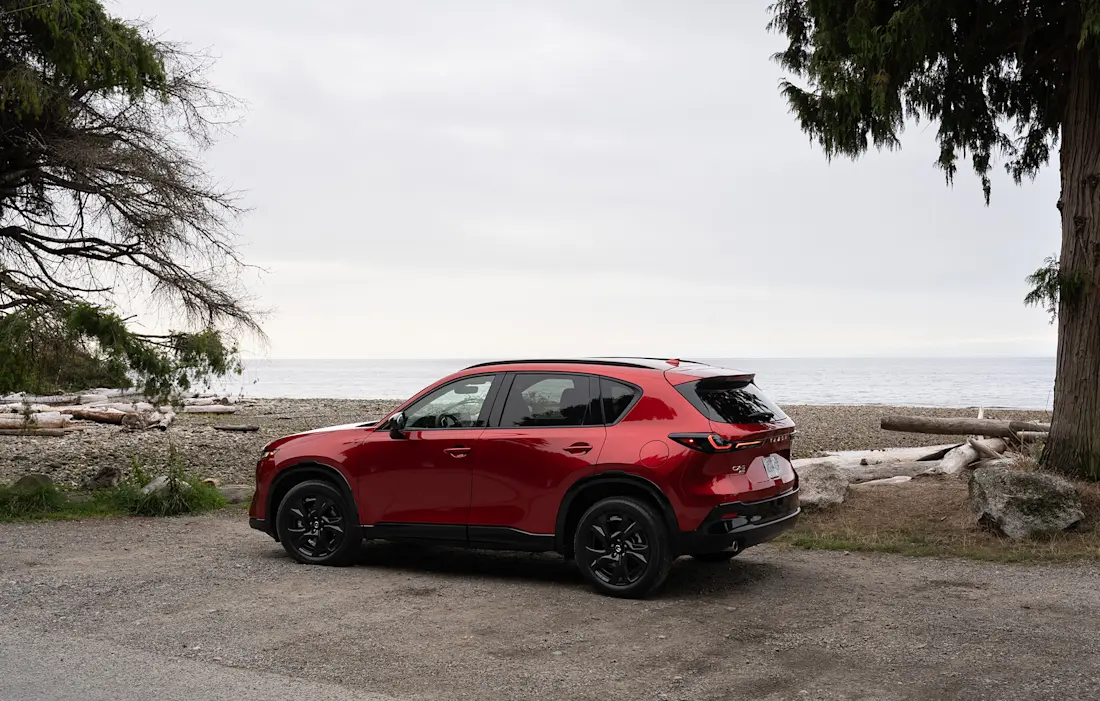
For quite a while now, Mazdas have stood out from the competition for their driving engagement and their styling. Starting with the so-called Kodo design language that was introduced almost 15 years ago, models like the CX-5 presented a sporty appearance without overt baubles and flourishes. In short, it was a clean, timeless approach to design that the company has honed and polished to keep fresh ever since.
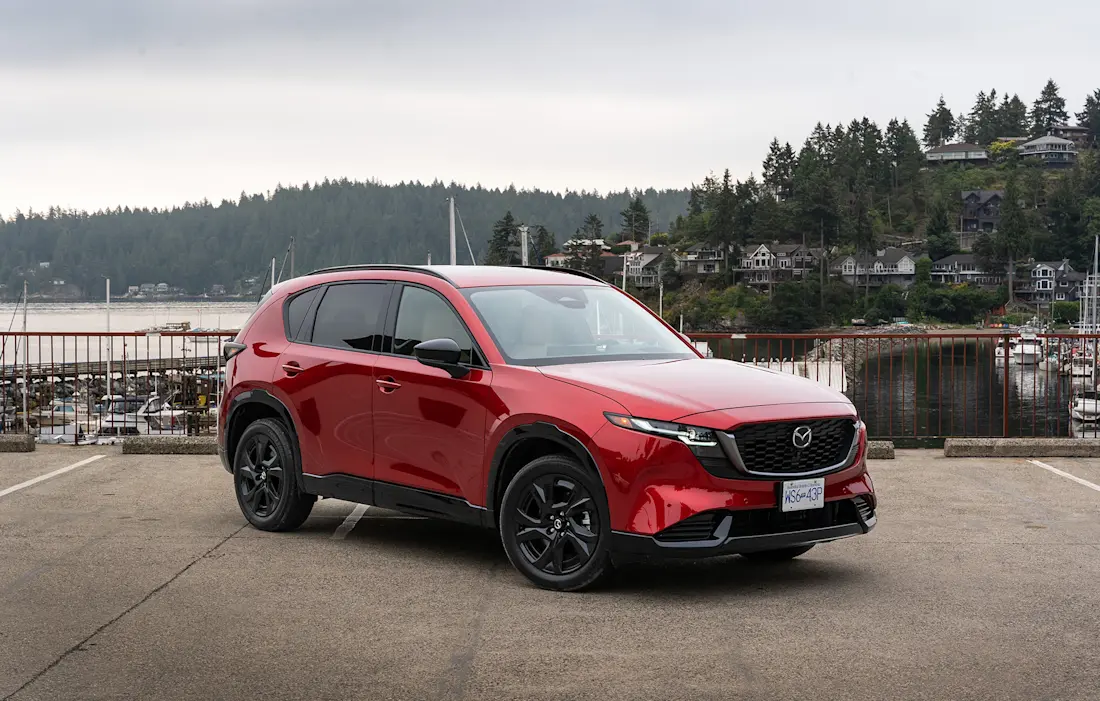
This new CX-5 continues the tradition with good proportions and a tasteful application of chrome around the grille. Of course, Mazda could cover a trash can in its gorgeous Soul Red paint pictured here and we’d be enamoured. My driving companion called it “juicy,” and it’s a wonderfully apt descriptor.
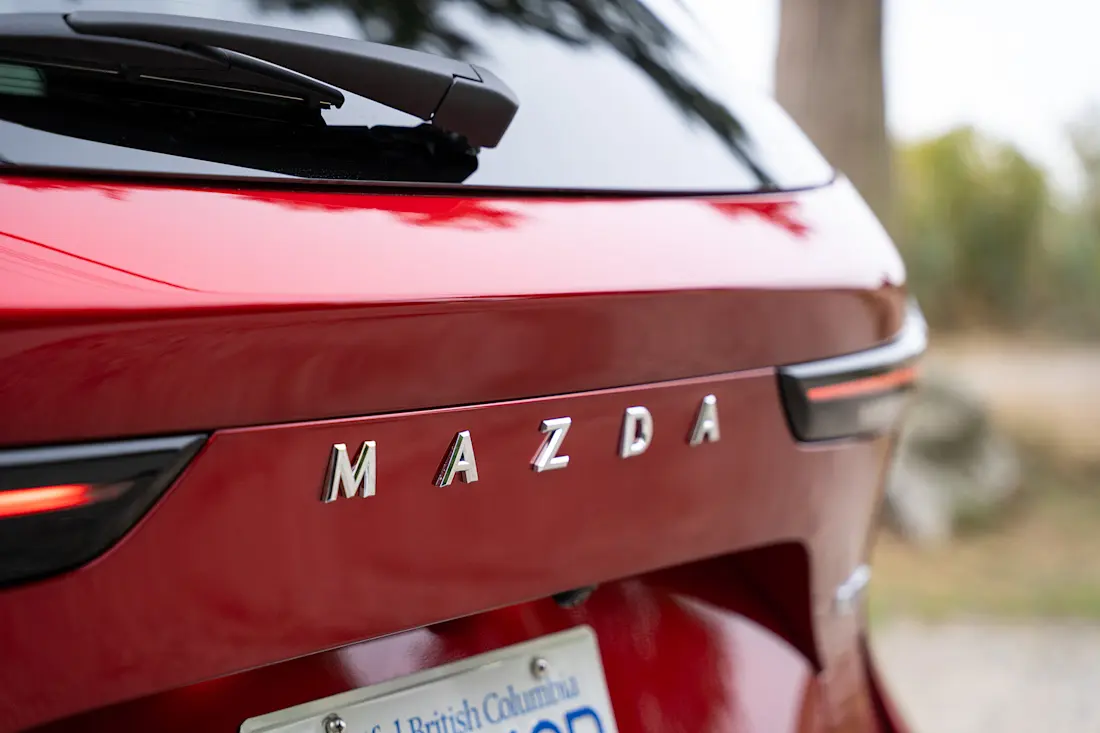
Mazda’s stylists have jumped on the bandwagon and swapped out the soaring seagull badge on the rear for the brand’s wordmark spelled out in block letters. It was kind of neat when a few luxury brands first did it, but, like black painted wheels, it’s a tired trope that’s a little behind the times now.
Inside, the GT trim tested here wore a handsome, high-contrast tan and black look. Unfortunately, the cost-cutting becomes immediately apparent once you’re seated inside. Other recent Mazdas have made a stronger move upmarket in terms of the look and finish of their interiors, but many of the material choices here are disappointing. Most egregious is the hard, shiny plastic on the dash top that instantly cheapens the experience.
Equipment: 8/10
The GT is the range-topper for the CX-5 lineup, and it comes with black 19-inch wheels and glossy black fender cladding, for better or worse. Inside, there’s a 12-speaker sound system, satellite radio, wireless phone charging, heated and ventilated leather front seats, plus heated rear seats, and a heated steering wheel. This tester was also equipped with the Premium package ($4,500) that includes a panoramic sunroof, a larger dash-top infotainment screen, and hands-free operation of the power tailgate.
User-Friendliness: 6/10
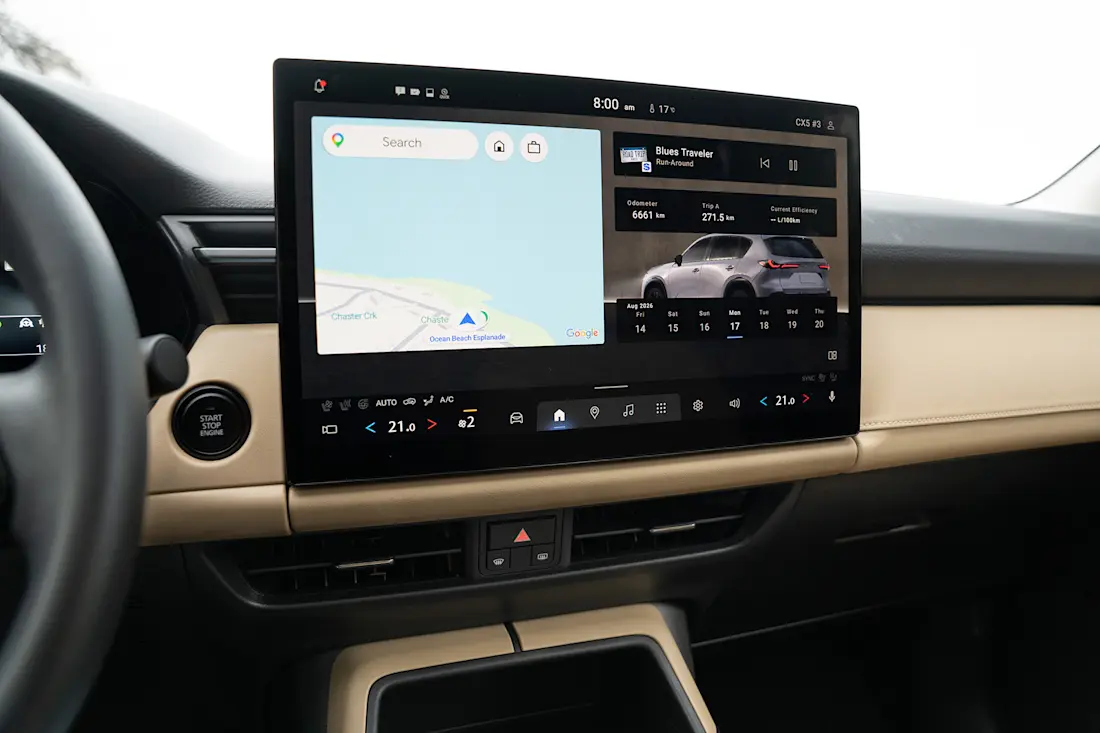
For years, most auto writers (including yours truly) moaned about Mazda’s archaic and tedious infotainment system that forced users to rely on a cumbersome rotary controller, unless you were using Apple CarPlay or Android Auto, which in most models worked via touch. Mazda’s developers certainly heard the complaints, and now there’s an enormous touchscreen in the middle of the CX-5’s dash.
Lesser trims have a sizable 12.9-inch display, but with the Premium package comes a massive 15.6-inch unit. Its graphics are bright and crisp, and it proved decently responsive to inputs, but far too many rudimentary controls now require pecking at a screen instead of the functional buttons and switches found in earlier Mazdas.
A volume knob has been replaced by swiping on a portion of the screen — or tapping a pad on the steering wheel — and some climate controls require digging into sub-menus to find. The car-buying public has been vocal about its disdain for distracting interfaces such as this, and other manufacturers have already begun reversing the trend and adding more physical switchgear back into their vehicles. It seems Mazda missed the memo.
Otherwise, the driving position allows good outward visibility, and wirelessly connecting a phone via Apple CarPlay is easy. Plus, while some manufacturers have forced confounding gear selectors in the form of dashboard buttons or console dials, Mazda has stayed properly old-school with a traditional gear lever.
Comfort: 8/10
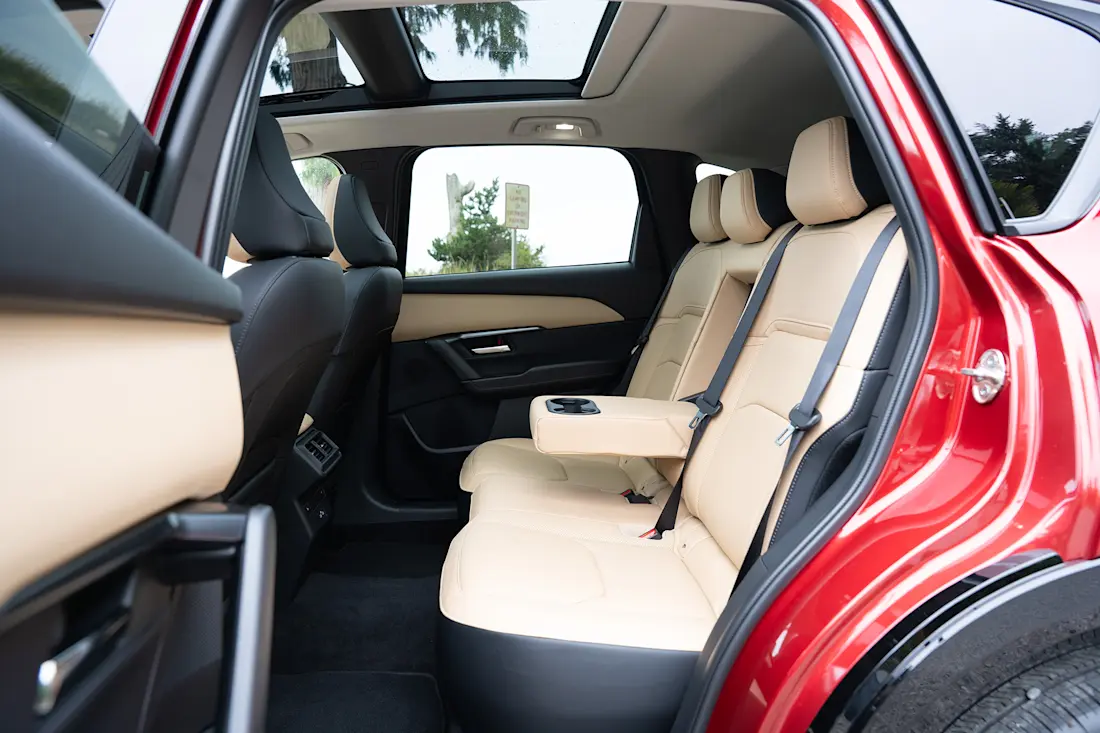
On paper, the numbers indicate there’s more room in the Toyota RAV4 and Honda CR-V in almost every respect. But Mazda has made meaningful improvements to both the passenger and cargo space in the new CX-5, and it’s noticeable — especially in the rear seat that provides generous head- and legroom.
Up front, occupants are treated to comfortable seats that kept my aging back from complaining while touring around British Columbia’s lower mainland. The CX-5’s suspension does an impressive job of soaking up bumps, and while the 19-inch wheels may not look as swanky as a set of 21s, the extra sidewall of the tires helps improve ride quality. Wind and road noise are well hushed, but the engine is raucous and always sounds like it’s working hard.
Everyday Usability: 7/10
The load floor is low and wide, and the space quite square, which makes the CX-5’s cargo hold very usable — even if its 954 L behind the rear seat is more than 100 L less than RAV4’s. Folded, the convenient 40/20/40 split rear seat opens up 1,882 L of volume, putting it about mid-pack amongst key competitors.
The CX-5’s 680-kg (1,500-lb) towing capacity is negligible but also typical of this segment. Here, too, the RAV4 more than doubles the Mazda’s capability, being rated for as much as 1,588 kg (3,500 lb).
Powertrain: 7/10
The Mazda’s lack of towing prowess might have something to do with the carryover engine fitted under its hood. The 2.5L four-cylinder is the only option as of this writing, delivering 187 hp and 186 lb-ft of torque. While competitive with the Subaru Forester’s engine, both the RAV4 and CR-V have hybrid powerplants that help generate a lot more oomph.
Still, the CX-5’s engine is certainly adequate, providing enough output to ensure it can keep up with traffic and execute passes without needing to schedule them on the calendar ahead of time. Mazda has also stuck with its venerable six-speed automatic transmission, which works well enough, delivering smooth shifts most of the time. It can snap off a decently quick gear change when called upon, too. However, having an extra gear (or two) would help maximize the engine’s performance and responsiveness.
Efficiency: 7/10
An extra gear or two would also help the CX-5’s fuel efficiency. As it is, with a combined average of 9.0 L/100 km, the Mazda trails the Forester and gas-only CR-V by small margins, but falls well behind the efficiency of the segment’s hybrids, including the RAV4 that’s only offered that way. During a week of mixed highway and city driving, I saw a rather disappointing indicated average of 10.1. A hybrid version of the CX-5 is reportedly on the way for next year.
Driving Feel: 8/10
Despite the CX-5’s supple ride, the chassis wizards at Mazda have still imbued it with the roadholding capabilities we’ve come to expect from the brand. For a compact crossover, the CX-5 is surprisingly nimble and willing to head for the hills, tackling curves with more zeal and composure than expected from a mainstream family machine. The steering is quick without being twitchy, and although the efficiency-oriented tires don’t offer sports car-like grip, they also don’t howl in protest at any sort of spirited driving.
Safety: 9/10

Mazda put serious effort into making the CX-5 a safe machine. The standard advanced safety suite provides emergency braking front and rear, plus lane-keeping and blind-spot monitoring with steering assistance. The driver attention monitoring isn’t as aggressive as some competitor systems, although it can still be a little bossy at times.
This tester featured adaptive front lighting, surround-view cameras and parking sensors, and adaptive cruise control. In practice, all the CX-5’s safety features and structure served it well when the Insurance Institute for Highway Safety (IIHS) performed its testing and awarded it the highest Top Safety Pick+ rating.
Value for Money: 8/10
With a starting price of less than $38,495 before tax but including freight ($2,195), the entry point to the CX-5 lineup is reasonably competitive with the more affordable offerings from Hyundai and Kia. Step up to the GT and its optional Premium package, and the CX-5 becomes a pretty solid value against the likes of the Honda CR-V and Toyota RAV4 in their most expensive trims. However, both are hybrid, and have more power.
The Verdict
The 2026 Mazda CX-5 presents a machine more contemporary in styling, technology, and features. Unfortunately, with the absence of a turbocharged or hybrid powertrain alternative, it only competes with the mid-pack offerings from other manufacturers. Add in the challenging ergonomics thanks to the screen-dependent user interface, and it might be worth the extra cash to consider the CR-V or RAV4 instead.

Specfications
Year Make Model Trim
2026 Mazda CX-5 GT
Base Price
$42,200
Options
$5,000 — Premium package, $4,500; Soul Red Crystal Metallic paint, $500
A/C Tax
$100
Destination
$2,195
Price as Tested
$59,495
Displacement
2.5L
Cylinder Count/Configuration
I4
Horsepower
187 hp @ 6,000 rpm
Torque
186 lb-ft @ 4,000 rpm
Fuel Economy
9.9 / 7.9 / 9.0 L/100 km cty/hwy/cmb
Cargo Space
954/ 1882 L seats up/down

All Articles
See all
2026 Mazda CX-5 Review
The redesigned CX-5 offers more space and more comfort, but also more frustration.
 Jil McIntosh

2026 Mazda3 Review
Fun to drive and easy on the eyes, Mazda’s sedan is starting to lag on technology.
 Benjamin Hunting

2026 Mazda CX-90 Review
Mazda’s CX-90 represents the emotional choice in its segment of three-row SUVs.
Jeff Wilson