
2026 Lamborghini Temerario Track Test + Video
 Dan Ilika
Denying the electrified future of the auto industry is futile.
Done grumbling yet? Good.
Much of what’s on the horizon is still being decided by executives and engineering departments around the world, but there’s no doubt Lamborghini has homed in on an intriguing strategy that it has applied once again, this time to its successor to the Huracán. That’s because like the Revuelto before it, the 2026 Lamborghini Temerario is technically a plug-in hybrid (PHEV), which means it’s capable of at least a little emissions-free driving.
In reality, those PHEV components — a small battery pack to go with a trio of electric motors — are used to augment the high-output eight-cylinder nestled a short distance behind the seatbacks. And when working in unison and unleashed on a world-class race track, the system delivers the type of total performance bliss that can turn skeptics into true believers of the literal and figurative power of electrification.
No Need For Cold Feet


Once again, Lamborghini has turned to electrification to solve the self-induced problem of squeezing evermore performance from its automobiles. OK, fine — some of it comes down to industrial emissions reduction targets instituted by regulators around the world. And in the case of automakers like Lamborghini parent company Audi, itself a subsidiary of the Volkswagen Group, that means an increasing reliance on downsized turbocharged engines to deliver results.
That includes performance cars like this one — a harsh reality for a brand that made a name for itself selling wedge-shaped cars with enormous 10- and 12-cylinder engines mounted midship. But as Davide Bizzarri, the brand’s head of vehicle motion and energy management, puts it, that type of forced induction on its own comes up short. And he really means it.
“I call the turbo a short blanket,” Bizzarri said with a wry smile, offering a semi-serious analogy for the imperfect nature of forcing more oxygen into the engine using exhaust gases.
The issue, especially in a high-performance application like this, is the size of the turbos themselves, hence his chosen metaphor. While small ones spool quickly, increasing low-end torque generation, they’re far less effective at high speed. That’s where bigger turbos work best, but they’re useless when it comes to acceleration.
One solution involves mismatched turbos, with one for the quickness and the other top-end velocity. Another is electrification. But, according to Bizzarri, the key to the execution here was to ensure the drive experience wasn’t diluted in any way. After all, as with the Revuelto, this is a Lamborghini, and there’s a certain rawness that’s supposed to exist no matter how precise the brand’s cars have become.
“We didn’t want to do a system that is like (playing) with a PlayStation,” Bizzarri said. “The car is helping you, is talking to you, is giving you feedback. But it’s not doing the job for you.”
An Engine That Sings
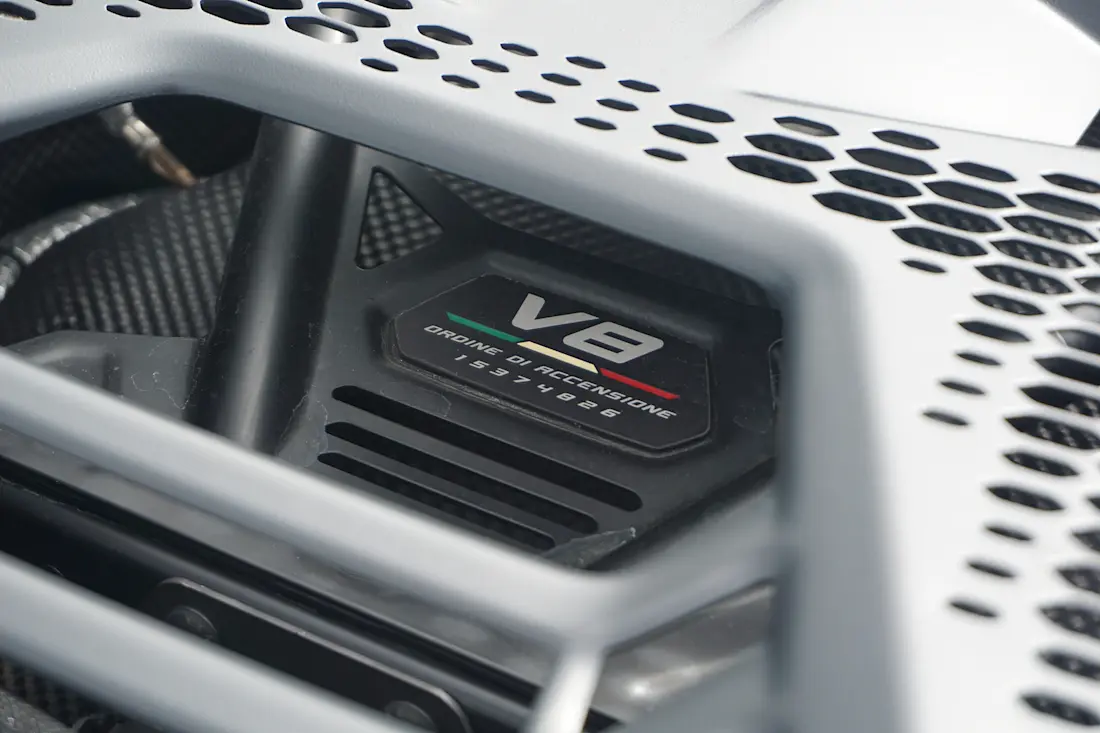
Of course, the electrical components are important to the powertrain. But at the Temerario’s heart is a hard-charging internal combustion engine. And while it uses turbochargers to generate more output than a V10 could reasonably make on its own — for reference, the one in the Huracán it replaces put out as much as 631 hp — the Temerario’s 789-hp eight-cylinder also happens to spin to a rather ridiculous 10,000 rpm.
For an engine to rev to those speeds means a single cylinder fires 83 times in a single second, according to Bizzarri, generating plenty of heat in the process. That’s why material use matters so much, with titanium components throughout, including the finger followers that open the valves. Some of those same parts are also finished with a diamond-like carbon (DLC) coating so they can better withstand high contact pressure.
“Some of the stresses like vibration (or) inertial load, they are not linear with speed — they tend to become more exponential,” he said, noting that the flat-plane crankshaft is made of the same high-strength aluminum alloy Ducati uses to build its MotoGP race engines.
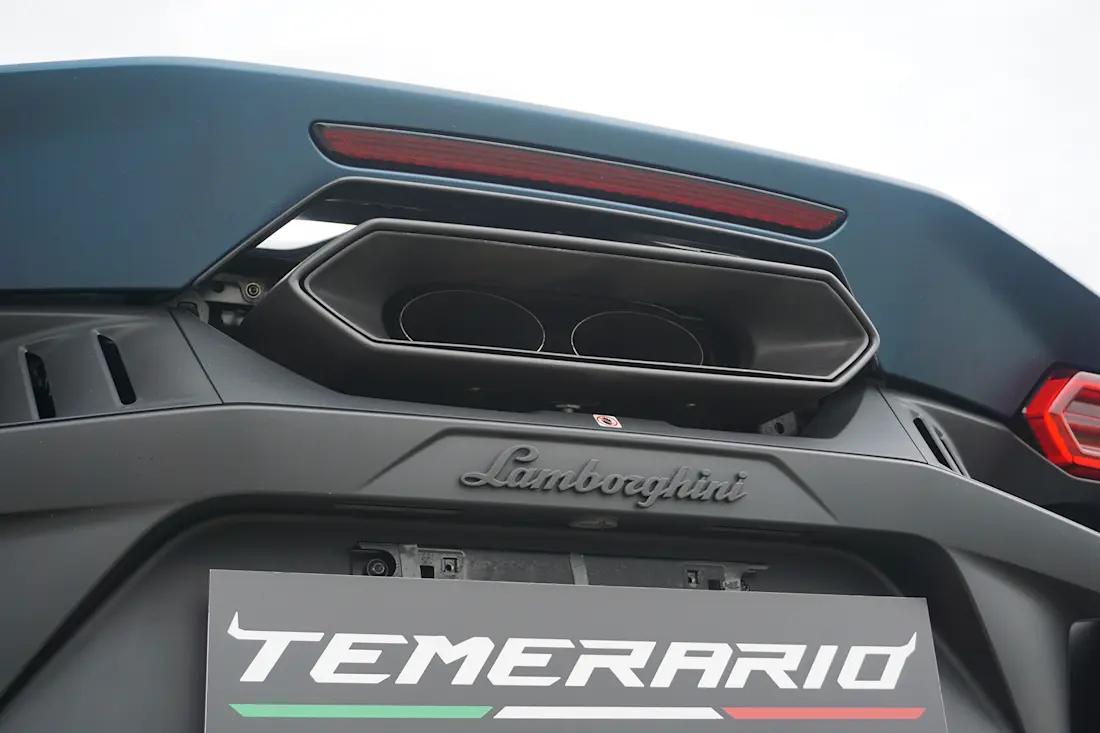
The transmission is an evolution of the eight-speed dual-clutch unit used in the Revuelto, and it’s mounted transversely behind the engine. This, according to Bizzarri, was done to make the gearbox compact while pushing the centre of gravity as far forward as possible — a consideration that matters even more when there’s a small electric motor mounted between the engine and transmission.
The battery is also shared with the Revuelto, with a 3.8-kWh capacity — tiny by PHEV standards. As with its sibling supercar, that high-voltage pack is mounted between the seats in the Temerario’s central tunnel, which helps with balance and weight distribution. But Bizzarri said its placement is also about simplicity and serviceability, including the ability to one day retrofit the car as battery technology advances.
Finally, there are the front-mounted e-axles — essentially small electric motors at each wheel — that are constantly delivering some degree of torque. Bizzarri said this decision was made to avoid the sense that something is wrong the way it would seem when the torque kicked in like it would with disconnecting axles instead.
Total out from the PHEV powertrain rings in at 907 net hp — that’s the most the gas and electric components can make when working together. And while the combined torque figure often quoted is equal to about 583 lb-ft, according to Bizzarri, that only accounts for the 4.0L engine and rear-mounted electric motor; factoring in the e-axles results in a combined 1,106 lb-ft, which helps propel the Temerario from zero to 100 km/h in just 2.7 seconds.
Sensational Supercar
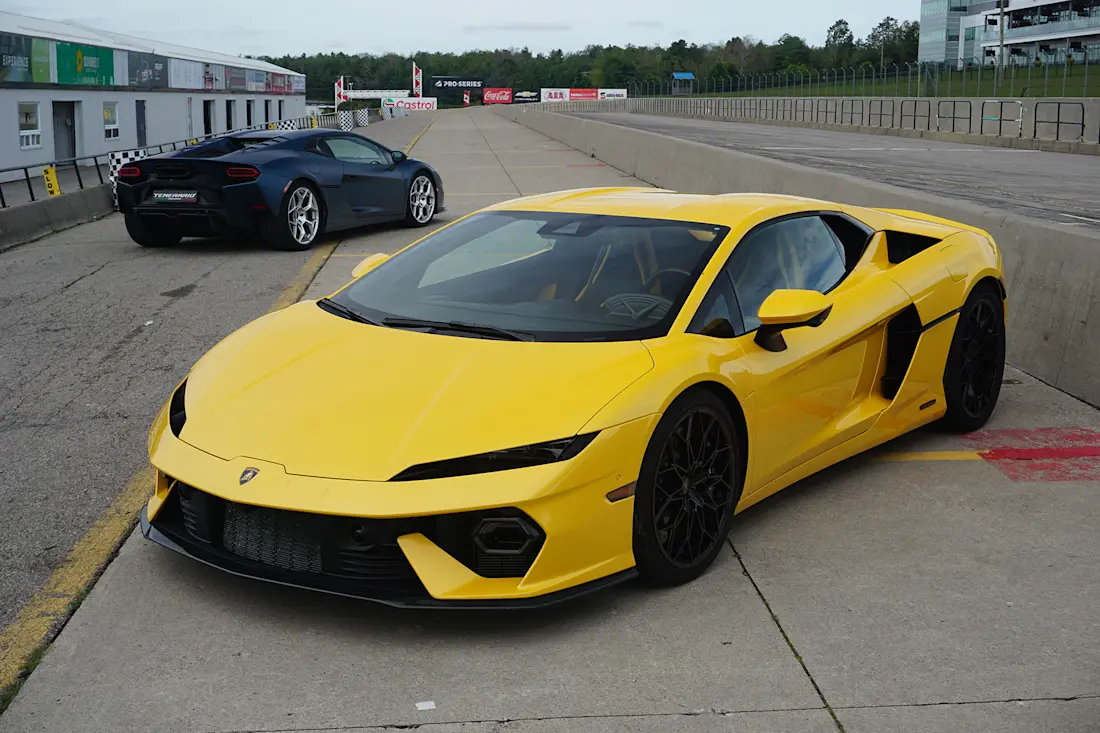
Those are the sort of numbers any automobile owner would proudly throw around, and they’d be seldom surpassed — certainly this side of an entirely electric vehicle (EV). Where the Temerario operates in a realm all its own, and for at least a few reasons, is the race track. It’s here that this supercar can slice through corners in a way so few others can match, with a rare mixture of precision and violence.
More specifically, a fast track like the grand prix circuit at Canadian Tire Motorsport Park (CTMP) is the type of place to ply the Temerario’s trade, with challenging corners spread across a little less than four km of asphalt, and a hair-raising high-speed straightaway that isn’t all that straight in the first place. It’s a long way from Bologna, sure, but it’s as tailor-made for the Temerario as any track in the world.
Pulling out of pit lane, the instructor in the preceding car starts communicating key information over the radio, and I manage to make sense of exactly none of it. It’s not for a lack of trying, but it’s the sort of trouble you run into when there are eight combustion chambers arranged neatly behind your head, all of which exit rearward through an exhaust that makes it sound as if you’re being pursued by a pack of pissed off superbikes.
There are other free-revving cars out there, including the naturally-aspirated Porsche 911 GT3 that can touch 9,000 rpm. But that Porsche requires at least a modicum of patience to tap into its powerband. In the Temerario, the curve is more like a casual climb, with the combination of its turbo engine and electric motors offering peak power from 7,000 to 9,750 rpm — and plenty to play with until then.
While never wanting to over-rotate, turn-in is sharp, with all the torque-vectoring you’d expect from such an overengineered machine. And with each passing lap I’m getting more comfortable and quicker, not to mention faster on the uphill Mario Andretti Straightaway, where I touch an insane 288 km/h in a car with no active aerodynamics — just a thoroughly refined version of the wedge-like shape that’s as synonymous with this brand as big engines.
Final Thoughts
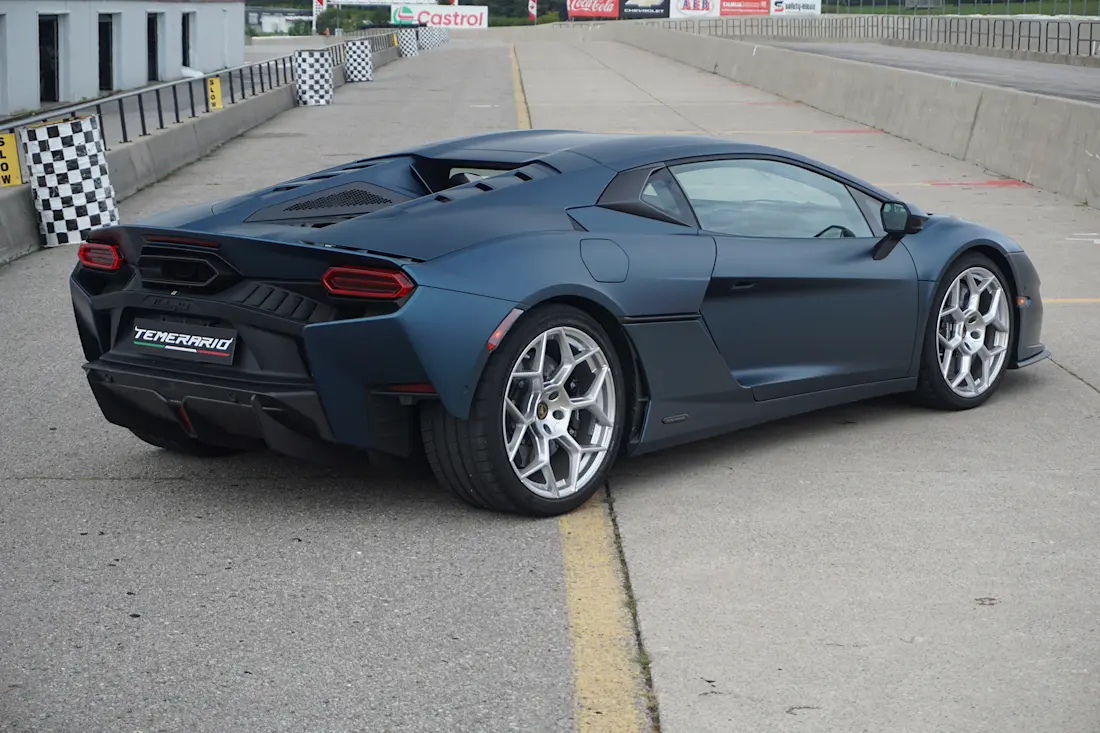
The 2026 Lamborghini Temerario isn’t going to help solve the world’s climate crisis, but then that’s not why it exists in the first place. Sure, the technology it relies on to enhance performance is rooted in emissions reduction, but if nothing else the Temerario proves once again that electrification doesn’t have to be a one-trick pony — or in this case, a one-fight bull.
At a starting price north of $430,000, it’s not going to address any affordability issues, either. But as far as innovation goes it’s second to none this side of its sibling Revuelto, taking the typically efficient PHEV formula and applying it to a performance machine that’s something to behold for skeptics and believers alike.

All Articles
See all
2021 Lamborghini Huracán STO First Drive Review
Street-legal track star
 Dustin Woods

Test Drive: 2019 Lamborghini Urus
From Rambo to all-season Lambo
 Michael Bettencourt

First Drive: 2018 Lamborghini Aventador S Roadster
Sunburn and sensory assault.
 Peter Bleakney