
2027 Kia EV5 Review
 Dan Ilika


Trader scores
This score is awarded by our team of expert reviewers after extensive testing of the car.
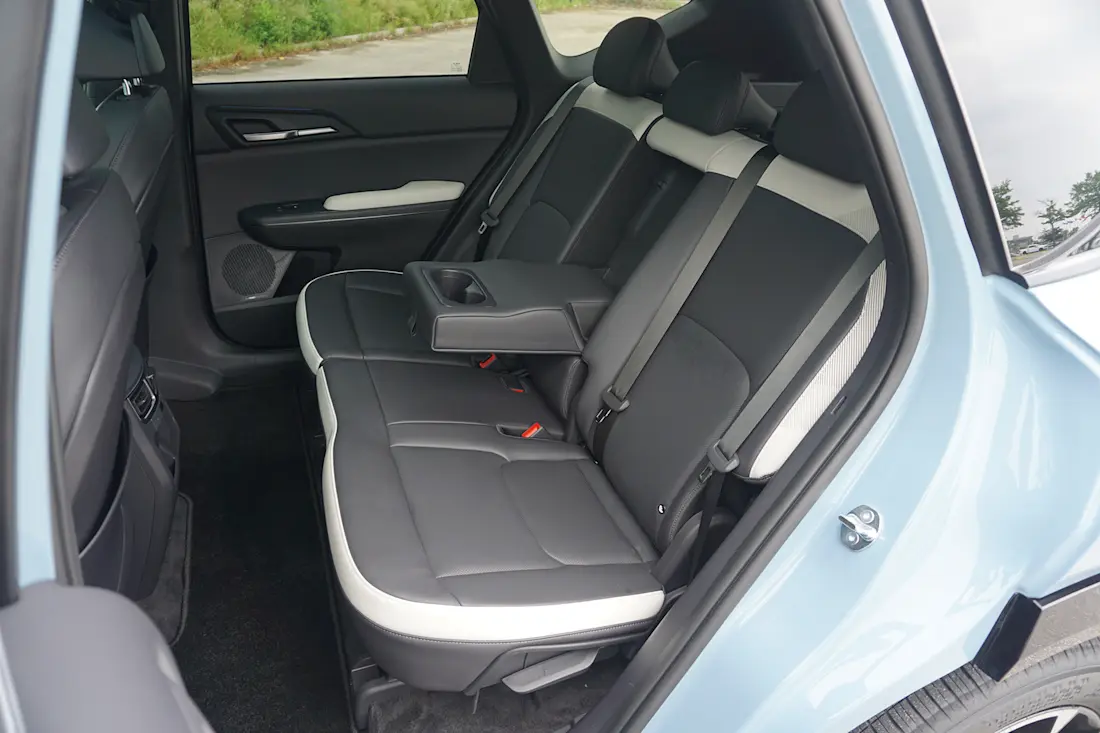
Fun fact: these words were written in the back seat of the 2027 Kia EV5, where your 6-foot-4 author found himself fitting comfortably, no contortion required, while plugged into a public charging station.
Positioned directly behind the driver’s seat — which, for what it’s worth, wasn’t adjusted in any way to maximize space — and with a laptop where its name would suggest it belongs, a short morning stop was enough to add nearly 30 kWh of energy to the EV5’s battery and get the first few hundred words of this review written. Now that’s what you call multitasking.
This isn’t supposed to be some sort of humble height brag, by the way. But what’s been accomplished as far as how much space there is inside this electric vehicle (EV), not to mention the way it’s used, might be its single greatest asset — impressive considering all there is to like about it, including pricing that’s competitive enough to offset its somewhat limited range.
Design: 9/10


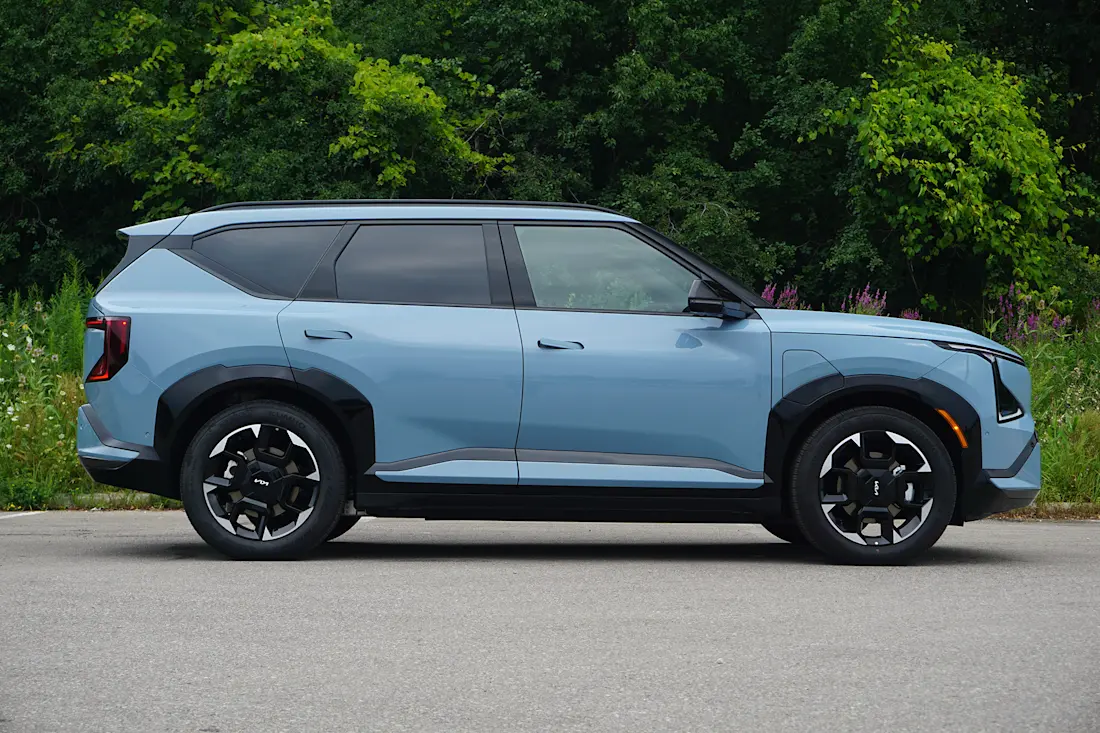
Kia’s ever-changing aesthetic makes the EV5’s design equal parts foreign and familiar, though you don’t have to squint to see the similarities it shares with the three-row EV9. Its headlights are certainly bolder, with jagged arrows pointing towards the painted panel that occupies the space you’d normally find a grille, all of which is part of an unquestionably unique appearance.
The cabin’s design pairs well with what’s happening outside, and you’ll find some of the same shapes and lines throughout. It also boasts a notable absence of the gloss-black plastic panels that are common in today’s cars and crossovers. In their place are gloss-grey surfaces that do a better job of hiding fingerprints and smudges, although dust accumulates just as obviously.
User-Friendliness: 7/10
Beyond its uncomplicated interior design, the EV5 is (mostly) easy to interact with thanks to its straightforward controls. Sure, the gear selector that’s tucked behind the steering wheel takes some getting used to — twist forward or back for drive and reverse, respectively, and press the button on the end for park — and the drive mode button is hidden in plain sight; but just about everything else inside should make sense to EV veterans and novices alike.
That includes the paddles on the back of the steering wheel that control the regenerative braking system. The one on the left works the way a downshift paddle would: pull to cycle through the three levels of slowing power, or pull and hold to activate one-pedal driving. Dubbed iPedal, it works no matter the level of regeneration, although it’s at its best when combined with the strongest setting, allowing you to come to a quick stop by simply easing off the accelerator.
The infotainment system is easy to use, too, although the small climate control panel that occupies the space between the twin 12.3-inch screens — one for infotainment, the other drive information — is obstructed from the driver’s view thanks to the steering wheel. That means attention-occupying effort is required for simple tasks like turning on the rear window defrost.
Everyday Usability: 10/10
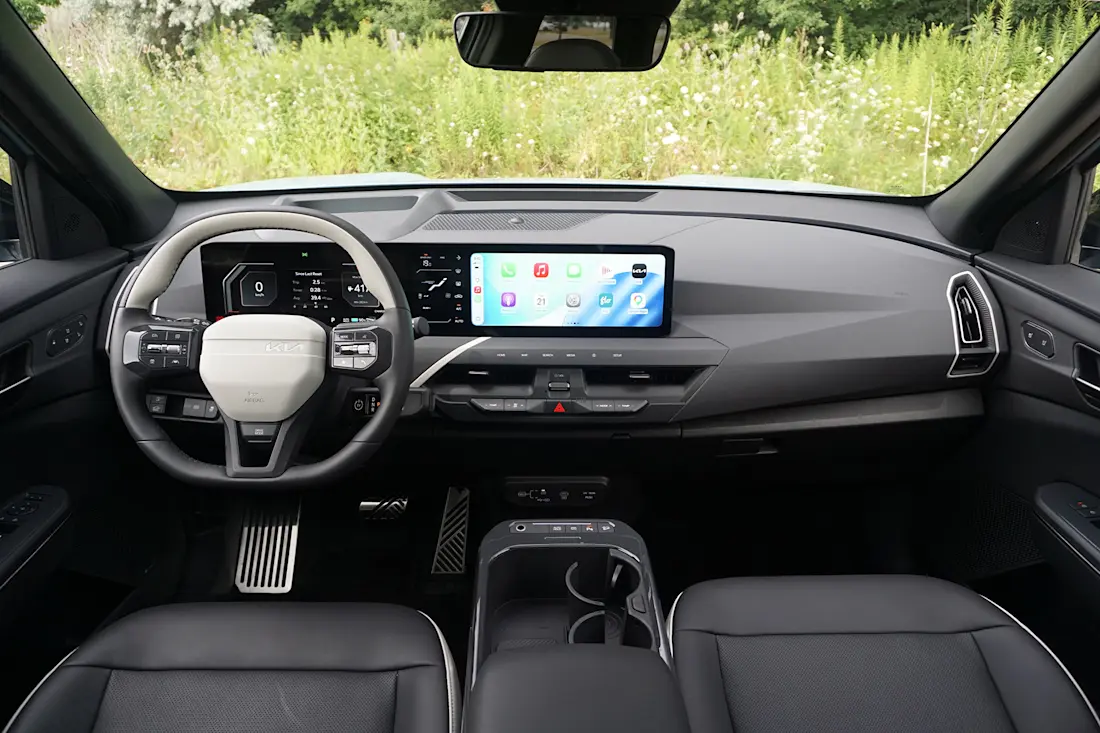
The dedicated EV platform this Kia rides on is responsible for the accompanying flat floor throughout the cabin as well as the low-mounted dashboard — a subtle difference between this and a conventionally powered crossover that improves visibility from the driver’s seat. Likewise, the properly sized front, rear, and side windows provide excellent outward views in all directions.
Whereas most EVs this size boast quirky shapes in the name of aerodynamics — take the Subaru Solterra, for example — the proportions here are downright conventional. In fact, in terms of size and shape the EV5 is strikingly similar to the redesigned Toyota RAV4, while cargo room isn’t far off at 965 L behind the back seats and 2,080 L with them folded. And there’s plenty of in-cabin storage, including a helpful drawer hidden on the back of the centre console.
Powertrain: 10/10
While EVs are undeniably quicker than their gas-powered counterparts thanks to how urgently their motors generate torque, this Kia is part of a new crop that correctly emphasizes efficiency over acceleration. Of course, that applies to this particular tester, which has a single electric motor that drives the front wheels alone. Dual-motor all-wheel-drive examples of the EV5 are coming, including a performance-focused GT trim, although they weren’t ready as of this writing.
Output measures a more than reasonable 214 hp and 218 lb-ft of torque; and the EV5 will comfortably outrun most conventional crossovers this size if you choose to stand on the accelerator. But rolling onto it gently instead produces adequate quickness and easy speed modulation, while easing off of it will bring this Kia to a steady stop with iPedal engaged.
Efficiency: 8/10
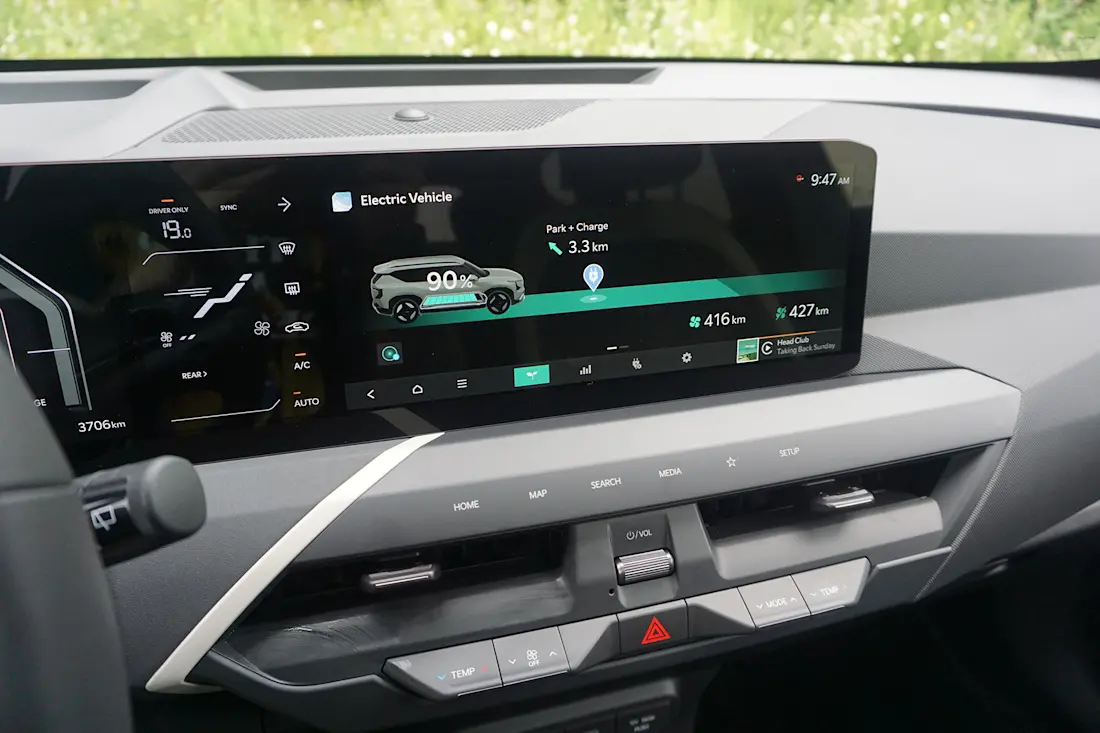
Not tested here was the base EV5 that makes less power and uses a 60.3-kWh battery instead of the 81.4-kWh pack found in the rest of the lineup. With its single electric motor drawing energy, this front-wheel-drive example is rated for 457 km on a full charge, according to Natural Resources Canada (NRCan) — slightly more than the 439 km the upcoming all-wheel-drive version is supposed to cover. (Meanwhile, the more powerful GT trim is good for 402 km.)
None of those numbers is especially impressive in an era when BMW is building EVs that can travel as much as 700 km on a single charge, although this summertime test proved more promising, with a little more than 500 km of real-world range. That was backed up by an indicated consumption rate of 15.9 kWh/100 km — better than its combined rating of 19.6.
Equipment: 10/10
Beyond the rate at which it burns through its battery, the EV5’s 400-volt architecture means it can add energy in a hurry when hooked up to a DC fast-charger. It can be plugged into 350-kW stations, which are among the fastest in Canada (although they’re few and far between), with the benchmark 10-to-80 per cent charge taking 30 minutes in ideal condition, according to Kia.
Connecting to a 50-kW station should provide the same boost in about 70 minutes, while a full charge should take a little more than seven hours with a 240-volt Level 2 hookup. Meanwhile, its North American Charging Standard (NACS) port means the EV5 can be plugged into Tesla’s network of Superchargers, while adapters grant access to stations with other interfaces.
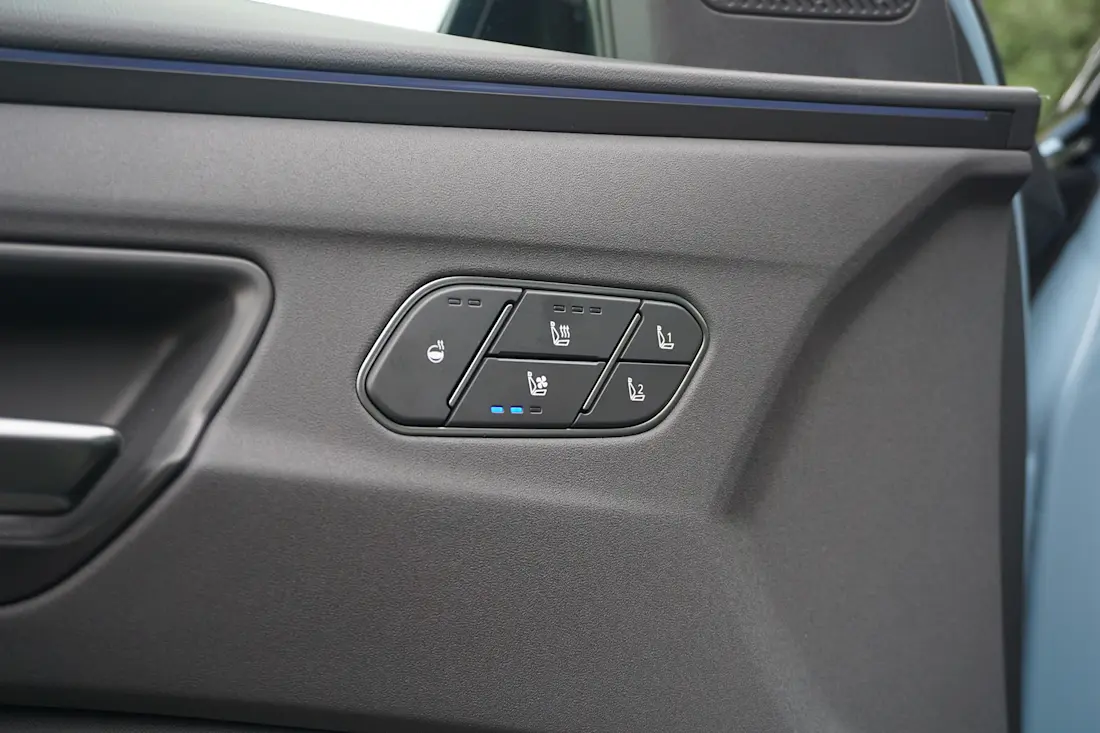
Otherwise, the EV5 can be had with a full complement of the kind of gear you’d expect in a modern crossover, electric or otherwise, including standard heated front seats and wireless Apple CarPlay and Android Auto, while the GT-Line Limited tested here adds everything from ventilated front seats and heated rear ones to phone-as-key functionality and a premium stereo.
Safety: 9.5/10
The list of standard advanced safety and driver-assist features is a long one, including blind-spot monitoring with rear cross-traffic alert and collision avoidance, forward collision warning with pedestrian and cyclist detection, automatic emergency braking, lane departure warning and following assistance, and adaptive cruise control. There’s also a safe exit assist system that can warn of approaching traffic, and a helpful rear-seat reminder.
The GT-Line trim adds a more advanced Highway Driving Assist system that can automate lane changes at the touch of either turn signal; and while two hands must remain on the steering wheel for it to work, it seems better calibrated than other implementations and won’t cancel a manoeuvre should your hand squeeze the wheel a little tighter while it’s happening. Meanwhile, the GT-Line Limited and GT trims add camera-based blind-spot monitoring and more.
Comfort: 8/10
With a conventional suspension setup of shocks and springs, the EV5’s impresses with its composure as well as the quality of its ride. Yes, the big and stiff battery pack that spans the floor makes its presence known across uneven surfaces, as do this tester’s 19-inch wheels; but it’s also fairly supple, while the cabin remains mostly quiet and the seats are comfortable.
Driving Dynamics: 9/10
This isn’t the kind of crossover you’re going to get excited about from behind the wheel, or at least not yet. There’s a performance-oriented GT trim on its way that should provide a few more thrills, although we’ll reserve judgement until we’ve had a chance to drive it. Instead, what you’re treated to is an appropriately agile and balanced experience, with limited body roll when cornering and reasonable response to inputs, although the steering system is a little vague.
Value for Money: 8/10
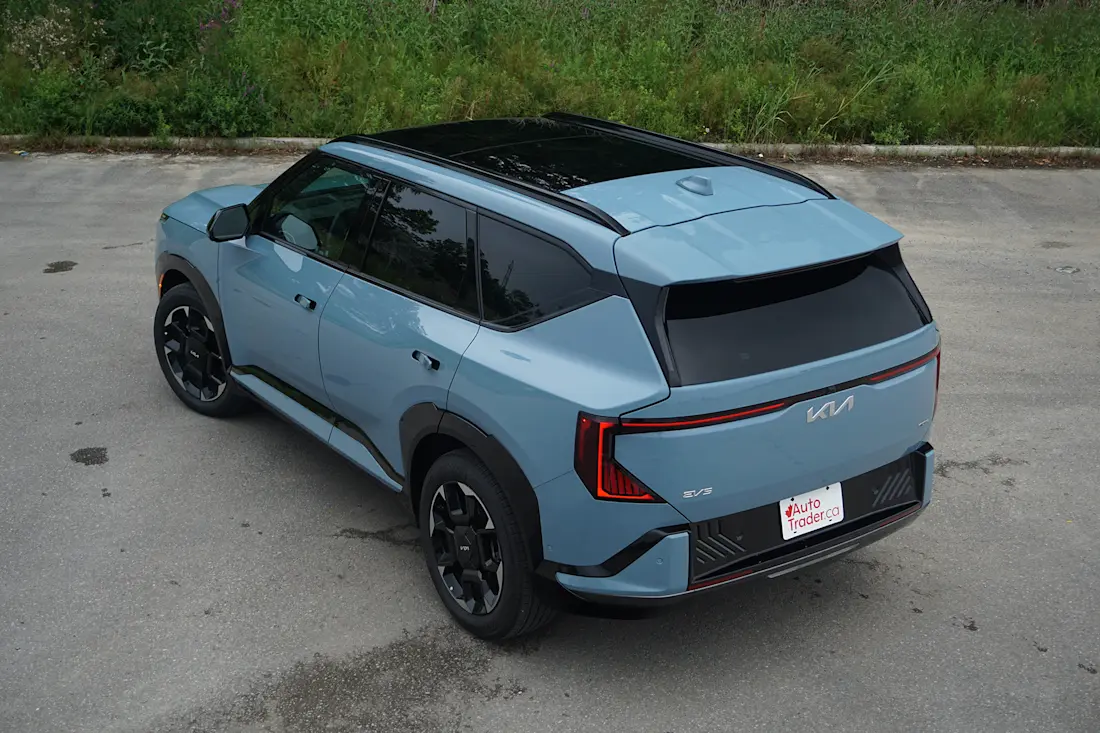
We’ve not yet reached a point of price parity between conventionally powered vehicles and electric ones like this, although this Kia comes close — with some caveats, of course. Among them is that you’re probably not going to get into an EV5 for the cost of a gas-only or conventional hybrid crossover this size, at least not like for like as far as features and amenities.
Where the EV5 is a properly cost-competitive option is next to a crossover like the Toyota RAV4 Plug-in Hybrid (PHEV), which starts at $50,680 before tax but including freight ($1,930). That makes it considerably more expensive than the cheapest EV5, which rings in at $45,680 with freight ($2,185), while even the EV5 Wind and its bigger battery is $49,680 before tax.
Granted, that’s for front-wheel drive; the same trim with four-wheel traction is $2,500 more, and that cost increase applies to the EV5 Land ($52,180) as well as the GT-Line ($57,680) and GT-Line Limited ($61,180). The range-topping GT trim comes with all-wheel drive as part of its $65,680 asking price. But then the RAV4 PHEV’s XSE trim is $58,330, while its optional Technology package pushes that to $61,280, and the GR Sport version is $60,335 before tax.
The Verdict
While EVs are still in their relative infancy, they’re quickly growing out of their awkward early years and into something more familiar and functional. There’s no better evidence of that evolution than the 2027 Kia EV5 that, while not as conservatively styled as the exceptionally popular Toyota RAV4, has similar proportions to go with more impressive packaging.
While it can’t go as far on a full charge as some of its contemporaries (albeit from premium brands like BMW), its price parity with mainstream PHEV models makes it unquestionably compelling. Imperfect though it may be — the climate control panel is plain bad — the EV5 gets enough right to make it among the most impressive small crossovers on the market.

Specifications
Trim Tested
2027 Kia EV5 GT-Line Limited
Base Price
$58,995
Options
$250 — Frost Blue paint, $250
A/C Tax
$100
Destination
$2,185
Price As Tested
$61,530
Engine Displacement
160 kW
Cylinders/Configuration
Single electric motor
Max Horsepower
214 hp
Max Torque
218 lb-ft
Fuel Economy
2.0 / 2.5 / 2.2 Le/100 km city/hwy/cmb, 17.7 / 22.0 / 19.6 kWh/100 km; 457 km est. range
Cargo Capacity
965 / 2,080 L seats up/down

All Articles
See all
2027 Kia Seltos and Seltos Hybrid First Drive + Video
This overhauled crossover has all the ingredients to be a segment leader.
 Jodi Lai

2026 Kia EV4 Review
Kia’s most affordable EV is up against some tough competition.
 Jeff Wilson

2026 Kia K4 Hatchback Review + Video
The five-door K4 is a true head-turner, but it most certainly isn’t a wagon.
Dan Ilika