
2027 Chevrolet Bolt Review + Video
 Jodi Lai
Trader scores
This score is awarded by our team of expert reviewers after extensive testing of the car.


The 2027 Chevrolet Bolt marks a return to market for the nameplate after a brief hiatus, and it’s better than ever.
It’s one of the most affordable electric vehicles (EVs) in Canada, yet it doesn’t make many compromises, and that’s exactly what we need right now. The Bolt was discontinued in 2023, and while this iteration looks very similar, Chevrolet has made some important improvements where it matters most. It’s just too bad it won’t be around for long.
Styling: 8/10
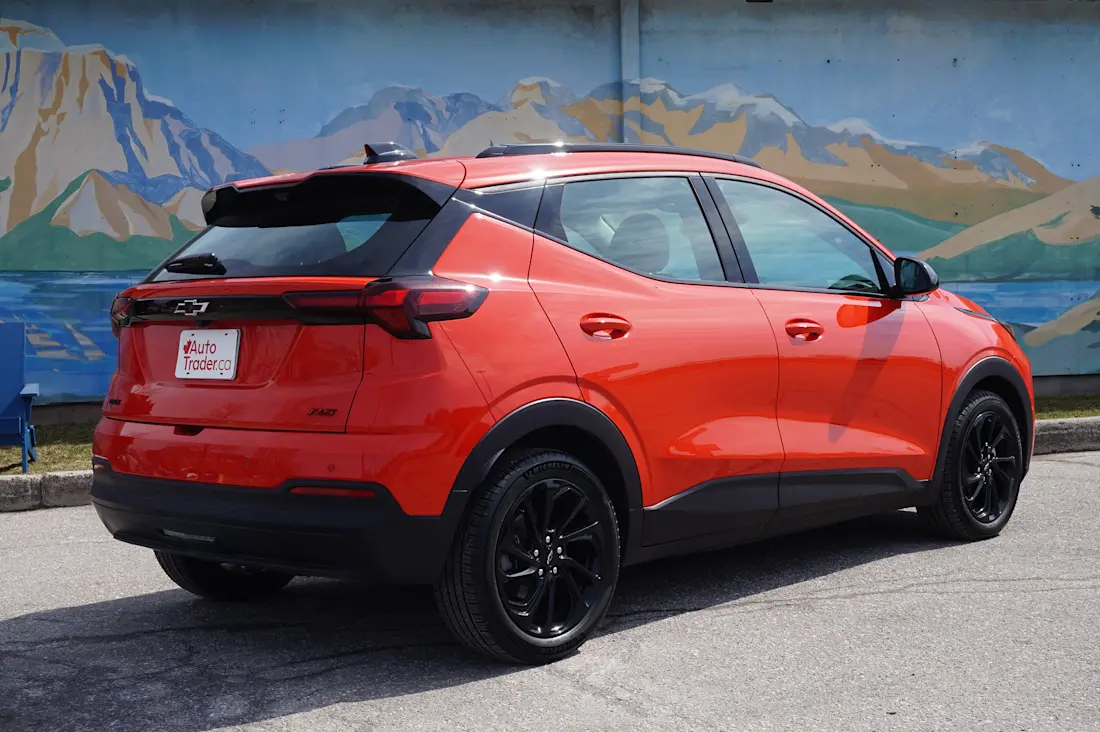
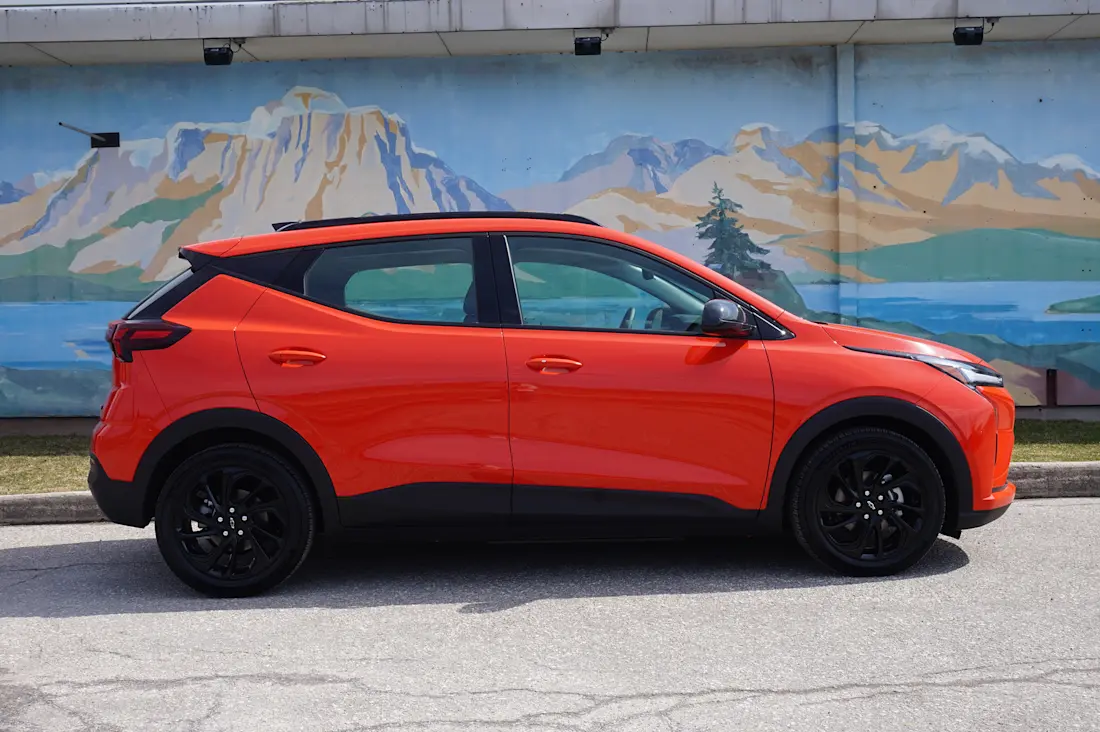
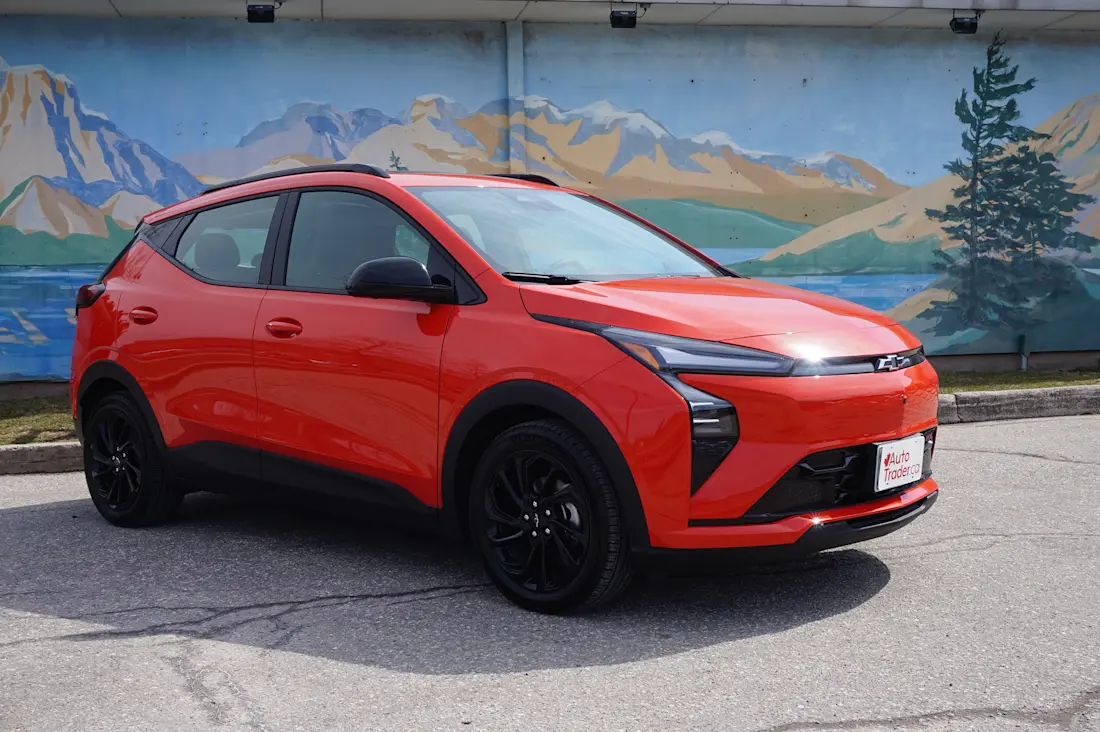
The refreshed Bolt has slightly more conventional styling that helps it look more like a shrunken SUV than a bubbly hatchback. The lighting has been updated to better match Chevrolet’s other EVs, and the previous model’s awkward-looking faux grille has been replaced by a body-coloured panel and “intake” that looks less like an open mouth. The look is sharper than it was, but the Bolt’s proportions still place it in cute or even quirky territory.
The RS trim is also new for 2027, and it’s meant to look a bit sportier with black wheels, badging, and roof rails. It looks great, especially in this tester’s vibrant Habanero Orange paint, a $595 upgrade. The ambient lighting inside the RS trim gives the cabin some personality and helps distract from all the hard plastic used throughout.
Fuel Economy: 9/10
The Bolt can travel an estimated 422 km on a full charge, a very good amount of range considering the price. Efficiency is rated at 17.5 kWh/100 km combined, but this tester’s indicated average was 18.5 kWh/100 km after about 600 km — not bad considering how much of that was racked up on the highway.
For the sake of comparison, the recently redesigned Nissan Leaf can travel any between 417 and 488 km, depending on trim. That EV uses a slightly larger 75-kWh battery compared to the Bolt’s 65-kWh unit.
The 2027 Bolt can accept charging speeds as fast as 150 kW, with charging times that are 2.5 times faster than before, according to Chevrolet. That means the jump from 10 to 80 per cent can be done in less than half an hour in ideal conditions.
The Bolt is also the first Chevrolet to come standard with a Tesla-style North American Charging Standard (NACS) port, which provides access to some of Tesla’s newer Supercharging stations. An adapter is available from Chevrolet for an extra $250, which allows it to be plugged into non-Tesla hookups.

Power: 9/10
The front-wheel-drive Bolt has a single electric motor that makes 220 hp and 169 lb-ft of torque. Taken together, it’s best described as zippy. While this EV is quite tall, the battery is low and helps the car feel planted, and the acceleration is quicker than you’ll ever really need. It doesn’t give you the organ-compressing acceleration that some other EVs do, but its instantaneous passing power is more than up to the task.
Driving Feel: 9/10
The steering is responsive and heavy, the ride is comfortable, and the Bolt’s small footprint makes it easy to manoeuvre and park. Its tall roof and big windows also make for great visibility.
The paddle on the back of the steering wheel to adjust the regenerative braking on the fly has been removed, but one-pedal driving is still offered and must be adjusted via a shortcut on the touchscreen. Drivers can pick between two levels, normal or high, or turn the system off completely. The high level was far too aggressive and difficult to get used to, but the normal mode can still bring the vehicle to a stop simply by easing off the throttle.
User Friendliness: 8/10
The Bolt’s new infotainment system is Google-based, but one red flag for many people will be the lack of Android Auto or Apple CarPlay. Instead, drivers will need to log into their Google accounts to get the best experience and rely on downloading and signing into apps to access features like Spotify or Waze.
The benefit of the Google integration is that Google Maps is the native navigation system and it’s excellent for EV trip-planning. Using Google Maps, drivers can easily find charging stations and filter by speed, outlet type, availability, or even price. If you input a fast charger as your destination, it will precondition the battery for more efficient charging, and the navigation system lets you know how much range you will have at your destination and upon return. If there isn’t enough range, it will suggest a charging station along the chosen route and update your estimated arrival accordingly.
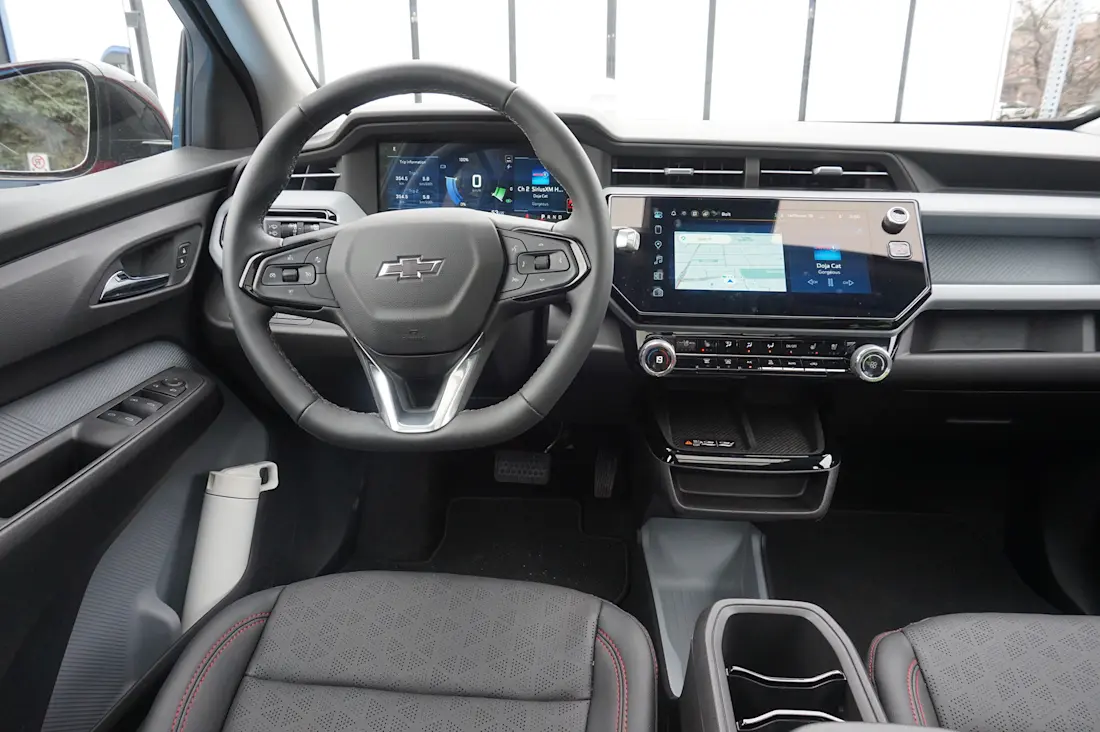
The screen itself is not as responsive as it needs to be, however, and it’s also angled upwards, which subjects it to glare and makes it a bit harder to reach while driving. The volume knob is located on the right-hand side of the screen, making it closer to the passenger than the driver. The iconography used could also be more obvious to indicate certain functions.
On the plus side, physical buttons and switches for climate control are helpful, you can see navigation instructions in the driver information display, and the hidden buttons on the back of the steering wheel for volume and cycling through radio presets help cut distracting touchscreen use.
Practicality: 9/10
The trunk measures 458 L, which expands to 1,594 L with the rear seats folded flat. There’s no frunk, but the sizable storage compartment under the trunk floor helps. The Bolt’s interior makes great use of all the space with many cubbies and storage options to help keep things organized. However, some rubberized surfaces would help keep the stuff stashed in the various cubbies and compartments from sliding around while driving.
Comfort: 9/10
The tall roof means generous headroom for all occupants, though the rear seats are quite high, so there’s less space in the back than in the front. Even with tall people up front, however, there is ample legroom for rear-seat passengers. The only minor issue is the armrest between the front seats feels like it’s in an awkward spot and is a bit too tall to actually use as an armrest.
Features: 8/10
All Bolts now come standard with a heat pump for more efficient cabin heating, adaptive cruise control, heated front seats, a heated steering wheel, automatic dimming rearview mirror, and three years of subscription-based Onstar and 5G connectivity with Wi-Fi hotspot capability. Optional add-ons include ventilated front seats (standard in the RS), a wireless phone charger, dual-pane sunroof, automatic rain-sensing wipers, and a camera-based rearview mirror.
Safety: 8/10
Standard safety features include automatic emergency braking with pedestrian and cyclist detection, junction traffic emergency braking, rear cross-traffic emergency braking, blind-spot monitoring with steering assist, lane departure warning and keeping assistance, side cyclist alert, and teen driver profile. Other features like driver attention assist, parking sensors, surround-view cameras, rear pedestrian alert, hands-free highway driving functionality for the adaptive cruise control system, and traffic sign recognition are available through packages.
Value: 9/10
The Bolt was already one of the most affordable EVs in Canada, and now that federal government incentives are back, it’s an even bigger bargain. The base Bolt LT starts at $39,999, while the Bolt RS starts at $42,599. With a few options and the destination fee ($2,600), it brings the as-tested total for the one seen here to $49,264 before tax — close to the $50,000 incentive cutoff for EVs not made in Canada. Be careful not to go over that threshold, as it can be easy with a couple more options added on.
The Verdict
If you were waiting for an affordable and practical EV, the Bolt is an excellent choice — especially since incentives are back. The Bolt’s powertrain is solid, its range is good, the car is easy to live with, fun and zippy, and the practicality is tough to beat at this price. Add it all up, and it’s a shame the 2027 Chevrolet Bolt will be discontinued again, so get it while you can.
Specifications
Trim Tested
2027 Chevrolet Bolt RS
Base Price
$42,599
Options
$3,965 — Panoramic sunroof, $1,875; Technology package, $1,495; Habanero Orange paint, $595
A/C Tax
$100
Destination
$2,600
Price as Tested
$49,264
Engine Displacement
157 kW
Cylinders/Configuration
Single electric motor
Max Horsepower
220 hp
Max Torque
169 lb-ft
Fuel Economy
1.8 / 2.2 / 2.0 Le/100 km cty/hwy/cmb,15.6 / 19.8 / 17.5 kWh/100 km; 422 km est. range
Cargo Capacity
458 / 1,594 L Seats up/down

All Articles
See all
2026 Chevrolet Equinox Review
Chevy’s compact crossover is far from class-leading, but it’s certainly intriguing.
 Peter Bleakney

2026 Chevrolet Trax Review
Chevy’s entry-level model is practical and surprisingly fun to drive.
 Jil McIntosh

2025 Chevrolet Equinox EV Review
With a sub-$50,000 starting price and 500 km of range, this Chevy is big on value.
 Kunal D’souza