
The BMW iX3 Offers a Drive Interface Revolution. Are Long-Time BMW Owners Ready For It?
 Benjamin Hunting

BMW’s Neue Klasse EV platform marks a sea change in how the automaker approaches not just electrification, but also the design of its vehicle interfaces. Part of the Neue Klasse’s tech-first playbook is a complete rethink of the company’s long-standing iDrive infotainment setup.
Controversial when it debuted more than 20 years ago, iDrive has featured a rotary dial on the center console, flanked by shortcut buttons, since the early 2000s. The design made it relatively simple to navigate menus on the main infotainment display without having to divert too much attention away from the road, or even use its touchscreen unless you really wanted to.
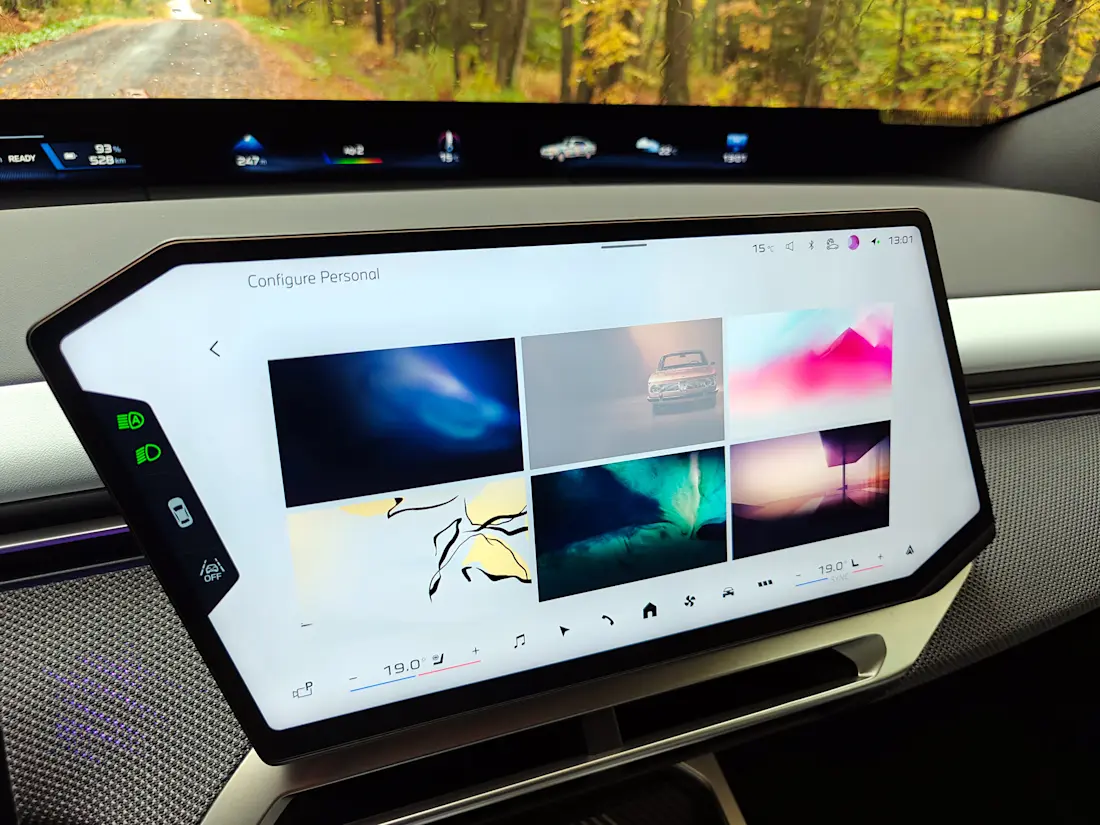
Starting with the 2027 BMW iX3 sport-utility, that all goes out the window. Dubbed “iDrive X,” or “Panoramic iDrive,” BMW’s new infotainment and driver information system wipes the console clean of nearly every vestige of physical control. Instead, more than 90 per cent of vehicle functions have migrated to the primary display on the dash, the steering wheel, and something the automaker calls “Panoramic Vision,” which is a 3D-ish panel that stretches from one pillar to the other across the base of the vehicle’s windshield.
It’s a move that’s as radical as it looks the first time you open the door to the iX3’s cockpit. A week together with Panoramic iDrive revealed that it’s possible to get used to anything — but that BMW’s new strategy poses important questions about driver distraction, road safety, and what exactly we want our vehicles to be.
Panoramic Display Wows, But is Equal Parts Flash and Substance
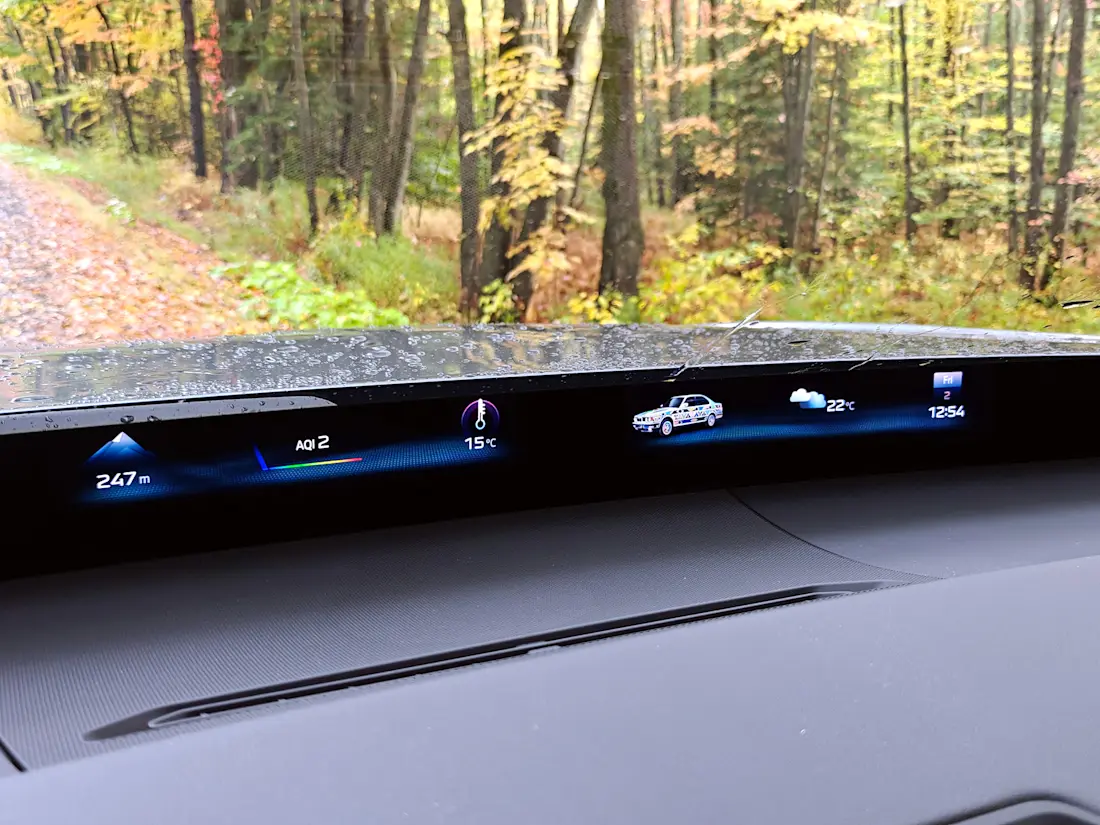
By far the most striking aspect of the BMW iX3’s cabin is its Panoramic Vision display. Wedged into the crack between the end of the dashboard and the base of the windshield, it’s a thin, yet all-encompassing sliver of screen that manages to achieve remarkable depth due to a projection system that bounces images off a reflective background. This preserves sharpness and legibility regardless of viewing angle.
Panoramic Vision replaces a traditional gauge cluster, with info like vehicle speed, battery charge, and navigation instructions now visible directly in the line of sight of the driver. In this way, it’s philosophically similar to Toyota's designs, a company that has increasingly pushed traditional gauge displays as far forward as dashboard real estate allows. BMW’s version is considerably more elegant in execution.
In practice, Panoramic Vision achieves its primary goal. Once the novelty wears off, it feels natural to dip your eyes just below the windshield to check how fast you’re going. Yet two other aspects of the display and how it interacts with other iDrive components speak to the larger problem of information overload increasingly saturating the modern driving experience.
Simply put, beyond presenting visual symmetry, Panoramic Vision doesn’t need to be as large as it is. The system itself proves it: drivers are asked to populate the display with widgets they can select from the main infotainment screen. While some of these (navigation or compass) benefit from sitting in the line of sight, so many others (date and time, temperature, phone status, air quality, altitude, steering wheel angle) are far from mission critical, with several doubled up on the top right corner of the primary traditional touchscreen display.
Then there are the widgets that are entirely decorative. I love looking at pretty pictures as much as the next person, but devoting a section of the Panoramic Vision screen to show one of BMW’s art cars merely drives home how little practical purpose its size has here. The same can be said when choosing to centre a static image of the BMW M logo.
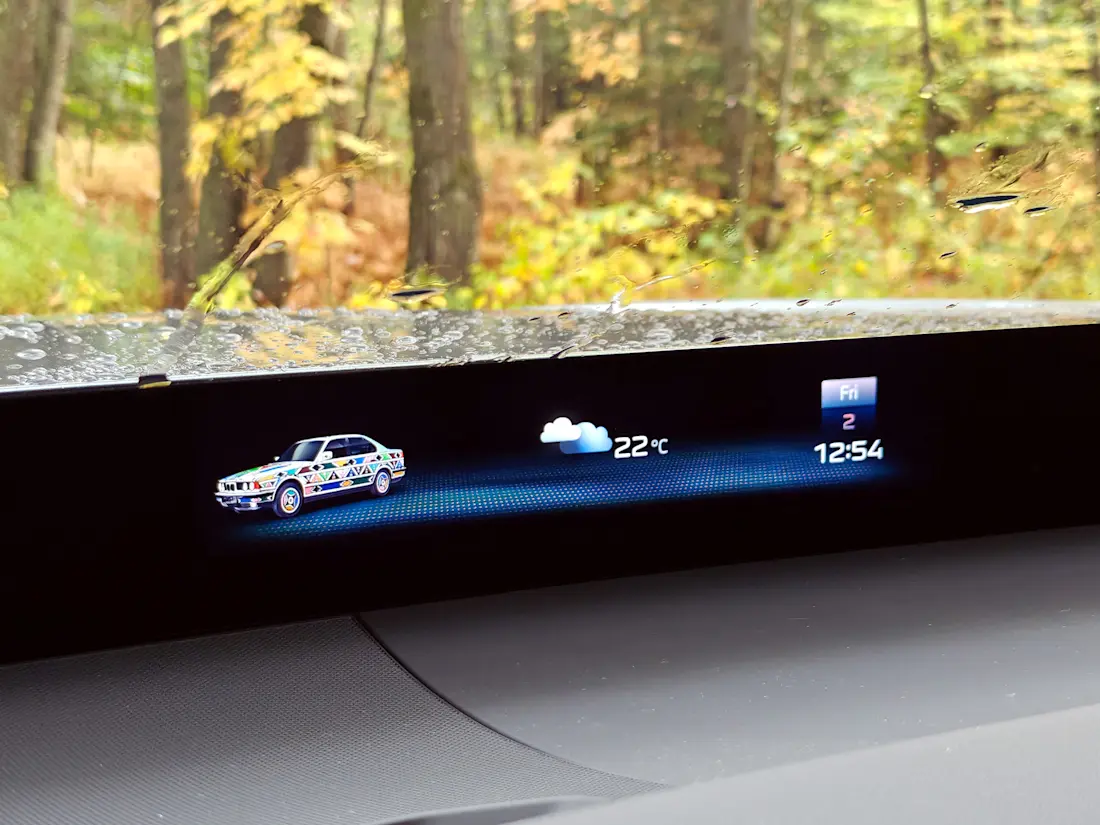
Then there’s the more pressing double-duty issue. BMW makes a head-up display (HUD) available as an option with iDrive X and Panoramic Vision. This means a second line-of-sight display on top of the first one, which most of the time duplicates the data being shown below it (vehicle speed, nav instructions, etc.).
Compared to past BMW HUDs, you can’t pare what’s projected over the hood down to the bare minimum, either. In fact, when using adaptive cruise control, the HUD’s graphics stretch forward to indicate the gap between the iX3 and traffic ahead, covering a sizable portion of the actual road, and adding yet another digital layer between a driver’s eyes and what’s going on around them.
Panoramic Vision is a much more palatable presentation than Mercedes-Benz's MBUX Hyperscreen, which covers the dashboard with a gigantic slab of piano-black trim far below the line of sight. Still, both lack a compelling argument for occupying so much visual space in a world where driver distraction is one of the leading causes of death and injury out on the road. Panoramic Vision is in some ways too much of a good technology, and that ultimately detracts from what it brings to the table.
No More Buttons or Dials = A Maze of On-Screen Touch Menus
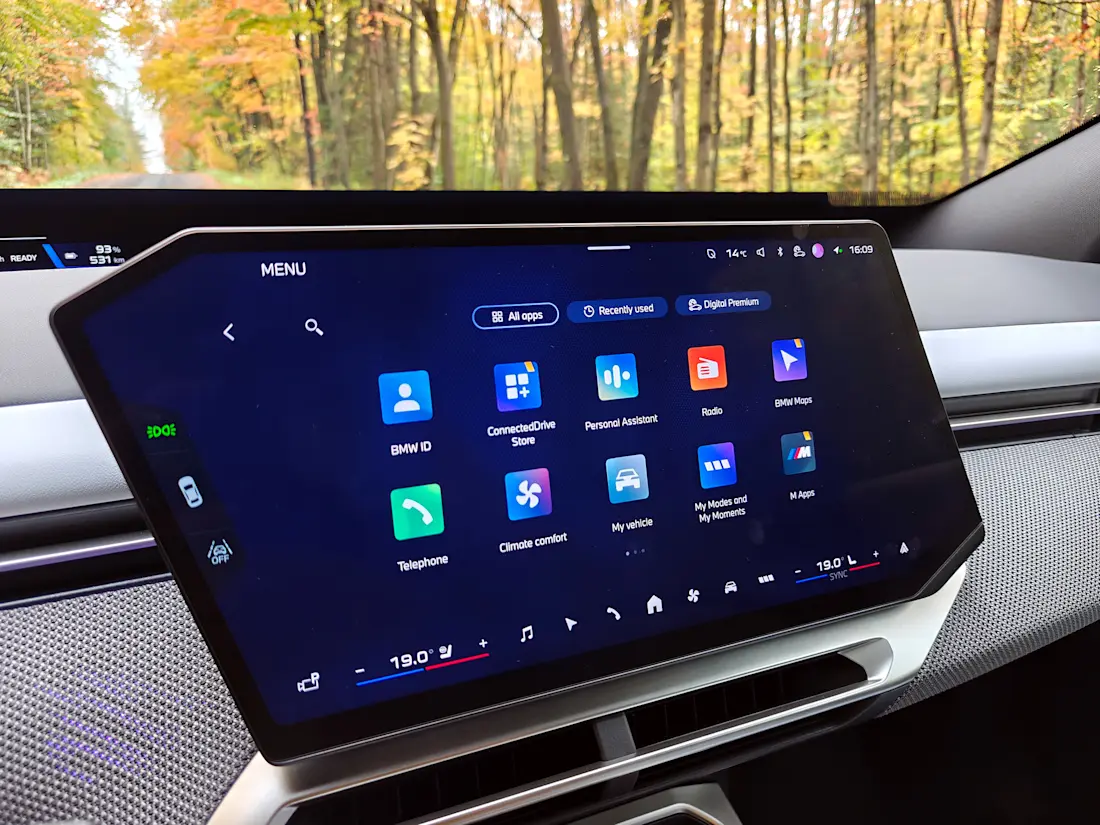
While Panoramic Vision is the most visible difference on the BMW iX3’s dashboard, the decision to make its central infotainment touchscreen the jump-off point for nearly every meaningful interaction between vehicle and driver that stands out as the biggest conceptual shift for iDrive X.
I mentioned earlier that the rotary iDrive controller is history, along with any and all iDrive-related buttons on the centre console. Only a roller for infotainment volume remains beside the flick-forward/flick-backwards shifter (along with small capacitive touch panels to skip tracks, change volume, or move through certain menus on the steering wheel). Almost everything else — climate control, vehicle setup, drive mode access, navigation, listening to music or podcasts — requires at least one, if not an entire sequence of screen presses to achieve.
Some of these are easy enough to deal with. Cabin temperature, for example, is always available at the bottom of the touchscreen. But if you want to get more specific about staying comfortable, expect to dig through multiple menus just to activate the heated seats. Even something as simple as moving a vent so that it doesn’t blow on your face means using the touchscreen to move the vent positions around with your finger.
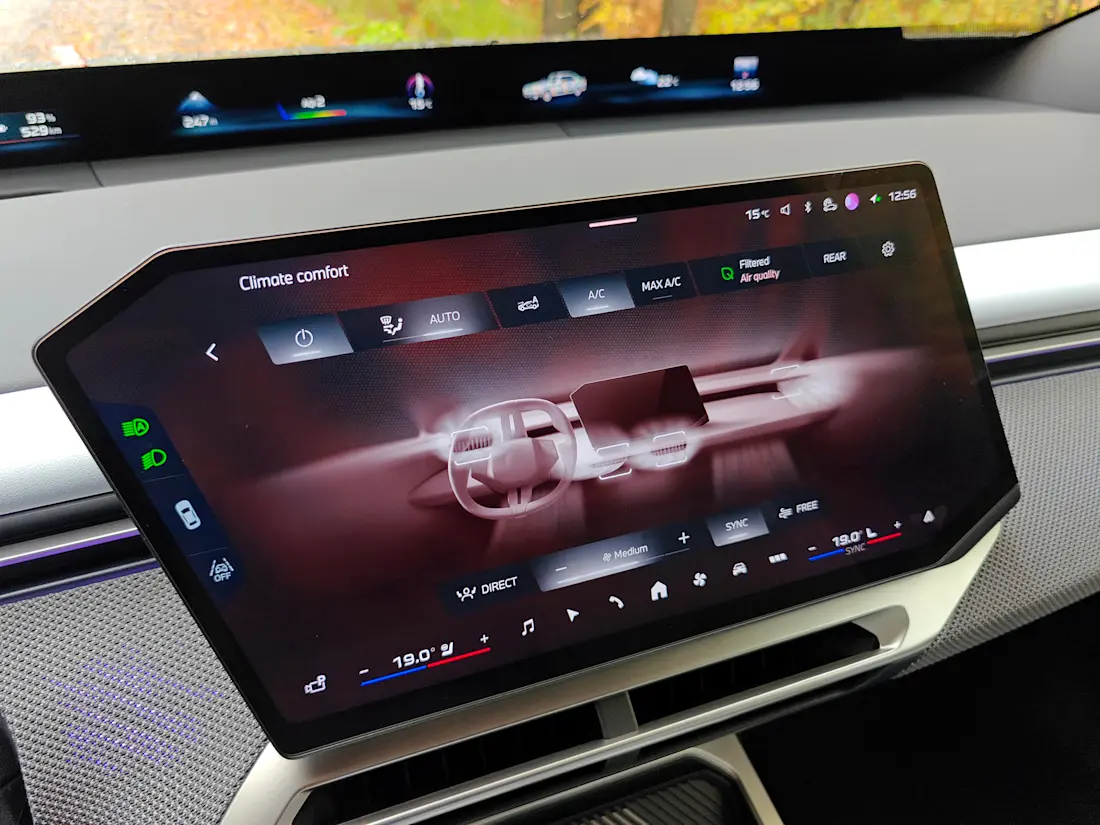
If that sounds incredibly distracting to do while you’re driving, you’re right — it is. Simple physical pull tabs on heating and cooling vents have worked well for decades, require almost no thought to use, and let you do it without taking your eyes off traffic. The move to locking up their position behind a screen is a perfect microcosm for how iDrive X expects owners to interact with the iX3 and future Neue Klasse models. It’s menus, behind menus, behind menus, all the way down, and while it’s possible to create shortcuts to certain commonly used features, you’ll likely be scrolling through the touchscreen to try to trace back to where you left those, too.
All this takes place against a vehicle safety landscape that underscores the distraction dangers of swapping touchscreens for buttons. Every second spent at highway speeds looking at a screen while hunting for a menu allows a vehicle to cover considerable ground with no one paying attention to what’s actually happening ahead.
In China, for example, a manufacturer rush to confine every aspect of a vehicle’s control systems to touchscreens has led to momentum within government to mandate a return to physical controls. Not even the presence of voice commands is seen as a viable workaround from a safety perspective. In Europe, there’s a similar, although less-sweeping piece of legislation aimed at returning physical buttons for features like turn signals, wipers, hazard lights, and the horn. The logic is similar: avoid driver distraction by providing controls that are within easy reach and don’t require diverting your gaze from the road to operate.
We Don’t Need Cars That Look and Act Like Phones
We need to ask ourselves why we’re so comfortable allowing the automotive industry to transform the interiors of our daily drivers so they resemble more and more the very mobile devices that are so deadly when it comes to distraction. As car companies struggle to differentiate one very good car from an equally excellent competitor, vehicle cabins are flooded with features that do little to actually address the task at hand — driving — and instead pull us farther away from the moment, with potentially disastrous results.
There are certainly parts of the BMW iX3’s infotainment setup that are praiseworthy, but they’re leavened by indulging the desire of designers to go fully digital. For example, Panoramic Vision is by far the best middle ground between a true HUD and a traditional gauge cluster I’ve ever encountered, but this accomplishment is overshadowed by the hat-on-a-hat head-up display it can pair with, and by its own overabundance of extraneous widgets and readouts.
BMW’s iDrive once led the way towards the hybrid use of physical controls and touchscreens that have dominated automotive interfaces for the past 15 years. With iDrive X, it heads in a new, far more minimalist direction that eschews knobs and buttons in favour of a software-first approach. In doing so, it increases the chance that BMW owners will be so overloaded with information, and so cognitively burdened when trying to operate a vehicle like the iX3, that they run a higher risk of becoming another distracted driver statistic than ever before.
It doesn’t have to be this way. There’s no reason — other than production costs — that physical controls can’t return to the iDrive stable, or that the Panoramic Display can’t be cut in half and refocused to include what’s necessary while omitting what’s not. First-year vehicles are test-beds for technologies, not the final word on what customers, or even regulators, will accept. I’m optimistic that with time, I’ll once again be able to reach out and stop a BMW dash vent from blowing right in my face without having to flourish my fingers across a confusing graphic buried behind a submenu on a slab of plastic.

All Articles
See all
New Cars Are Getting Too Complicated — Buyers Are Pushing Back
From frustrating touchscreens to intrusive safety alerts, new car tech is overwhelming drivers. Here’s how automakers are responding.
 John LeBlanc

Subaru’s Uncharted Could Point to the Future of Enthusiast Hatchbacks
This electric Subaru is surprisingly fun, but is it more fun than a Golf R?
 Jeff Wilson

SRT Debuts Electric Turbocharger for Hellcat Response, But it Could Also Save Fuel
Dodge's SRT eBoost Air uses electricity to deliver more low-end torque.
 Chris Tsui