
BFGoodrich Winter T/A KSI Review: Our Ice and Snow Test Results
 Chris Chase

The BFGoodrich Winter T/A KSI is a mid-range winter tire built for Canada, and when we drove it back to back against three rivals on a closed course outside Ottawa in March 2017, it stopped shorter on ice than the Firestone Winterforce and held a snowy handling course more predictably than the Yokohama IceGuard. Its ice traction and snow traction suit drivers who want dependable winter performance without paying premium money.
Key takeaways
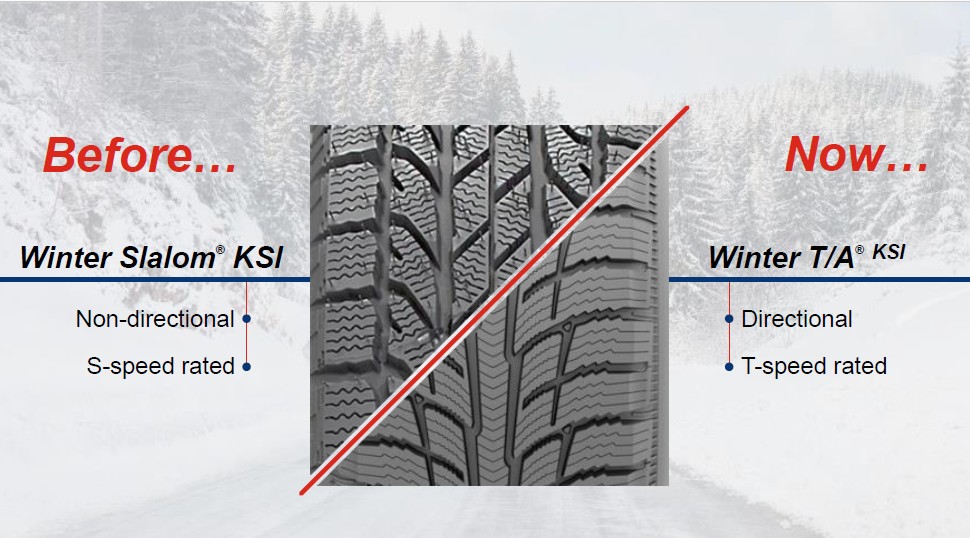
- The Winter T/A KSI replaced the Winter Slalom KSI in BFGoodrich's Tier 2 range, the mid-priced bracket where most Canadians buy winter tires.
- In our testing it out-braked the Firestone Winterforce on ice and in the wet, and recovered grip more smoothly than the Toyo Observe GSi-5 in an ice slalom.
- The Yokohama IceGuard was more fun. The BFGoodrich was more controllable, which matters more on a snow-covered highway in real winter conditions.
- Our testing dates from the March 2017 launch event. BFGoodrich supplied the rival tires and chose which test each one ran, so read the results as a manufacturer benchmark, not an independent tire test.
- Mandatory winter tires apply in Quebec from December 1 to March 15, and British Columbia requires winter tires or chains on most of its highways from October 1. Elsewhere in Canada a snow tire is a choice.
Where This Winter Tire Sits in the Market
BFGoodrich sells the Winter T/A KSI into the Tier 2 segment, the middle of the winter tire market. That placement decides what you should expect from it. The best winter tires beat it in specific conditions. The KSI is built to be the sensible answer, not the outright winner.
Our BF Goodrich winter tire comparison covers the all-terrain side of the range.
A Mid-Priced Tier 2 Tire, Not a Premium One
The Winter T/A KSI took over from the well-known Winter Slalom KSI, and BFG says Tier 2 is where most winter tire buyers spend their money. Mid-priced does not mean compromised. The engineering budget went where most drivers notice it: durability, winter traction and a quiet ride, not the last percent of ice grip.
Compare Michelin's premium X-Ice Xi3, which chases ice traction and longevity harder and charges for it. Michelin owns BFGoodrich, so the two are rungs on one ladder. A standard limited warranty covers defects in workmanship and materials.
BFGoodrich has not published Canadian pricing we can cite here, so treat the Tier 2 label as the guide to where this tire sits.
Who This Tire Suits, and Who Should Look Elsewhere
This suits the driver covering a normal Canadian winter in a sedan, a crossover or a small SUV. Tire sizes run from 14 to 20 inches, so fitment covers most of what Canadians drive.
Look at this BFGoodrich winter tire if you:
- Drive a commuter route that is plowed and salted more often than it is buried
- Want winter traction without stepping up to premium pricing
- Keep a second set of wheels and handle the seasonal changeover yourself
- Run a used vehicle where a premium ice tire would cost a noticeable share of what the car is worth
Look elsewhere if you live somewhere that gets properly hammered, where a premium snow tire earns its money. On a tighter budget, a cheaper option like the MotoMaster Winter Edge II is worth a look. Weighing an all-season tire, or all-season tires already on the car, or an all-weather tire against a winter set is a different question.
How the Winter T/A KSI Performed in Our Testing
BFGoodrich flew media to a wind-swept airfield outside Ottawa for three exercises: a snowy handling course, an ice slalom, and a straight-line ice braking test. A tire test at a launch is unusual in one respect. Manufacturers bring the tires they benchmarked against, so we drove the competition on the same surface, the same day, in the same cars.
One caveat worth stating up front. BFG picked the rivals and picked which test each one ran.
Snow Handling in the Mazda3: KSI Against the Yokohama IceGuard
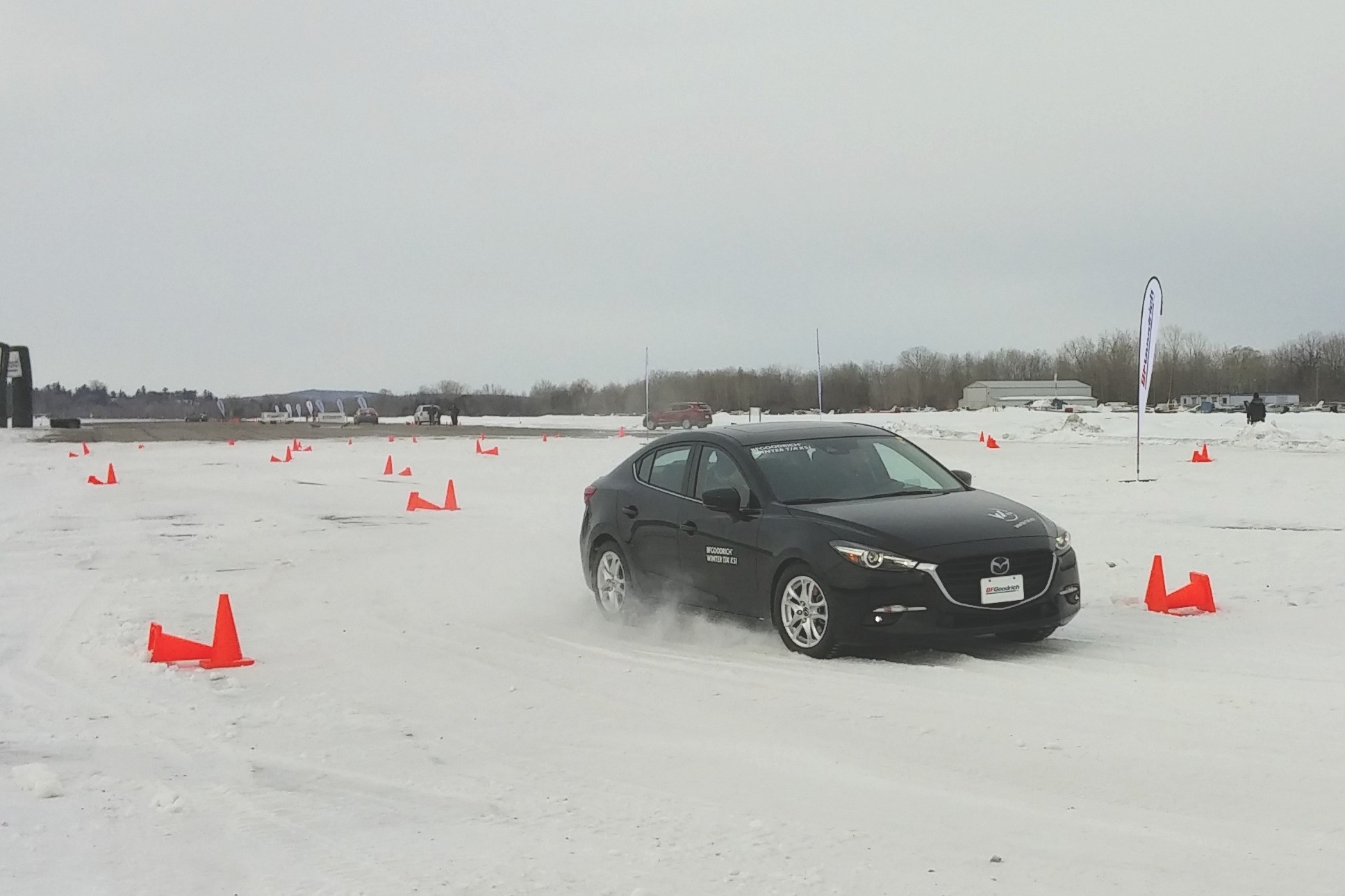
We tossed a pair of Mazda3 sedans around a snowy handling course, one on the KSI and one on Yokohama IceGuards, traction and stability control switched off. Nobody drives that way. It does let you feel the tire without the electronics papering over it.
The course linked two slalom sections with sweeping turns, so you provoked oversteer going in and fought understeer powering out. The Winter T/A KSI held grip more predictably, and its cornering stayed tidier as the surface broke up. The Yokohama let the car move around more, and it was the more entertaining tire. On icy roads we would still put a cautious driver on the BFGoodrich.
Ice Slalom in the Honda CR-V: KSI Against the Toyo Observe GSi-5
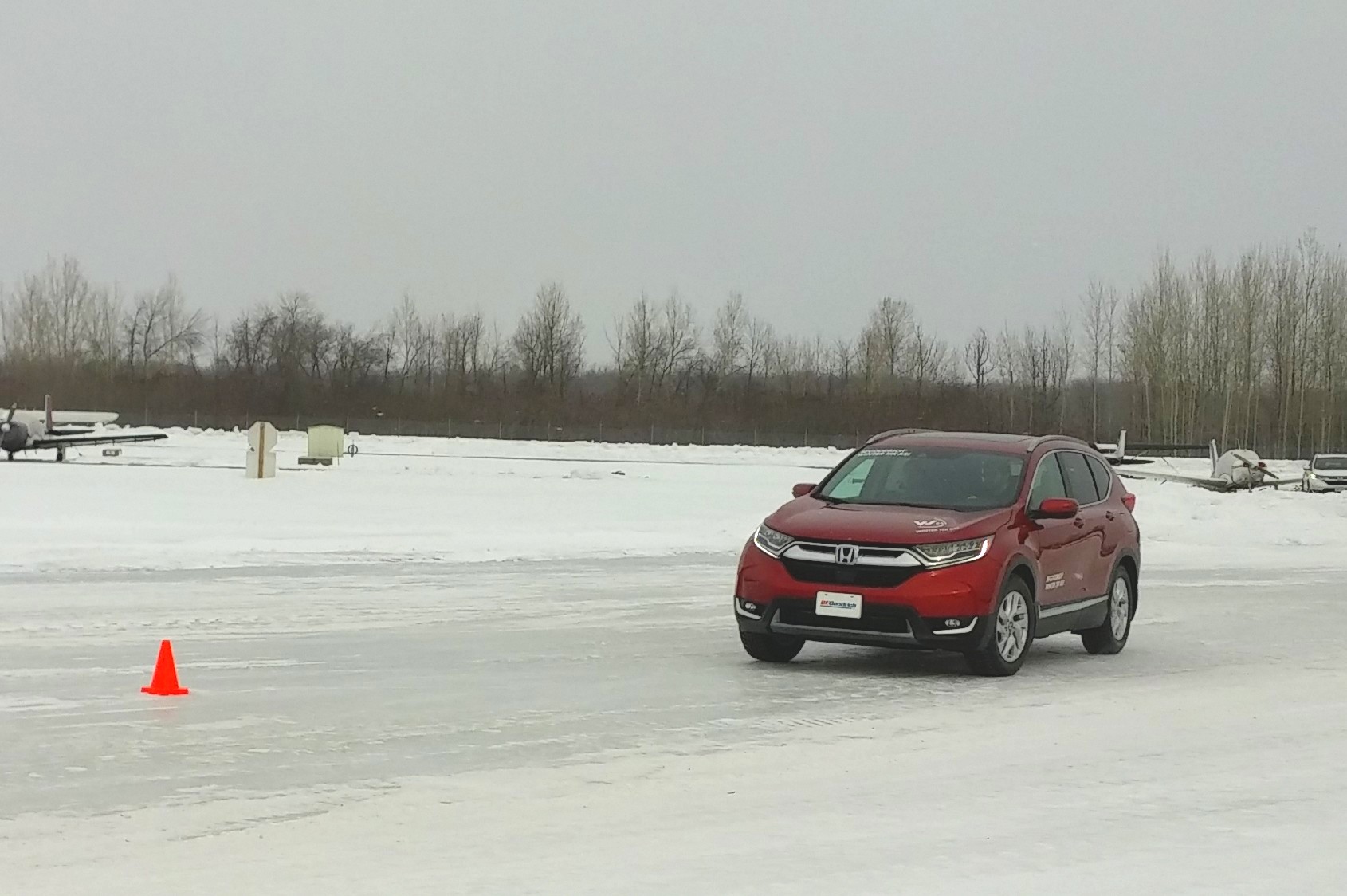
Second test, Honda CR-Vs, a steady 30 km/h through a pylon course laid out on ice. Both tires slid at initial turn-in. Neither is magic.
Recovery separated them. The KSI regained traction progressively and let you steer back onto line, which is what ice traction feels like from the driver's seat. The Toyo snapped back more abruptly and less consistently. The GSi-5 has since been replaced: the GSi-5's successor, the Toyo Observe GSi-6, is the current model, and we tested the HP version separately.
Ice and Wet Braking Against the Firestone Winterforce
Back into the Mazda3s for straight-line ice braking against the Firestone Winterforce. No skill required. Accelerate, wait for the signal, stand on the brake pedal.
Seat of the pants told us nothing, which is why the organisers ran GPS-based performance meters. The data was clear: the KSI posted shorter stopping distances than the Firestone and repeated them within a tighter spread. Consistency is the underrated half of braking performance. A tire that stops short once and long the next time cannot be trusted.
Wet performance, measured the day before in mild rain, went the same way: shorter, more repeatable stops than the Firestone.
It is easy to assume a tire company brings the rivals it expects to beat. BFG's people told us those tires were among the ones they benchmarked while developing the KSI. A reasonable basis for comparison, and still not an independent test.
Find Used Vehicles Ready for Canadian Winters on AutoTrader.ca
Tires are the only part of the car that touches the road. Start with the vehicle, then fit it properly.
Browse Used Vehicles Built for Canadian Winters
Winter Traction: Silica Compound and Tread Design
Two things decide how a winter tire behaves: the rubber compound and the tread design. BFGoodrich changed both for the Winter T/A KSI, and the reasoning behind the directional tread pattern beats most tire marketing for clarity.
Sipes, Biting Edges and the Serrated Shoulder in Deep Snow
The compound carries more silica, very fine sand, which keeps the rubber pliable at sub-freezing temperatures. Soft rubber grips cold pavement. Stiff rubber skates across it.
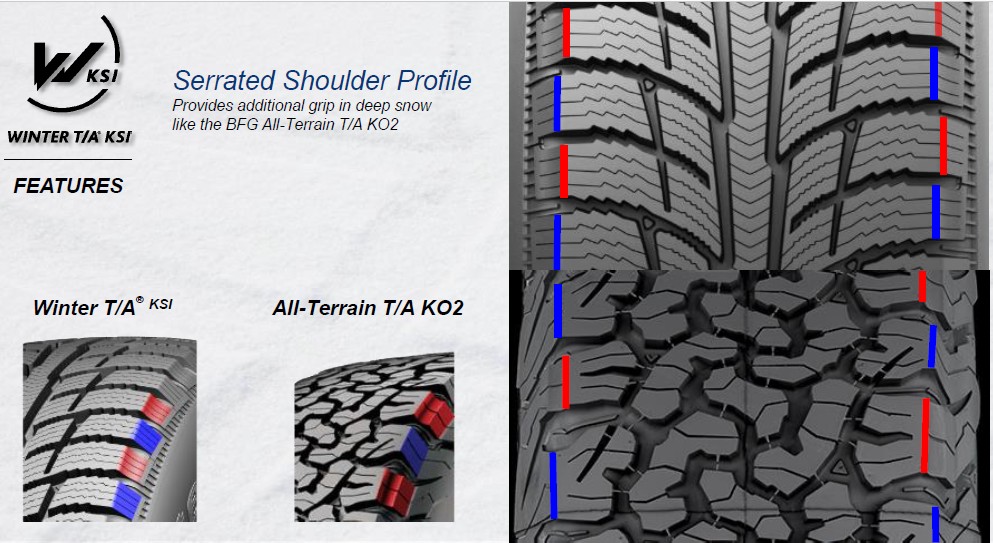
The tread does the mechanical work. Zig-zag 3D sipes cut thousands of biting edges into the tread blocks so the tire keys into ice, and on the KSI those sipes interlock, steadying the blocks instead of letting them squirm. A continuous centre rib sharpens steering feel.
Saw-toothed groove edges and a serrated shoulder profile, built from tread blocks of alternating width, are tricks BFGoodrich lifted from its own All-Terrain T/A KO2 to claw out of ruts in deep snow and slush. Wide grooves push water and slush clear, which also reduces the risk of hydroplaning through a slush rut.
Rubber casing protectors resist stone drilling on gravel, and BFGoodrich applies the same CoreGard Technology it developed for the Baja T/A KR3 to guard the sidewall.
To see how a BFG compound holds up over a full season rather than a single day, our long-term test of BFG's four-season rubber tracks the wear.
Why Clear-Pavement Behaviour Drives Most Complaints
Here is the part that surprised us. Research by Michelin, BFGoodrich's parent company, puts the average Canadian at about 20 percent of winter driving on genuinely slippery surfaces. The rest of the season the contact patch is on clear pavement, wet or dry.
That is where BFGoodrich winter tires, and every rival, draw most complaints. Older soft-compound rubber felt unsettled and squirmy once temperatures climbed above freezing, and road noise rose with it. The interlocking sipe design and stiffer rib fix behaviour at moderate cold temperatures rather than winning an ice test. A sane priority, given where the tires spend the winter season.
When Winter Tires Are Mandatory in Canada
Winter tire law in Canada is simpler than drivers think, because only one province has one. The rest is recommendation, insurance discount, or a highway-specific rule.
Quebec: Mandatory From December 1 to March 15
Quebec requires winter tires from December 1 to March 15 inclusive on every motorized road vehicle registered in the province, other than heavy vehicles, tool vehicles and farm machinery. The Société de l'assurance automobile du Québec, or SAAQ, sets a fine of $200 to $300 plus costs for driving without them, and the rule covers rental cars, mopeds and motorcycles.
The tires must carry the three-peak mountain snowflake symbol, certifying severe winter service. The Winter T/A KSI is not studdable, though studded tires are legal in Quebec across a longer window. Book early: tire dealers around Montreal fill up through November.
British Columbia, Ontario and the Rest of Canada
Outside Quebec, winter tire use is voluntary but far from unusual. British Columbia comes closest to a second mandate, requiring winter tires or chains on most provincial highways from October 1, not only on the mountain passes. It accepts either an M+S marking or the three-peak mountain snowflake symbol, with a minimum tread depth of 3.5 mm.
Elsewhere the lever is money. Ontario obliges insurers to offer a winter tire discount, with the amount left to the insurer, and Manitoba Public Insurance finances winter tires at prime plus two per cent. Transport Canada treats winter tires as a safety recommendation, not a federal requirement.
The rest is climate and habit. Alberta and the Prairies get cold enough that all-season rubber stiffens long before the first snow.
Compare Winter-Ready Crossovers and SUVs on AutoTrader.ca
Ground clearance and all-wheel drive help you go. Tires are what stop you. Both matter, in that order.
Winter Tire FAQ for Canadian Drivers

All Articles
See all
Subaru’s Uncharted Could Point to the Future of Enthusiast Hatchbacks
This electric Subaru is surprisingly fun, but is it more fun than a Golf R?
 Jeff Wilson

SRT Debuts Electric Turbocharger for Hellcat Response, But it Could Also Save Fuel
Dodge's SRT eBoost Air uses electricity to deliver more low-end torque.
 Chris Tsui

Here’s What Ford is Doing to Combat Vehicle Theft
Ford’s Security Package is designed for more peace of mind, but you have to pay up for it.
 Michael Karant