
2026 Harley-Davidson Low Rider S Review
 Jeff Wilson


Technological advancements are mushrooming into our lives at an accelerating rate.
One minute we’re hunting, gathering, and cooking over open flames, and the next we’ve got refrigerators connected to Wi-Fi that can help us grocery shop, and robots to vacuum, cut grass, and clear snow.
On the one hand, it’s nice having automation free up time for us by simplifying or removing chores from our daily lives; on the other, it seems we spend too much of that free time doom scrolling. Is that really progress?
Riding a motorcycle forces you to set aside the distractions and mind-clutter we all have and focus fully on the task at hand, lest the consequences be dire. But technology is infiltrating our rides, too, and in some respects it’s crept in so quietly — yet prolifically — that we may not have noticed how prevalent it is.
That’s why the 2026 Harley-Davidson Low Rider S is a great reset to what motorcycling should be. This is a machine that harkens back to what the Motor Company has done so well for so long: build a big, burly V-twin with a motorcycle around it, and make it look (and sound) damned cool.
The Tech — or Lack of it
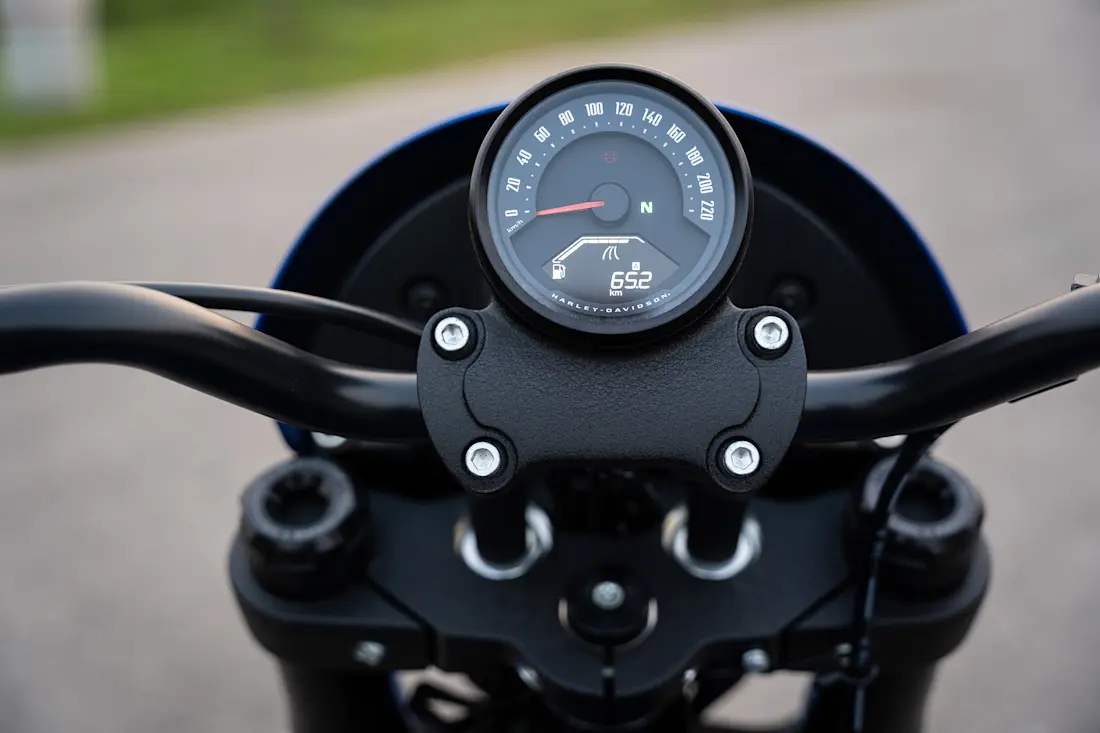
For many riders, this one included, the Low Rider S is the epitome of what a Harley should be. It’s low (duh), long, and utterly simple, which means the riding experience is about just that: the sensations of riding, not a large screen with a zillion different computer settings and ride modes, a GPS, and satellite radio to fiddle with.
The Low Rider S has a single, small round pod perched atop the clamp that holds the handle bars on. It’s dominated by an old-school analog speedometer, and while it has a digital portion, it’s about as complex as a Casio watch.
The little display shows a tiny bar graph for a fuel gauge, the odometer, and a small graphic to indicate which of the three rudimentary ride modes is selected: road, rain, or sport. Yes, those are technological gizmos that no Low Rider pilot would’ve dreamt of or wished for decades ago, but in truth, they do little more than adjust the throttle’s responsiveness and the level of traction control intervention.
Traditionalists might bark that their throttle hands are all the traction control they need, and while that may be, it’s tough to fault Harley-Davidson for including the lean-sensitive system, or anti-lock braking, since none of us need those features until that one time we actually do, and then it saves scraping up the Low Rider’s cool paint job (or our butts). There’s still no wheelie control, if that helps make it more macho, but don’t tell your riding buddies you used the standard cruise control during your last highway stint.
The Ride

The fact is, none of the technology that’s found on the Low Rider S does anything to diminish the purity of the ride experience. You still sit down, knees up and legs splayed around the big engine, arms up and spread wide as the wind blast hits you square in the chest.
You’re out there in the experience when you ride the Low Rider S, and if you forego a full-face helmet, you’re catching all the bugs in the teeth you could ever want. Some folks, especially if they’re long-legged, will want to opt for the forward-mounted controls that help stretch the rider out further at the expense of a bit of turning control.
Despite being a relatively stripped-down model (there’s not even a pillion seat or pegs, and only the tiniest of fairings up front), the Low Rider S’s 304-kg (670-lb) mass when fully fuelled is about the same as a baby grand piano. Still, the weight is really only felt when hauling this Harley off its side stand, and once under way it wears it well, keeping the centre of gravity low and tracking nicely through sweeping curves.
The Low Rider S is a long bike, so it isn’t nimble, and it can be a lot to wrestle around when navigating parking lots, especially for riders who are coming to this bike from sport or sport touring machines.
The pair of 292-mm (11.5-in) front rotors are clamped by four-piston calipers and do a good job of shedding speed, but despite one of the few Harley-Davidson cruisers that has dual front brakes, it still doesn’t offer the immediacy or braking bite that riders of sportier bikes expect.
Oh, That Engine
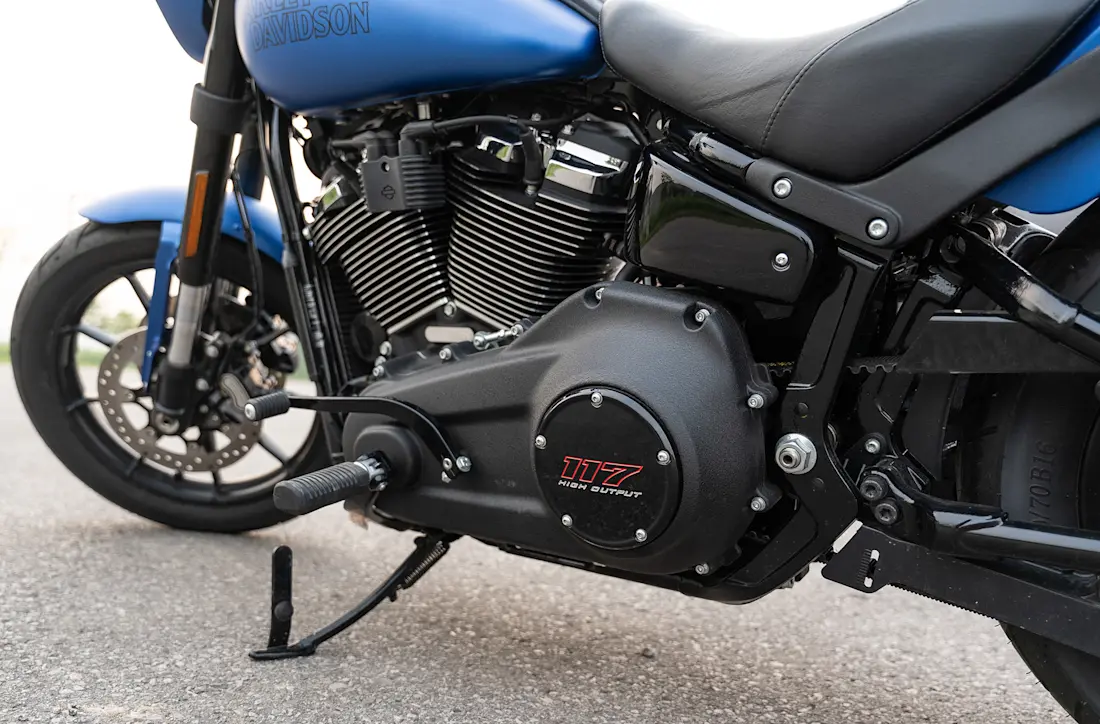
The Low Rider S’s Milwaukee-Eight 117 engine is most-certainly its defining feature. The 117 in the name refers to cubic inches, which translates to a gargantuan 1,923 cc here in the metric world. As expected with a pair of cans displacing nearly a litre each, the Low Rider S is never wanting for torque. In fact, at 128 lb-ft of it at 4,000 rpm, it’s one of the burliest two-wheeled machines around. Its 114 hp is nothing to scoff at either, and combined with the six-speed transmission’s relatively tall gearing, it means a rider rarely needs to shift out of second gear when cruising around town.
Naturally, a big V-twin isn’t a high-revving engine, but the 117 builds steam enthusiastically, and considering Harley’s reputation for paint-shaker smoothness, the vibrations in Low Rider S seem to be all harmoniously calibrated to give the bike the sound people expect, and the visceral experience riders desire. Surprisingly, the Milwaukee-Eight is notably quieter here than expected, but then maybe it’s just because there’s nary a stock exhaust to be found on any Harley-Davidson anywhere outside the showroom.
At highway speeds, the Low Rider S tracks well and again, its engine is not only smooth, but the fuelling is measured out so perfectly that snapping open the throttle to pass slower traffic is never met with any sort of hesitation. At low speeds, the on-off nature of the throttle can be a bit jumpy, though, and it can take a steady hand to be smooth.
Riders who have the fortitude to exercise restraint with their throttle hand can be rewarded with an average fuel consumption of 5.0 L/100 km, and a theoretical range of over 370 km. This rider does not possess that sort of self-control and found my range to be not much more than 200 km between fillups.
Pricing and Competition

These are strange and trying times in the motorcycle industry, and there are surprisingly few bikes that offer the sort of pure power-cruiser experience the Low Rider S does. The Japanese competitors have moved into cushier, touring machines, while BMW’s R18’s Boxer-twin engine provides a very different vibe than the big V-twins, though it is more affordable. The closest competitor is the Indian Chief Dark Horse, which like those other machines, falls just short on displacement and thrust, but starts a couple grand below the Low Rider S’s $25,599 price (including obligatory freight and delivery charges).
Curiously, ordering the new-for-2026 chrome package shaves $1,400 off the cost of our blacked-out test bike that also wore the optional Aurora Blue Denim (matte) finish and an as-tested cost of $27,799, confirming this is indeed a premium product despite its relative simplicity.
Final Thoughts
In too many facets of life, technology seems to be taking over, and rarely for the better. Motorcycles aren’t exempt from the increasing complexity designed to make life easier, which makes the 2026 Harley-Davidson Low Rider S all the more appealing. The company’s use of technology is well-hidden and largely related to reasonable safety features that otherwise leaves just a raw, pure riding experience that fans of power cruisers demand.


All Articles
See all
2026 BMW R 1300 RS Review
Handsome and unique, but with a very specific sort of appeal.
Jeff Wilson
Quick Spin: 2019 Electra Meccanica Solo
The future of urban personal transportation?
 Greg Wilson

Test Ride: 2018 Kawasaki Ninja 400
How is the new Kawasaki like a puppy? Jeff lists the ways.
Jeff Wilson