
2026 Lexus RX 450h+ PHEV Review
 Chris Tsui


Trader scores
This score is awarded by our team of expert reviewers after extensive testing of the car.
When it comes to luxury crossovers as most people know them today, the Lexus RX is the genesis.
No, not in the Hyundai sub-brand sense, but in the where-it-all-began sense. It was the first unibody (read: not truck-based) SUV from a luxury automaker when it was first introduced in 1998, and it spawned an entire segment of vehicle that dominates the luxury market these days.
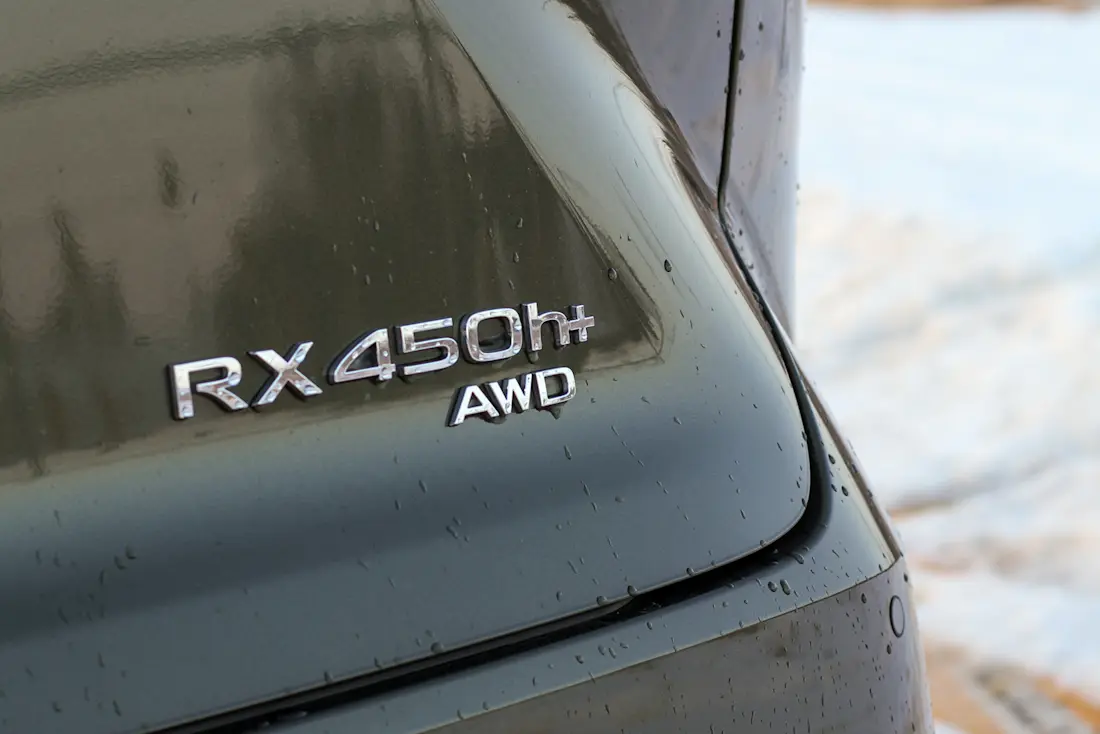
The latest version comes with the choice of four distinct powertrains. There’s the base non-hybrid 350, the conventional hybrid 350h and higher-performance 500h, but the subject of this test is the plug-in hybrid (PHEV) 2026 Lexus RX 450h+ — a RX that looks like the rest but can travel 61 km on electricity alone.
Styling: 7.5/10
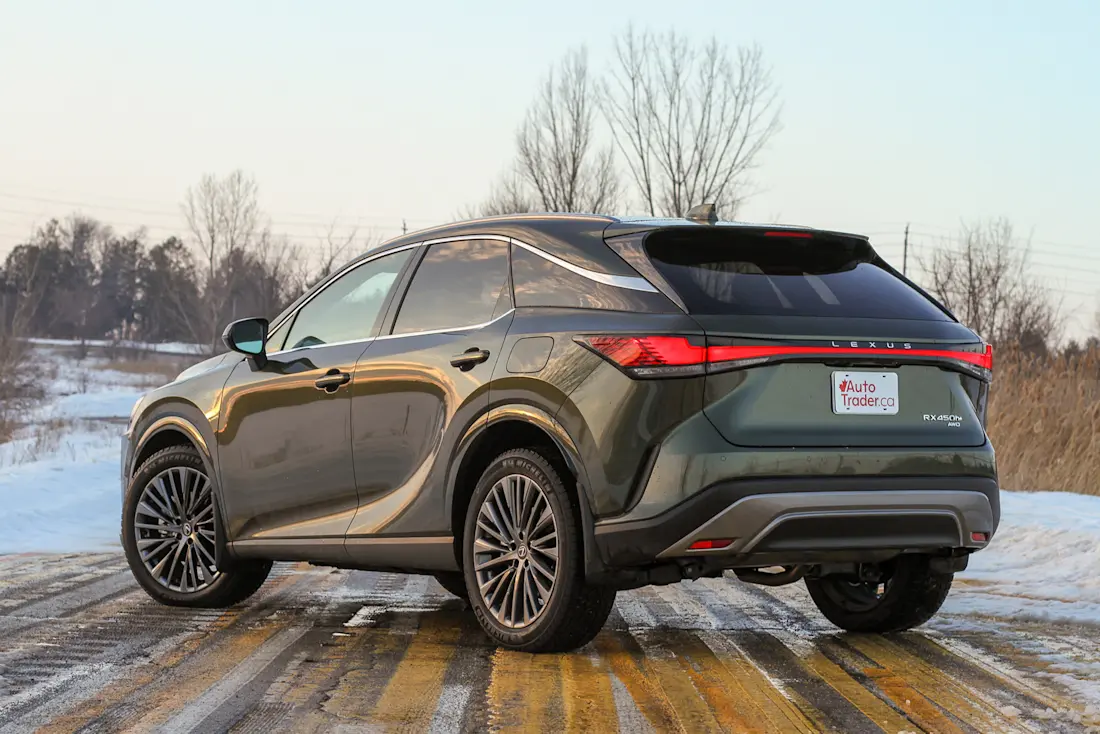
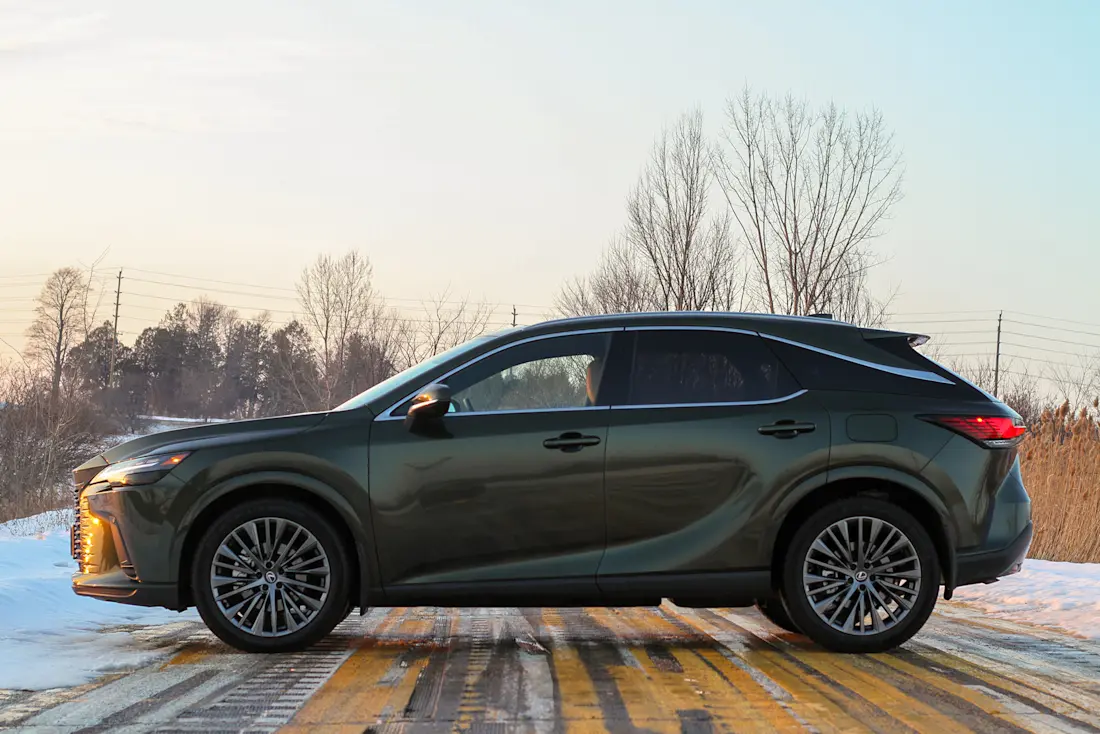
Now in its fourth model year, this generation of the RX has become quite a common sight on Canadian roads. It’s swoopy and premium-looking, although the part up front between the headlights that juts out looks a bit like a bruise that never healed.
Inside, it’s a similarly luxurious space without feeling pretentious or gaudy. Lexus’s aesthetic is stylized yet approachable, but more fashion-forward drivers may gravitate toward more striking (and less common) rivals like the Bentley-esque Genesis GV80, or the very Scandinavian Volvo XC90 that’s also available with a PHEV powertrain.
Safety: 7/10
Encompassing adaptive cruise control with curve speed management, lane departure warning, and steering assist, among others, the Lexus Safety System+ 3.0 set of assisted-driving technology is standard equipment with the RX 450h+. The adaptive cruise does a decent job of semi-automating highway driving, and it’s able to keep itself within a lane even through curves with reasonable stability.
This generation of the RX misses out on the Insurance Institute of Highway Safety’s (IIHS) Top Safety Pick designations mostly due to a “Poor” result in the updated moderate front overlap crash test. It scored “Good” in all other areas.
Features: 8/10
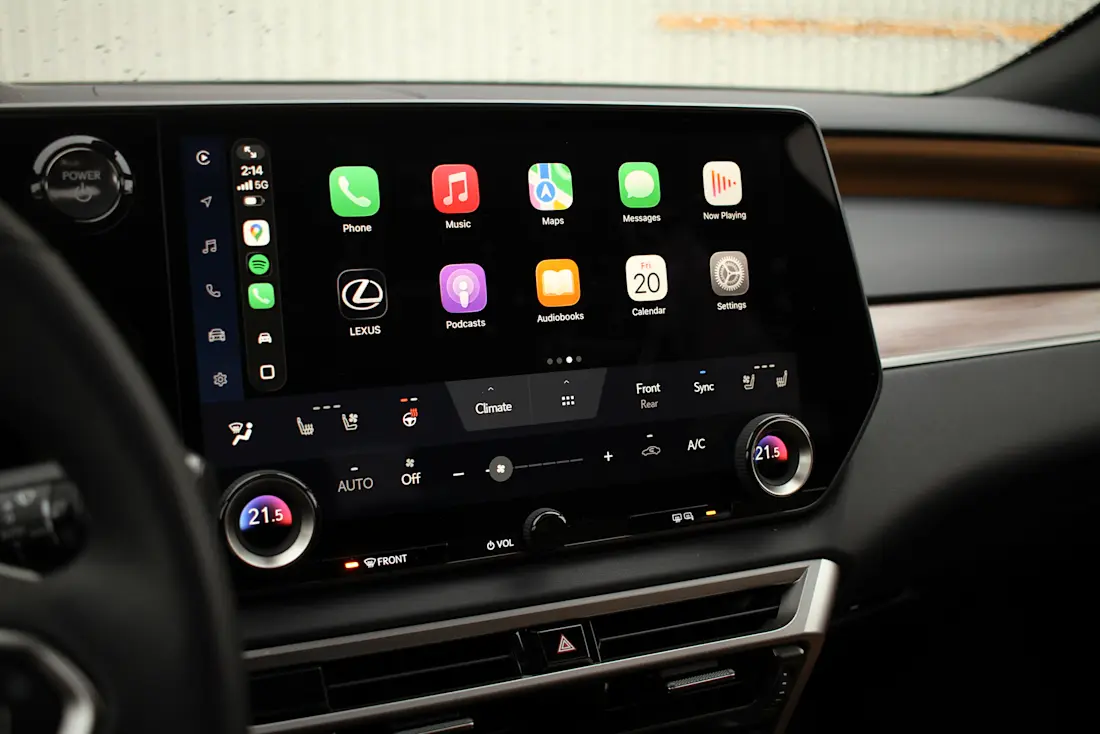
There’s a single optional package called the Executive, whereas the base trim is called the Ultra Premium. It has a healthy amount of standard features, including a regular-size sunroof, power-adjustable front seats with lumbar support, a heated and power-adjustable steering wheel, wireless phone charging, a washer for the backup camera, a big 14-inch touchscreen, and a 12.3-inch instrument display.
That $8,890 Executive package adds a panoramic sunroof, auto-levelling, triple-beam LED headlights, a 21-speaker stereo, head-up display, heated rear seats, a power tailgate with a kick sensor, a 360-degree camera system, and shinier wheels.
User-Friendliness: 7.5/10
The centrepiece of the RX user experience is the 14-inch touchscreen running wireless Apple CarPlay and Android Auto, but there’s still a fair amount of physical controls, including knobs for temperature and volume. If you’ve never driven a modern Toyota or Lexus product, common confusion points will include the gear selector, which requires a slightly awkward L-shaped movement to put it in drive or reverse, and the interior door releases, which are electronic buttons on the sides of the armrests.
But the buttons on the steering wheel are trivial, and the general ergonomics are decent. It’s not an analog, old-school paradise inside, but it also isn’t egregiously touch-dependent, either.
Practicality: 7.5/10
Sitting in the RX’s back seat, it’s reasonably spacious with a good amount of legroom. Headroom isn’t tight, per se, but may be if you’re anywhere close to six feet tall. There’s definitely more passenger room than you get with its smaller sibling, the NX, and a quick spec sheet comparison says the RX’s second row is about as roomy as that of the Acura MDX but trails the Mercedes-Benz GLE-Class’s back row. Rear passengers get their own climate zone and air vents, as well as dedicated USB-C ports and dome lights.
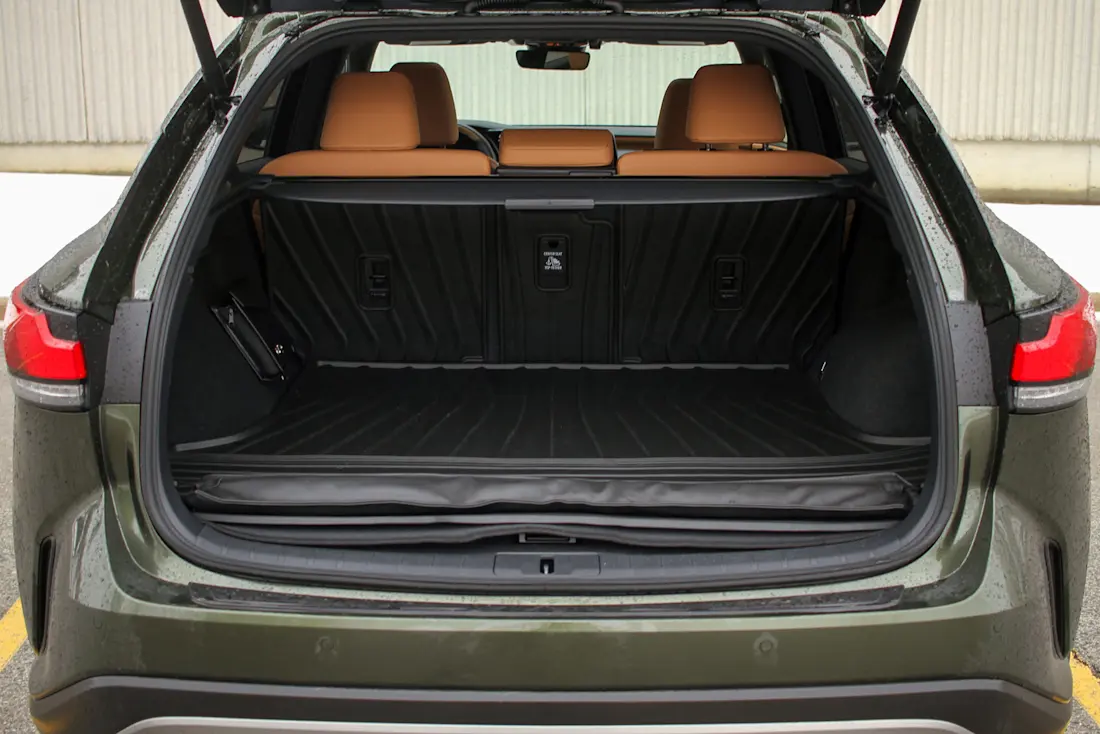
The cargo area is also fairly sized, but the load floor feels quite high. Initially, I suspected this had something to do with having to accommodate the PHEV battery, but cargo space is, in fact, identical across all RX models, according to Lexus Canada specifications.
Comfort: 9/10
As one of the highlights of the entire vehicle the RX is extremely comfortable. The ride soaks up bumps and potholes, no matter how big, while the seats are supportive and supple. Wind and road noise are kept to a reasonable minimum, too, making long highway trips feel relaxing for both driver and passengers.
Power: 7.5/10
With gas and electricity combined, the RX 450h+ makes 304 hp, which in the context of a heavy hybrid SUV is just enough to let it become appropriately speedy when you need it to be. Driving in electric mode feels smooth for sure, but perhaps a notch less so than some luxury full-EVs, which can feel downright silky.
RX shoppers with a heavy right foot will likely be better served by the 500h, an F Sport-only model that puts out 367 hp but can’t be plugged in.
Driving Feel: 8/10
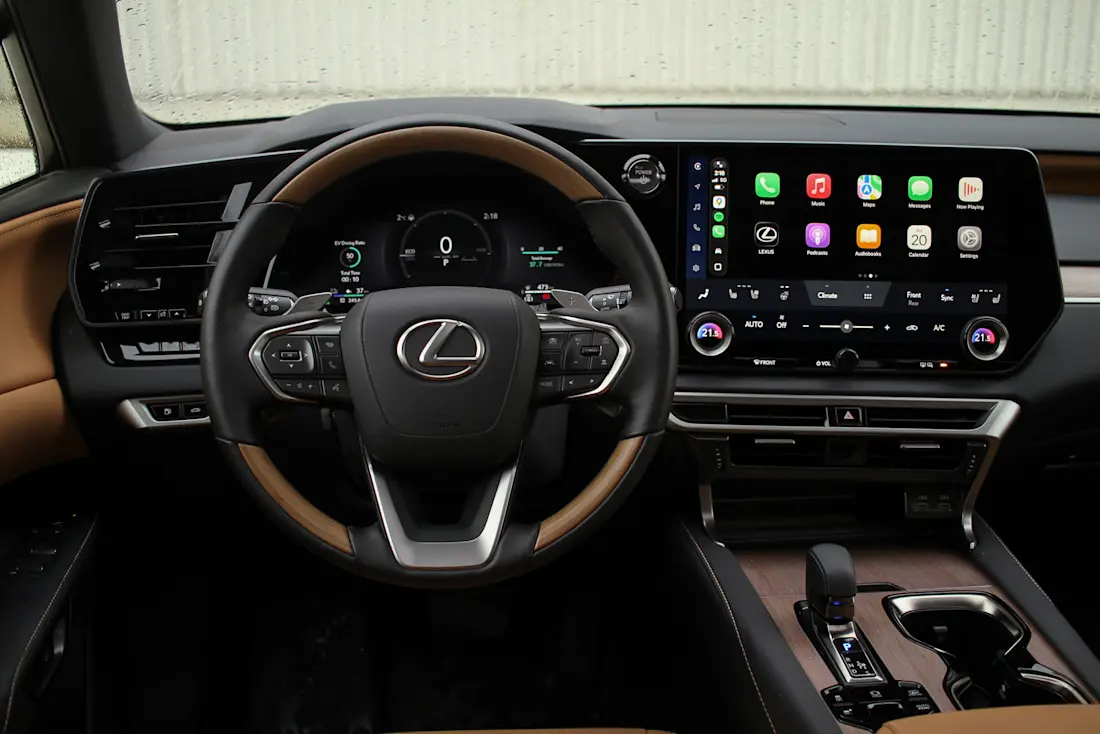
As an everyday family hauler, the RX is confidently and comfortably quite nice to drive. The steering feels easy and natural, while the brakes are easy to use with precision. It also feels more substantial than an NX but less ungainly than the three-row TX, sitting in a nice middle ground in the Lexus crossover hierarchy.
Fuel Economy: 9/10
In this 450h+ form, the RX’s officially claimed electric-only range stands at 61 km. For comparison, the Volvo XC90 T8 PHEV can go 53 km, while the BMW X5 xDrive50e can go 64 km and the Mercedes GLE 450e can travel 79 km.
As a bit of a stress test, I locked this car in EV mode, took it on a highway-heavy journey at temperatures just below freezing and was able to travel 45 km before the gas engine kicked in. Expect it to get closer to its 60-km brochure figure in warmer, more reasonable driving.
Driving in hybrid mode, Natural Resources Canada (NRCan) rates this car for 6.5 L/100 km in the city, 6.9 on the highway, and 6.7 combined, but I observed about 7.5 L/100 km throughout this wintertime test — still not bad at all considering this vehicle’s size and power.
Taking into account the three times I recharged the battery throughout this week-long test and the subsequent electric-only driving, my fuel spend was equivalent to that of a non-PHEV averaging 6.1 L/100 km.
Value: 8/10
If you’re OK with a base, non-hybrid 350 model, the 2026 RX can be had for as little as $63,190, including $2,205 for destination. If you’d like this PHEV RX 450h+, however, it’s $80,800 to start, although that premium also pays for more bells and whistles in addition to the more advanced powertrain.
Among competitors with similar brand clout, this is around the same price as the Acura MDX Platinum Elite A-Spec, although that’s not available as a hybrid at all. Among the PHEV offerings in this segment, however, the RX 450h+ represents a bit of a bargain, as the Mercedes GLE 450e starts at over $90,000 while the BMW X5 xDrive50e starts at more than $100,000.
The Verdict
The 2026 Lexus RX 450h+ does practically everything it needs to do with a consistent level of competence that makes it hard to argue against. It’s a smooth, drama-free drive that packs a lot of decently conceived, easy-to-use, non-overbearing tech. It’s reasonably attractive to look at, roomy without feeling bulky, and, in 450h+ form, an efficient part-time EV. It’s an excellent, practical luxury vehicle in a long line of them.
Specification
Trim Tested
2026 Lexus RX 450h+ Ultra Premium
Base Price
$78,495
Options
N/A
A/C Tax
$100
Destination
$2,205
Price As Tested
$80,800
Engine Displacement
2.5L
Cylinders/Configuration
I4 PHEV
Max Horsepower
304 net hp
Max Torque
N/A
Fuel Economy
6.5 / 6.9 / 6.7 L/100 km cty/hwy/cmb, 2.8 Le/100 km; 61 km est. range
Cargo Capacity
838 / 1,308 L seats up/down

All Articles
See all
2026 Lexus TX Review
As far as luxury-leaning three-row crossovers are concerned, it’s hard to do better than this.
 Sami Haj-Assaad

2026 Lexus ES First Drive Review
If three sedans must spiritually exist as one, you can do a lot worse than the new ES.
Chris Tsui
