
2026 Ford Maverick Review + Video
 Dan Ilika


Trader scores
This score is awarded by our team of expert reviewers after extensive testing of the car.
Last year, before I picked the Subaru Forester Wilderness as my new daily driver, I almost ended up with something entirely different.
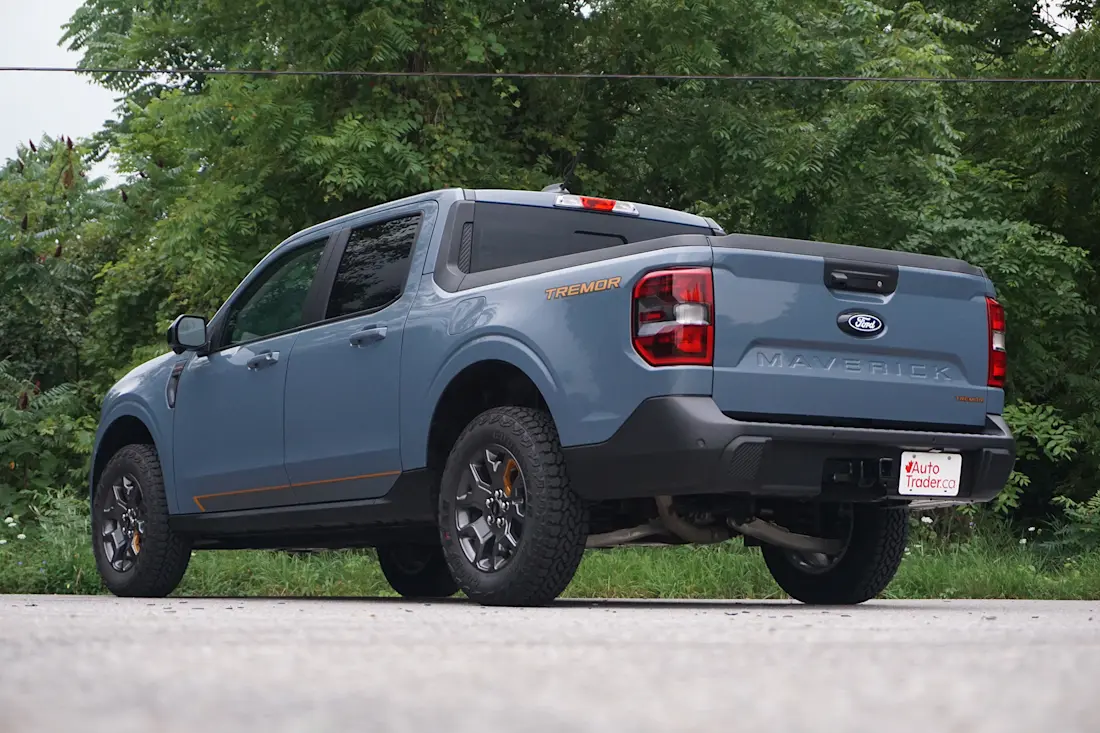
Yes, Ford’s tiny truck was on my shortlist, which might come as a surprise considering how vastly different the Maverick is from the ruggedized version of Subaru’s proverbial box on wheels. And while I’m happy to report having no regrets about my purchase decision, a two-week test of the 2026 Ford Maverick Tremor was a reminder of what could’ve been.
User-Friendliness: 6/10


Before we dive too deep, it’s worth noting that the Maverick is a multi-time AutoTrader Awards winner — not just amongst small trucks but across the entire market, including perennial best-sellers like the full-size F-150 — and with good reason. However, that doesn’t mean it’s perfect, and there are some inherent issues with its user experience that make the Maverick more frustrating to interact with than it needs to be.
For starters, the shift dial isn’t my preferred method of gear selection, but this one’s especially egregious for the absence of hard stops for park and drive. Instead, it spins endlessly like a volume knob, which takes some of the set-it-and-forget-it straightforwardness out of everyday interactions like parking or making a three-point turn, especially under pressure.
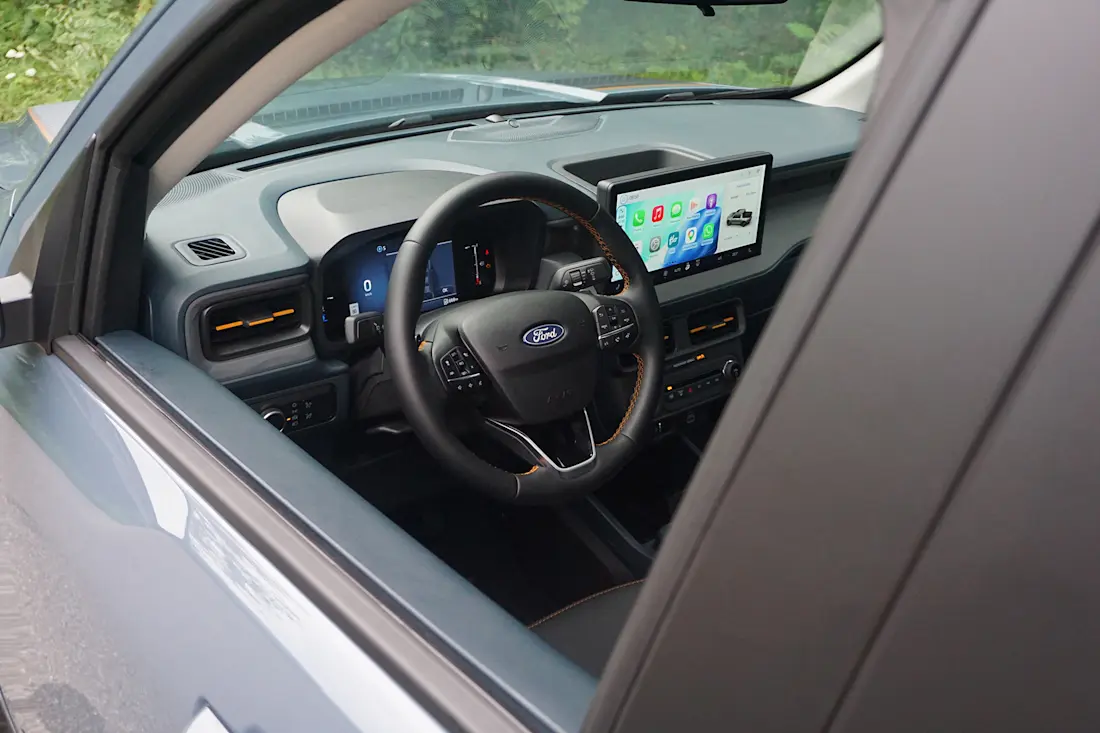
Beyond that, Ford’s decision to ditch the physical climate controls the Maverick used to have in favour of ones entirely integrated within its 13.2-inch touchscreen means even simple adjustments aren’t as easy as they once were. Tiny icons that span the bottom of the display are tough to pick out at a glance, taking precious attention away from where it should be focused: on the road ahead.
And while the Sync 4 infotainment software is mostly fine, there’s a noticeable delay when toggling between features and functions — say, switching from the radio to the home screen. But then the wireless Apple CarPlay connectivity was all but flawless for the entirety of this test (the system offers Android Auto compatibility, too), plus the big and bright display is affixed to the dashboard in a way that isn’t entirely distracting.
Design: 7/10
On the subject of the dashboard, it retains the same unique combination of colours and textures as before, with a blend of blue, grey, and black plastic. Not all of it feels especially impressive, but it suits the character of this compact pickup. However, the colour mix means it doesn’t pair well with every exterior paint choice. Among the exceptions is this tester’s shade of Azure Grey ($800), which happens to be the one I would’ve picked had I opted for the Maverick.
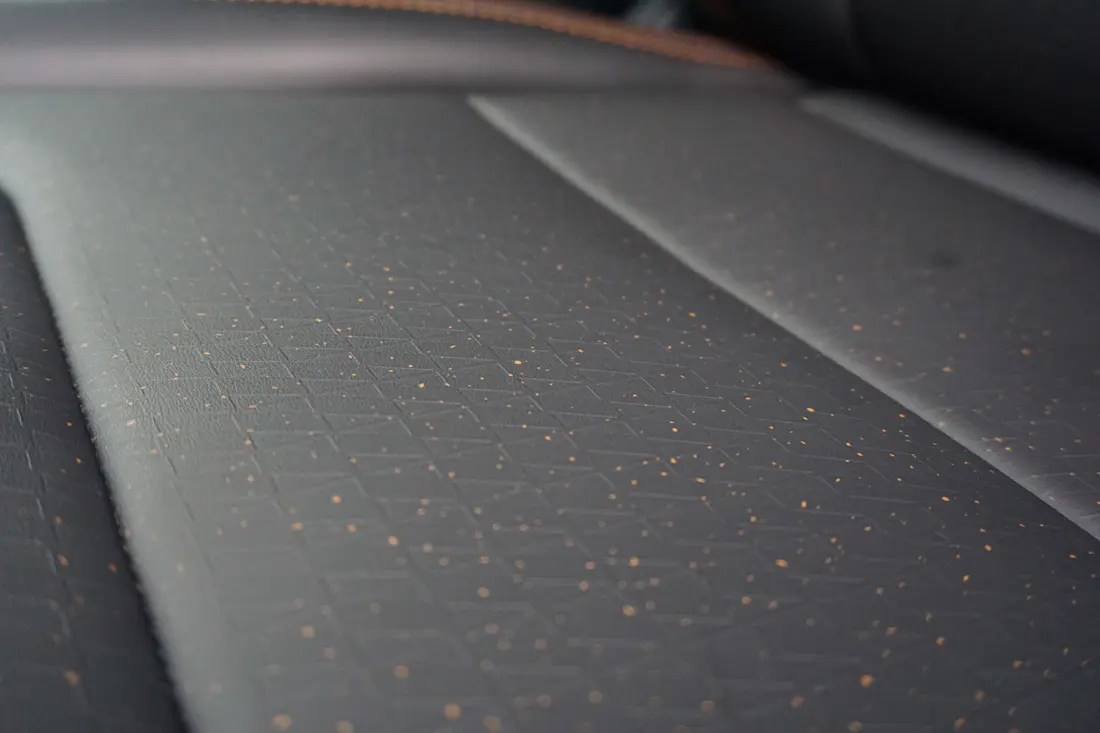
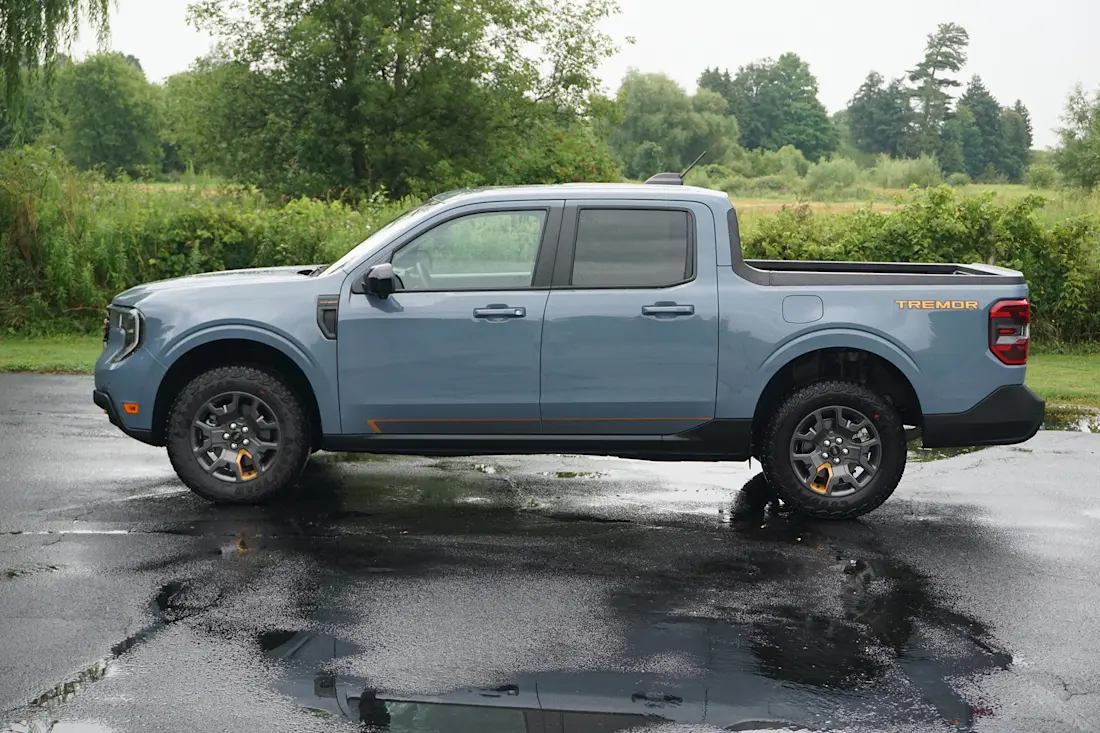
The Tremor treatment adds some yellow accents inside and out — in particular, I like the subtle speckled upholstery — and, as part of last year’s facelift, some hood and bodyside graphics I’d happily live without. Likewise, the hooked headlights aren’t my favourite, with an almost fang-like quality. But this pickup is largely innocuous otherwise, and is much less polarizing than the similarly sized (and shorter-lived) Hyundai Santa Cruz.
Everyday Usability: 7/10
The Maverick’s compact dimensions mean it’s more manageable and manoeuvrable than a bigger truck, which isn’t only beneficial to city dwellers but anyone who has dreams of front-row parking at the grocery store on a rainy day without the risk of a door ding. Of course, that means it can’t tow or haul as much as a midsize or half-ton truck, and the Tremor trim is only rated to pull 907 kg (2,000 lb).
That’s half of what the standard truck can safely handle, including the hybrid, which is likely due to the unique gearing that comes with its twin-clutch rear differential (more on that later). Payload is also down, although not as drastically, with a capacity of 517 kg (1,140 lb) compared to a maximum of 680 kg (1,499 lb). Otherwise, the cabin is spacious considering the footprint the Maverick occupies, while small-item storage is more than reasonable.
Powertrain: 10/10
Among the reasons to consider the Maverick is its efficient hybrid powertrain, which can’t be paired with the Tremor trim. That means there’s a turbocharged 2.0L four-cylinder in its place that makes 250 hp and 280 lb-ft of torque — ample output for a truck this size. Not only does it make this a responsive and quick companion, but it even sounds good from inside, with the turbo spooling audibly before a subtle growl takes over as the revs rise.
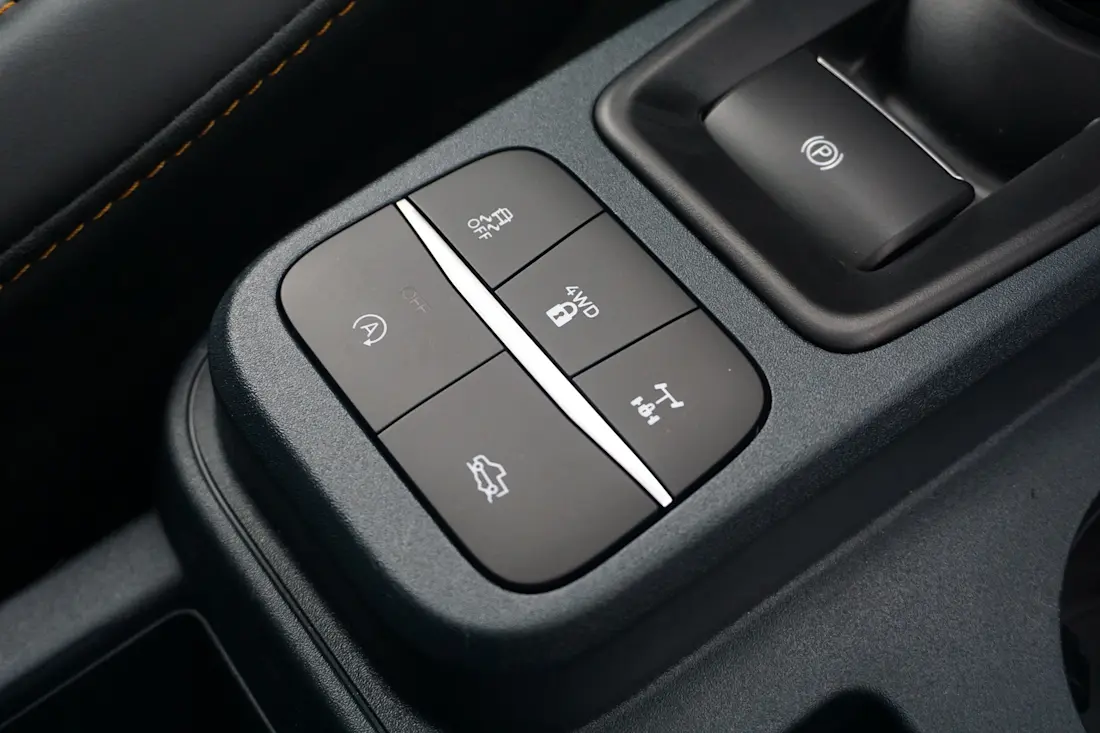
The engine works in conjunction with an eight-speed automatic transmission and an all-wheel-drive system that can be locked for permanent traction front and rear, while the differential in the back is a quick-acting twin-clutch unit that has torque vectoring technology. It’s the same one as the street-focused Maverick Lobo, as well as the Badlands version of the Ford Bronco Sport, and like the latter, it’s tuned for trail use. It can also be locked when required.
Driving Feel: 10/10
Also part of the Tremor package are proper all-terrain tires with aggressive tread blocks, though they do nothing to negatively impact the steering system that’s been expertly tuned for a firm feel and good responsiveness when changing direction. Maybe Ford’s engineers went further than they needed to in making the Maverick drive like a “real” truck, but I for one have no complaints about the outcome.
Comfort: 7/10
While those tires improve the Maverick Tremor’s performance off the pavement, they’re tremendously noisy on it. That’s not just on the highway, either, which is pretty common. Instead, it’s all the time. (For what it’s worth, the same type of tires on my Forester Wilderness are significantly quieter, especially at city speeds.) But the ride quality is reasonable, and the front seats are supportive enough to limit fatigue during long drives.
Efficiency: 7/10
While the Maverick’s humble hybrid powertrain might not be well suited to off-road sojourns, the turbocharged setup that takes its place under the Tremor trim’s hood isn’t nearly as efficient. It’s officially rated to burn 10.1 L/100 km combined, according to Natural Resources Canada (NRCan), which makes it the thirstiest in the lineup. (An all-wheel-drive example of the Maverick Hybrid is good for a combined rating of 6.4 L/100 km, according to NRCan.)
This test, which skewed more heavily towards highway use, finished with an indicated average of 9.4 L/100 km across more than 850 km. As it happens, that’s slightly worse than the 9.0 L/100 km my 2025 Forester Wilderness is supposed to consume in combined conditions, while the Bronco Sport Badlands and its optional Sasquatch package that uses the same components as the Maverick Tremor is rated for 9.7 L/100 km in mixed city and highway driving.
Equipment: 6/10
While premium brands like Porsche are notorious for charging what can add up to absurd amounts for mundane features, Ford isn’t far behind with the Maverick. Not only are heated seats kept out of the cheapest XL trim, to get them in the XLT (along with a steering wheel to match) means opting for the $2,000 Luxury package. Looking at it even less favourably, to get those creature comforts in a Maverick costs at least $42,095 before tax.
That’s quite a bit more than its entry-level price of $38,095 including freight ($2,495), which nets a fairly basic truck with manually adjustable seats and door mirrors, plus single-zone climate control, although the 13.2-inch touchscreen with wireless smartphone mirroring is standard. And while heated front seats are available higher in the lineup, they don’t come ventilated, nor are heated rear seats offered.
Safety: 7/10
The advanced safety and driver-assist features follow a similar structure, with standard items limited to forward collision warning with automatic emergency braking, lane departure warning and keeping, and the back-up camera that’s mandatory. Meanwhile, blind-spot monitoring with trailer coverage and rear cross-traffic alert can be added to the cheapest trim, while others get all that plus adaptive cruise control.
Value for Money: 6/10
While the $38,095 pre-tax price tag for the cheapest Maverick isn’t entirely unreasonable, it’s worth noting that it nets a fairly basic front-wheel-drive truck with a hybrid powertrain. Want to add all-wheel drive? It’s an extra $2,000. Meanwhile, the gas-only setup includes four-wheel traction for its $38,595 asking price, although the package that increases towing capacity to 1,814 kg (4,000 lb) is the same $1,000 regardless of what’s under the hood.
Next is the XLT trim that starts at $40,095, while all-wheel drive makes it $42,095 (and the turbo version rings in at $40,595). From there, the gas-only Maverick Lobo is $44,395 before options and taxes, while the Lariat starts at $47,595, although that’s for the turbo motor; opting for the hybrid is $2,000 more, but all-wheel drive is included. And finally, the Tremor trim starts at $50,595 before any extras are factored in.
The Verdict
The Maverick’s escalating pricing played at least a small role in my own purchase, with one specced how I’d want it — an XLT hybrid finished in Azure Grey and with all-wheel drive, heated seats, a spray-in bedliner, and a locking tonneau cover — touching $50,000 before tax. But beyond that narrowing value proposition, it’s the way the stuff inside works that steered me away from this truck and into the Subaru Forester Wilderness.
While I don’t have any regrets about my decision, that doesn’t mean I wouldn’t have been happy had I picked the Maverick instead. It’s great at what it does, which is provide the sensibility of a pickup in a compact package. Yes, that means its capabilities have been scaled down to match its size — those payload and towing capacities are worth remembering, especially with the Tremor version — but then it benefits from the manoeuvrability of a crossover.
Make no mistake: the Maverick isn’t an alternative to a half-ton truck like the F-150. But it manages to be a fun, funky, and functional daily driver that’s nothing if not unique.

Specifications
Trim Tested
2026 Ford Maverick Tremor
Base Price
$48,100
Options
$3,370 — Power sunroof, $1,200; Connectivity package, $1,020; Azure Grey Metallic paint, $800; Power-sliding rear window, $350
A/C Tax
$100
Destination
$2,495
Price As Tested
$54,065
Engine Displacement
2.0L
Cylinders/Configuration
Turbo I4
Max Horsepower
250 hp @ 5,500 rpm
Max Torque
280 lb-ft @ 3,000 rpm
Fuel Economy
11.2 / 8.7 / 10.1 L/100 km cty/hwy/cmb
Cargo Capacity
5’4” / 1,382 mm bed

All Articles
See all
2026 Ford Ranger Raptor Review + Video
The Ranger Raptor doesn’t come cheap, but it delivers all kinds of capability.
Dan Ilika
2026 Ford Mustang Mach-E GT + Video
Six years after it launched, this EV is starting to fall behind.

2026 Ford Bronco Sport Review
Ford’s baby Bronco doesn’t come cheap, but it’s also uniquely rugged and cool.
 Sami Haj-Assaad