
2026 Dodge Charger Sixpack Review + Video
 Dan Ilika


Trader scores
This score is awarded by our team of expert reviewers after extensive testing of the car.
For nearly two decades, Dodge dutifully recruited members to a rowdy fraternal order.
Oh, sure — the brand built muscle cars back in their heyday, but it was the launch of the retro-inspired Challenger in 2008 that saw Dodge lean into its heritage, and with huge success. It embraced displacement as fully and completely as possible, even though it undoubtedly sold significantly more V6-powered examples of the Challenger and its sibling Charger sedan than ones with the supercharged Hellcat shoehorned under their hoods.
It wasn’t just the cars, either. The entire persona projected by the brand saw a significant shift over the same period, culminating in the so-called brotherhood of muscle in more recent years. Suddenly it had an almost anti-establishment edge, boasting about the size of its engines and eschewing emissions regulations along the way. In short, Dodge leaned into a particular lifestyle, and it leaned in hard.
As if haunted by the consequences of its own choices, the 2026 Dodge Charger Sixpack is taking up room on dealer lots alongside an entirely electric version of the brand’s modern-day muscle car. It’s all a lot to unpack.
Styling: 9/10


The new Charger looks like a tribute to the short-lived second-generation car that came out all the way back in 1968. Dukes of Hazzard fans are sure to rejoice. Setting it apart from the all-electric Charger Daytona is a pair of actual exhaust tips, as well as a grille that feeds the engine bay instead of forcing air up and onto the hood. Otherwise, they’re strikingly similar (and stylish) cars that wear their retro-inspired looks well.
The cabin is more modern than muscle car, with twin digital displays and a low-mounted dashboard that wraps down onto the doors, and a console that’s canted towards the driver. Meanwhile, the optional faux-carbon fibre finish pictured here pops alongside the selectable ambient lighting, which looks especially slick set to red with accent stitching in the same colour.
Everyday Usability: 7/10
Looks aside, there’s no hiding from the enormity of this car, which is significantly larger than both the Challenger and Charger models from before. (Dodge replaced them both with this one, which is appropriately named given the all-electric version that’s sold alongside this gas-powered model.) That helps explain how (or why) the two- and four-door models are dimensionally identical both inside and out, although it doesn’t tell the full story.
Because the 2026 Charger isn’t just longer than its predecessors by a significant margin — it’s wider, too. In fact, at 2,030 mm (79.9 in), its body spans almost the same distance as the Ram 1500 full-size pickup. Dodge even boasts about this being the widest production car on the market today, even exceeding the fender flare-clad editions of old by 40 mm (1.6 in). In short, it’s a lot of car to cruise around in.
Like the last Challenger, the two-door version in particular will likely pose problems in parking-lot scenarios, although the enormous openings on either side provide plenty of room to climb in and out. And Dodge has equipped the new Charger with a liftback hatch instead of a conventional trunk, which means there’s all kinds of room for stuff. According to Dodge, there’s a total of 628 L behind the back seats and 1,059 L with them folded.
User-Friendliness: 9/10
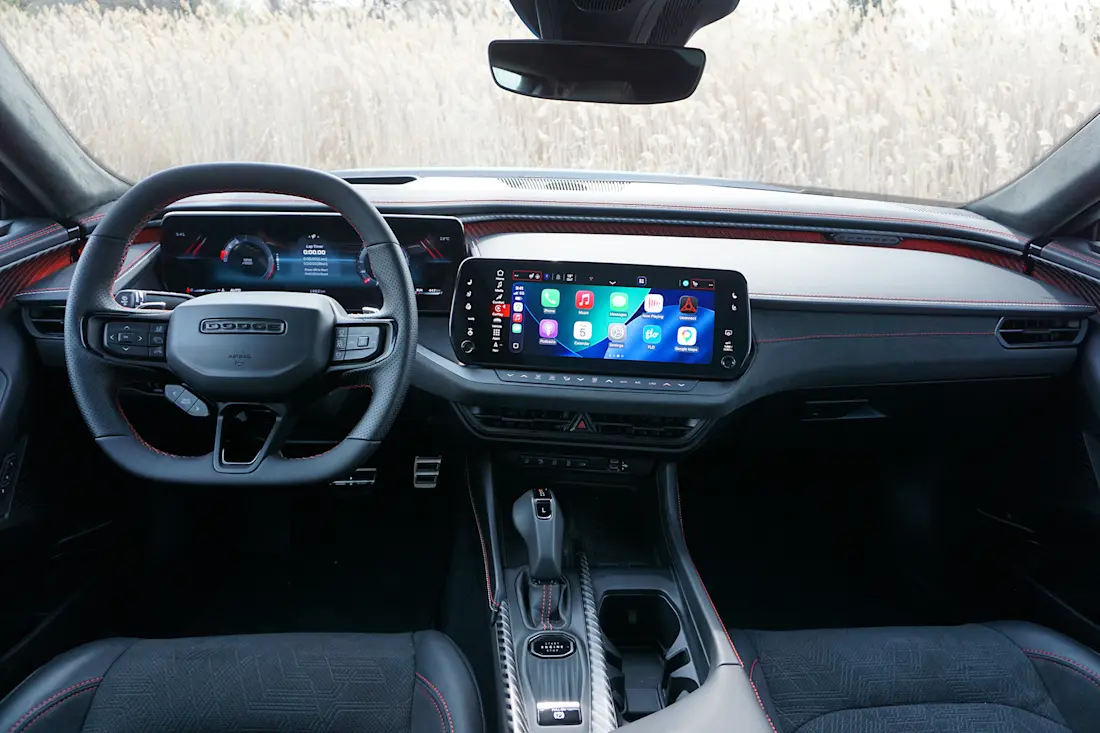
For all the upside that comes with the Charger’s hatch, Dodge parent company Stellantis’s insistence on putting the button to close it inside the cargo area instead of on the trunk lid itself defies industry norms and adds unnecessary frustration to the user experience. But then the automaker has finally added height programmability to its power tailgates, for those who park in garages with low ceilings, proving some progress is better than none at all.
While the pistol-grip gear selector is a bit unconventional — its long-neck design makes it a little too easy to put the car in neutral instead of drive, for example — the rest of the features and functions inside make good sense. That includes the Uconnect 5 infotainment interface that worked all but seamlessly during this test, plus there’s wireless Android Auto and Apple CarPlay compatibility for easy smartphone integration.
Powertrain: 9/10
There’s been plenty of chatter about the possibility of Dodge putting a Hemi under the Charger’s hood, but as of this writing the only gas engine is a twin-turbocharged inline six-cylinder. The 3.0L is offered in standard- and high-output variants, with the latter revving higher and having more boost pressure in this Scat Pack trim. The result is 550 hp and 531 lb-ft of torque — significant increases compared to the R/T (420 hp, 468 lb-ft).
Even the previous Scat Pack setup can’t touch this one based on output alone, with its enormous naturally-aspirated V8 pushing out 485 hp and 475 lb-ft of torque. But for as smooth and responsive as this new engine is — and it’s certainly capable of quickness when working in tandem with the Charger’s all-wheel-drive system, with a zero-to-100 km/h sprint time of about four seconds, according to Dodge — what’s missing here is the aural experience of old.
Driving Dynamics: 9/10
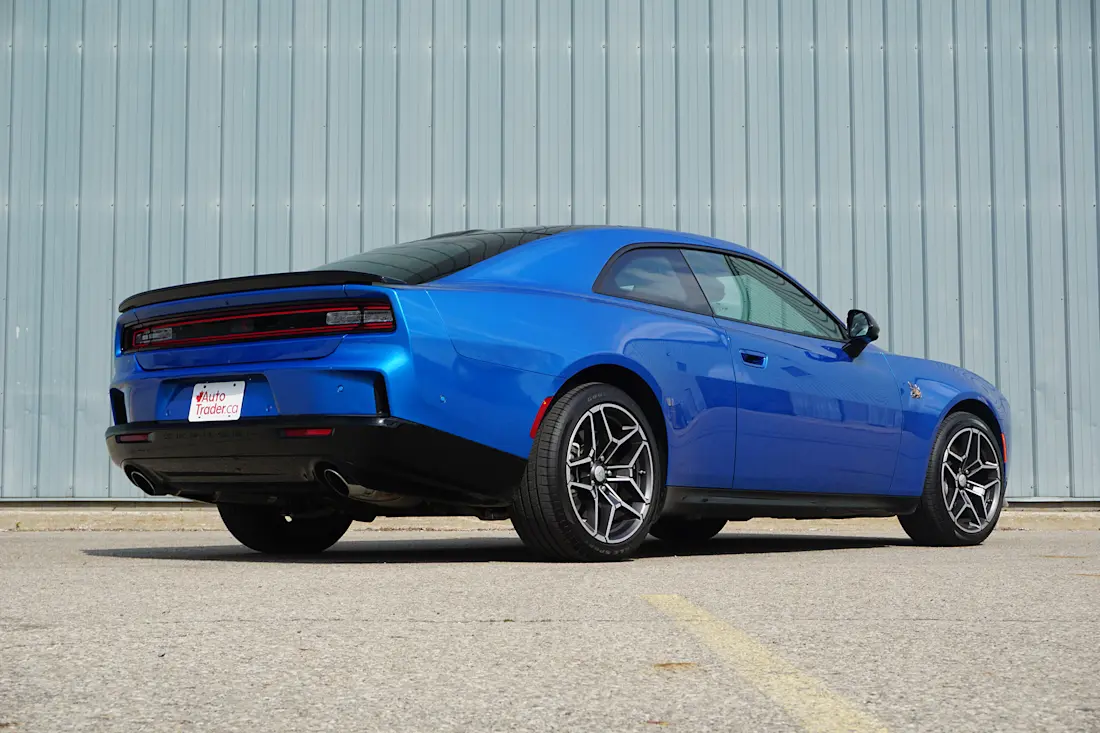
Indeed, muscle cars are meant to sound good, and while this one certainly has its moments, they come and go. When they’re gone, they’re often replaced with an incessant droning — especially when cruising on the highway — that’s quick to grow tiresome. But then the rest of the experience is far more rewarding, including the sense from the driver’s seat that this isn’t a muscle car at all.
OK, fine — that’s not entirely true. But unlike its pair of predecessors, this Dodge doesn’t do well in straight lines alone, and it’s possible to approach a winding stretch of road without slowing to a crawl first. In fact, it would even be fair to describe the Charger as enjoyable in such scenarios, with the dynamics of an oversized sports car. It’s seriously impressive stuff.
Comfort: 9/10
Equally remarkable is how smooth and supple the ride can be. Yes, this is a big and heavy car, and its 20-inch wheels wrapped in low-profile tires have a tendency to overcommunicate what’s happening on the road below; but even without the kind of adaptive suspension setup that’s sure to come with a subsequent (higher-performing) trim, the Charger does an admirable job of remaining composed and comfortable.
Equipment: 8/10
The infotainment system — along with this tester’s 16-inch digital instrument display, up from the standard 10.25-inch unit — is where to find the Charger’s performance parameters, including different drive settings. Among them is selectable rear-wheel drive, as well as adjustable steering feel and drivetrain behaviour, just like its predecessors. It all helps the 2026 Charger feel close in execution to the cars that came before it.
Other noteworthy features aren’t necessarily muscle car-specific, although not all of them are standard, either. So while wireless Android Auto and Apple CarPlay connectivity are included, the big instrument display pictured here isn’t; it’s part of the optional Plus package that’s offered with both the R/T and Scat Pack trims. Likewise, heat for the front seats isn’t standard, but it can be added along with ventilation (and heat for the steering wheel and rear seats).
Efficiency: 6/10
The move to a straight-six instead of an eight-cylinder was done ostensibly to improve efficiency and reduce emissions, but the data shows that’s barely the case when it comes to the former. Natural Resources Canada (NRCan) data shows ratings of 14.1 L/100 km in the city, 9.0 on the highway, and 11.8 combined for the 2026 Charger R/T, while the more stout Scat Pack version is good for 14.5 around town, 10.0 on the highway, and 12.5 combined.
Those figures compare to NRCan numbers of 14.7 in the city, 9.4 on the highway, and 12.3 combined for the previous Charger R/T that was powered by a 5.7L V8. Then there was the Scat Pack version that had a 6.4L under the hood; it came in at 15.9 in the city, 9.6 on the highway, and 13.1 combined. Those are strikingly similar consumption ratings despite the differences between them.
But then that’s to be expected when dealing with such a big and heavy car, with the new Charger R/T weighing in at upwards of 2,150 kg (4,741 lb), and the Scat Pack tipping the scales at some 2,207 kg (4,856 lb). For the sake of comparison, the biggest and heaviest Charger SRT Hellcat from before, with its fire-breathing supercharged V8, came in at 2,083 kg (4,594 lb), according to Dodge.
Safety: 9/10
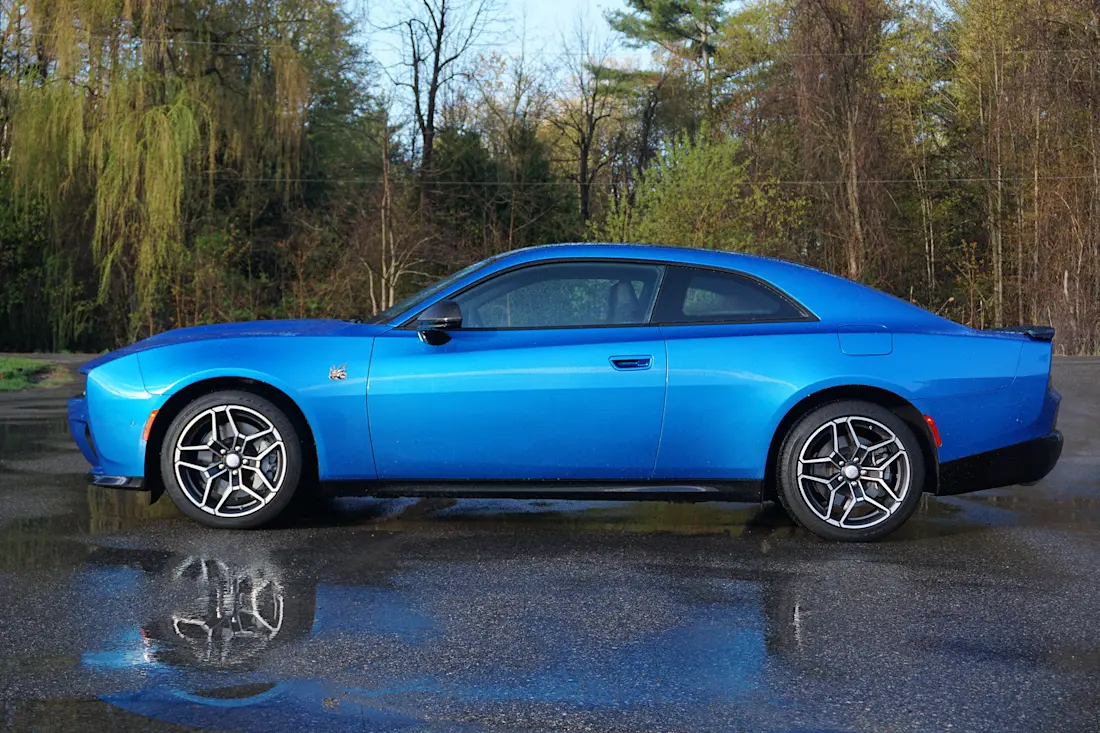
At least some of that extra heft can be chalked up to the sensors and other equipment that come with the 2026 Charger’s advanced safety and driver-assistance systems, most of which are standard. Those would be forward collision warning, including the ability to alert to oncoming traffic when turning left, automatic emergency braking, blind-spot monitoring, lane departure warning and keeping assistance, and adaptive cruise control that works in stop-and-go traffic.
Value: 6/10
The entry-level R/T trim starts at $61,990 before options but including freight — a $1,995 charge that applies to the entire Charger lineup. That’s for the two-door model; add $3,000 to the asking price for the four-door. Then there’s the Scat Pack tested here that’s $71,990 to start (and there’s the same $3,000 difference for the four-door), although this one had plenty of extras.
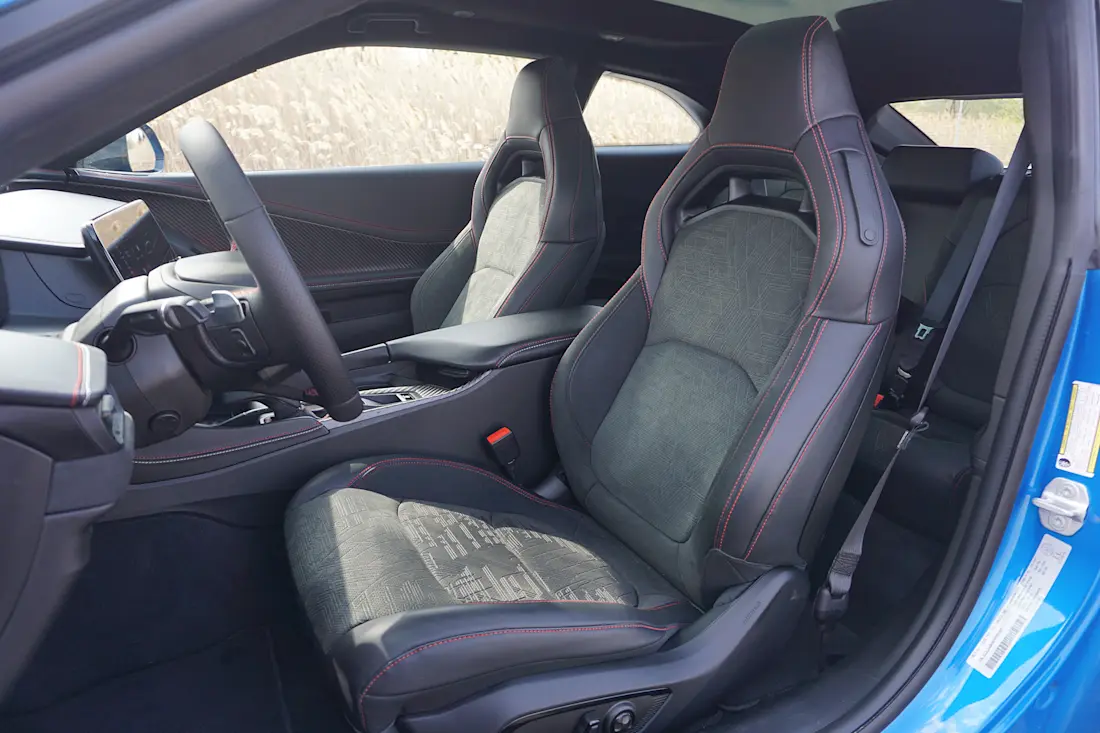
The front seats shown here can be added on their own ($1,395) or as part of a package of carbon fibre and suede ($2,495), the latter of which also has a unique pattern in the upholstery. Then there’s the Plus package of extras, 18-speaker stereo, and fixed glass roof. Add it all up — along with a premium paint job like the shade of Bludicrous seen here ($795) — and this particular example rang the register at $86,665 before the government’s share.
The Verdict
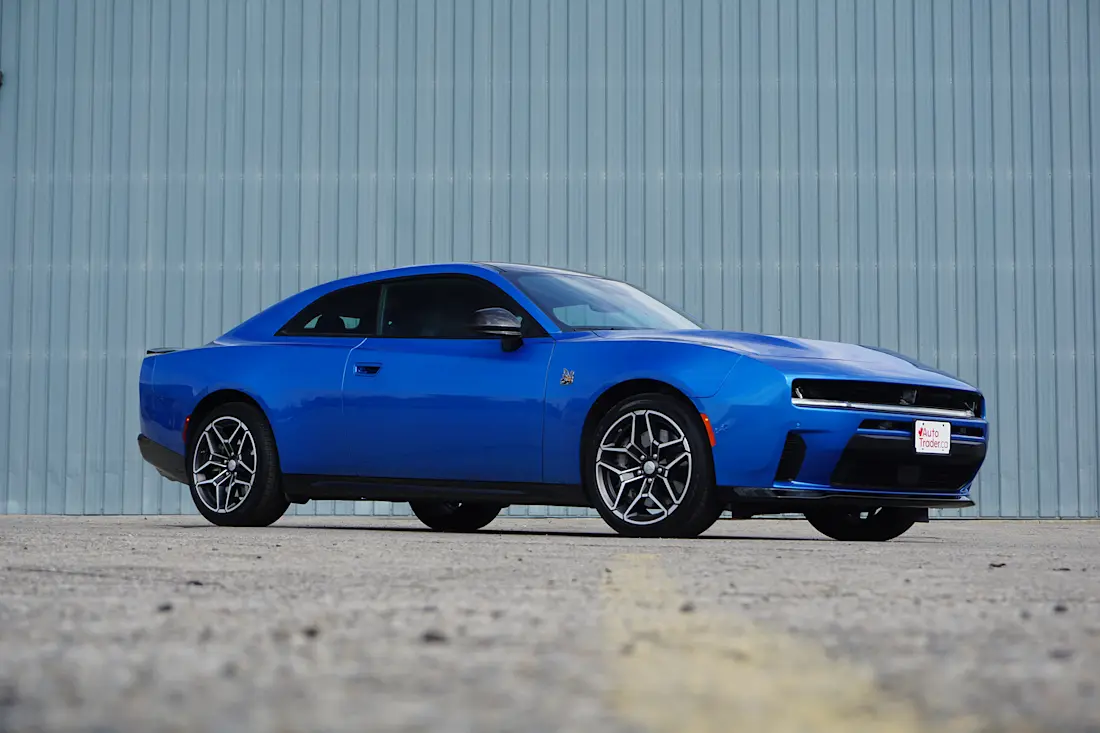
There’s so much to sort through with the 2026 Dodge Charger, most of which was piled on by the very brand that builds it. That doesn’t mean it’s a bad car by any stretch; in fact, it’s quite good just the way it is — and that’s true of both the electric- and gas-powered versions. But almost everything about it runs counter to the character Dodge decided to play for the better part of two decades.
Now Dodge finds itself in an awkward spot, looking back towards yesterday’s big-displacement engines to solve the self-imposed problems it’s facing today. In the meantime, it remains to be seen what kind of brotherhood is being mobilized to rally around this modern-day muscle car, no matter how worthy it is of that same treatment.

Specifications
Trim Tested
2026 Dodge Charger 2-Door Scat Pack
Base Price
$69,995
Options
$14,275 — Plus package, $7,495; Carbon and Suede package, $2,495; 18-speaker stereo, $1,995; Full glass roof, $1,495; Bludicrous paint, $795
A/C Tax
$100
Destination
$2,295
Price As Tested
$86,665
Engine Displacement
3.0L
Cylinders/Configuration
Turbo I6
Max Horsepower
550 hp @ 6,200 rpm
Max Torque
531 lb-ft @ 3,500 rpm
Fuel Economy
14.5 / 10.0 / 12.5 L/100 km cty/hwy/cmb
Cargo Capacity
628 / 1,059 L seats up/down

All Articles
See all
2024 Dodge Charger Daytona First Drive Review + Video
This all-new EV is so much more than a muscle car.
Dan Ilika
2024 Dodge Hornet R/T PHEV Review and Video
Fine in theory but flawed in execution, this plug-in hybrid is plagued by problems.
Dan Ilika
2023 Dodge Challenger Shakedown Review and Video
It’s the last call for this old-school, ridiculous, and entertaining muscle car.
 Jodi Lai