
Car Value Canada: Figure Out the True Value of Your Trade-In
 Justin Pritchard

Figure Out the True Value of Your Trade-in Gallery


Every Canadian who sells a vehicle asks the same question first: what is my car worth right now? Car value is a range, not a single number, and the range moves with mileage, condition, province, and season. A 2019 Toyota RAV4 with 80,000 km does not fetch the same price in Calgary in October as it does in Montreal in March.
This guide covers how to find the value of your car, how a trade-in figure differs from a private sale figure, and how to read the numbers before you negotiate.
Key takeaways
- Car value in Canada splits into three numbers: trade-in value, private sale value, and retail value. They are never the same.
- Trade-in value sits closest to wholesale. Private sale value usually lands meaningfully higher, because you absorb the advertising, screening, and paperwork.
- Mileage, maintenance records, and accident history move the number more than model year does once a vehicle is a few years old.
- Trading in reduces the sales tax you pay on the replacement vehicle in most provinces, because tax applies to the difference rather than the full price.
- A dealer appraisal is a floor, not a ceiling. It is priced for reconditioning and resale margin.
Who this guide is for
This guide is for:
- Private sellers
- Trade-in shoppers
- Buyers who want to check an asking price before negotiating
Sellers need a fair market value they can defend. Price above the market and the listing sits. Price below it and the money is gone. Buyers benefit too: running a valuation on a vehicle you are considering tells you whether the asking price is anchored in anything real.
Owners who are not selling still have reasons to know what their used car value is. Insurance settlements, loan payoffs, and estate paperwork all turn on vehicle value. If you are refinancing or deciding whether to keep a car another year, the rate at which vehicles depreciate is the deciding input.
What to know before you start
Three definitions do most of the work.
- Trade-in value is what a dealership will pay you against another vehicle. It sits closest to wholesale auction pricing.
- Private sale value is what another consumer will pay you directly. It usually lands higher than trade-in.
- Retail value is the asking price a dealer sets after reconditioning.
Book value is a fourth term you will encounter. However, it lags live market demand, so treat it as a reference baseline rather than a quote.
The same vehicle carries all three prices at the same moment. Our guide to wholesale, trade-in, and retail pricing works through the differences in detail.
| Value type | What it means | Who pays it | Where it sits | Use it when |
|---|---|---|---|---|
| Trade-in value | What a dealer credits you against another vehicle | Dealership | Lowest of the three | Trading in, or setting your negotiating floor |
| Private sale value | What another consumer pays you directly | Private buyer | Between trade-in and retail | Selling privately, insuring, settling an estate |
| Retail value | The asking price after a dealer reconditions and lists it | Retail buyer | Highest of the three | Checking whether an asking price is fair |
The number you get is only as good as the details you feed it. Trim level and options change the result more than most sellers expect.
Step-by-step process
1. Gather your vehicle details
Pull this together before you start:
- VIN
- Model year
- Make and model
- Trim level
- Transmission
- Drivetrain
- Exact odometer reading in kilometres
- Postal code
- Service history and accident reports
Trim matters. A Honda Civic LX and a Civic Touring of the same model year can be separated by thousands of dollars, and options such as all-wheel drive or a tow package add measurable value in the right market.
2. Run a valuation
AutoTrader's valuation tool asks whether you plan to sell privately or trade in, because the answer changes the number. Enter the VIN or the year, make, model, and trim, along with your exact odometer reading and postal code.
Record what it returns. That figure is your starting point, not your asking price.
3. Check comparable listings
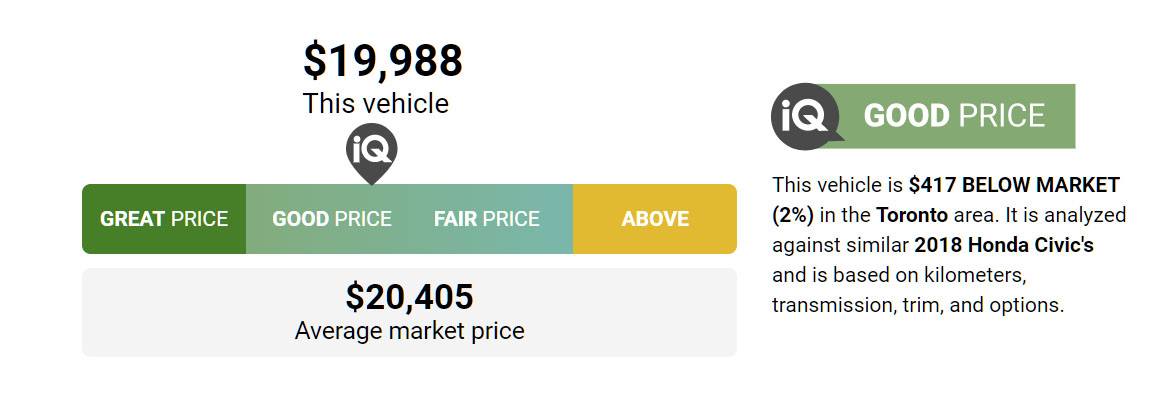
A valuation tells you what a vehicle should be worth. Listings tell you what sellers in your area are asking this week.
Search used listings for the same make, model, model year, and trim within a few hundred kilometres of your postal code. Match on mileage range and accident history, not just the badge. A 2017 Civic with 80,000 km and a clean history is a different vehicle from one with 140,000 km and a reported collision.
Note how long comparable listings have been posted, too. Stale listings signal a price the market has already rejected.
4. Get a dealer offer

Submit your vehicle details through AutoTrader's Instant Cash Offer to collect a dealer offer without leaving home. You receive a cash offer certificate you can take to a participating dealership.

Expect the number to land below your private sale research. That gap is not a lowball. The dealer prices reconditioning, transport, and resale margin into the offer.
In most provinces, trading in also reduces the sales tax you pay on the replacement vehicle, because tax applies to the difference rather than the full price. What that saves depends on where you live. A $30,000 trade is worth about $1,500 in Alberta, where only the 5% GST applies, and roughly $3,900 in Ontario at 13% HST. Check your provincial rate before you compare a dealer offer against a private sale.
Costs and documents

Selling privately costs less in fees and more in effort.
- Vehicle history report: buyers expect one. CARFAX Canada is a listing partner of AutoTrader, and reports can be ordered while posting an ad.
- Safety standards certificate: in Ontario, a buyer can register the vehicle without one but cannot put plates on it, so most private buyers expect the seller to supply it. Inspections happen at a licensed DriveON centre; the certificate is valid for 36 days, and shops set their own rates, so do not book it weeks before you list. Rules differ by province, so check your own registry.
- Used Vehicle Information Package: mandatory in Ontario, purchased from ServiceOntario.
- Bill of sale: required everywhere. Keep a signed copy.
- Reconditioning: detailing, tires or brake work. Spend only where the return is obvious.
A listing on AutoTrader is free for private sellers, so the advertising line in your budget is usually zero.
Our guide to how to sell your car covers the paperwork end to end.
Common mistakes
- Overstating condition is the costliest. "Excellent" means no cosmetic flaws, complete service records, and no accident history. Most vehicles are "good". An inflated input just moves the disappointment later.
- Confusing trade-in value with private sale value. Walking into a dealership expecting the private number produces a bad conversation.
- Ignoring rust. In salt provinces, visible corrosion takes a real bite out of the price, and no valuation sees it until someone inspects the vehicle.
- Skipping the comparables. A single estimate without live listings behind it leaves you negotiating from one unverified number.
The five biggest factors that affect resale value cover what moves the figure most, and our guide on how to maximise your resale and trade-in value covers what you can still change before you sell.
Canadian considerations
Where you sell changes what you get. Season matters too. Trucks and all-wheel-drive vehicles sell strongest in late fall, ahead of winter. Convertibles peak in spring. Luxury vehicles depreciate hardest early, then flatten.
For how used prices are moving nationally, the AutoTrader Price Index tracks the market quarter by quarter.
Licence plates follow different rules by province. In Ontario, Manitoba, and most of the country, the plates stay with the seller. Notify your provincial registry either way, or you remain exposed to tickets after the sale.
Check your provincial registry before you hand over the keys. The paperwork rules are not national.
Find Out What Your Car Is Worth
Free valuation, no account required, about two minutes. Enter your VIN or make and model to see a suggested price range built on Canadian market data.
Sources and quality assurance
- Vehicle valuation ranges: AutoTrader.ca valuation tool
- Used-price market trends: AutoTrader Price Index
- Sales tax treatment of trade-ins: Canada Revenue Agency, GST/HST and motor vehicles; provincial revenue authorities for provincial rates
- Vehicle history, liens and accident records: CARFAX Canada
- Ontario safety standards certificate rules: Ontario Ministry of Transportation, ontario.ca (updated 19 August 2026)
Figures reflect the Canadian market at the time of writing and shift with demand and season.
Frequently asked questions

All Articles
See all
5 Biggest Factors That Affect Your Car’s Resale Value
Here’s what to consider when finding out what your car is worth.
 Jack Kazmierski

How to Maximize Your Car’s Resale and Trade-In Value
If you follow these tips, your car will be worth more when it’s time to sell it.
Jack Kazmierski
How to Sell Your Car
Simplifying the sales process so you can feel more confident
 Dan Ilika